Print this article Print this article

Easy Seville Orange Marmalade recipe


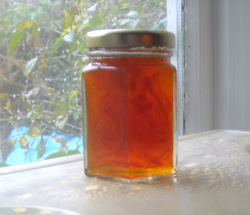
Photo: Fine cut Seville orange marmalade

Photo: Fine cut Seville orange marmalade

“I want to make a marmalade that looks pretty. Like this.” I pushed our copy of New British Classics by Gary Rhodes across the table.
“It looks stunning but it would take hours to remove the pith and cut the peel that fine.”
“Not if I poach the oranges à la Delia. I could probably scoop out the pith with a spoon.”

I’d been researching making marmalade in depth. Having been brought up in a dark chunky marmalade household I’ve steadfastly continued with the tradition. Assuming that this is the best marmalade. Until last year, that is, when The Chicken Lady presented us with a jar of her own marmalade. Sweet, clear and filled with shreds of peel. This was the jolt that I needed to get of the Oxford marmalade path and onto the main marmalade making highway.

I discovered that it’s the pith that gives Seville orange marmalade most of its bitterness. If I removed the pith, I should end up with a more intensely orange flavoured marmalade. The marmalade angels must have been lurking as this recipe turned out to be better than expected. A tasty base with the shreds giving little bursts of deep orange tanginess. Truly good and well worth the effort.

Delia’s method of poaching the fruit prior to chopping makes marmalade making a doddle. The fruit is soft and easy to cut and handle. I easily removed the pith from the skin using a metal spoon.
Easy Seville Orange Marmalade recipe

Ingredients:

2lbs 8ozs/1134g of Seville oranges
10ozs of lemons/284g of lemons
4 pints/2273 litres of water
4lbs 4ozs/1927g of white granulated sugar

Method:

Scrub the oranges and lemons to remove any wax. Put the fruit in a large heavy bottomed saucepan and cover with the water. Put the lid on and bring to simmering point. Then turn the heat down very low and slip a piece of aluminium foil under the lid to ensure a good seal. Simmer very gently for 3 hours until the fruit is soft.  Allow to cool overnight in the poaching liquid.

The next day cut the oranges and lemons in half and scoop out the flesh and pips into a separate saucepan. Add about a pint/570 millilitres of the poaching juice and simmer gently for at least half an hour and then pour into a sieve lined with muslin set over a bowl.

Meanwhile discard the lemon peel and cut the halves of oranges in half again and remove the pith by scraping with the edge of a metal spoon. When this is done rinse the peel and cut into fine strips. I set the skins in blocks cutting about 8 skins at a time.

By this stage the pulp liquid will have almost dripped through but it’s worth giving it an extra squeeze. Knot the muslin and pass two wooden spoons (juxtaposed) beneath the knots turn the spoons against each other which will squeeze out any remaining juice with little effort.

Add the pectin rich juice to the poaching liquid and check that you still have 4 pints of juice. Top it up with cold water if necessary.

Bring the peel gently to simmering point in the poaching liquid add the sugar and stir until it is completely dissolved. Taste the mixture – if it’s too tart for your taste add a little more sugar stirring again until it is completely dissolved. Then bring the marmalade to a rolling boil.

After 15 minutes test for a set (see Tips and Tricks below). If the marmalade is not set bring back to a rolling boil and test every five minutes or so. Just before the marmalade reaches setting point it moves from forming thousands if tiny bubbles to a much more gloopy boil.
Using a ladle and a funnel pour into hot sterilised jars and seal immediately. Leave to stand overnight and label the next day.

If your peel wants to rise to the top of the jars keep on turning the jars every ten minutes or so and the peel will settle evenly distributed within the jar.

Tips and tricks:
Marmalade “set” or “setting point”:
Getting the right set can be tricky. I have tried using a jam thermometer but find it easier to use the following method. Before you start to make the marmalade, put a couple of plates in the fridge so that the warm marmalade can be drizzled onto a cold plate (when we make marmalade we often forget to return the plate to the fridge between tests, using two plates means that you have a spare cold plate). Return the plate to the fridge to cool for approx two minutes. It has set when you run your finger through it and leave a crinkly track mark. If after two minutes the cooled jam is too liquid, continue to boil the marmalade, testing it every few minutes until you have the right set. The marmalade is far more delicious if it is slightly runny.
Sterilising the jars:
We collect jars all year round for our jelly, chutney and jam making sessions. I try to soak off labels and store the clean jars and metal plastic coated screw-top lids in an accessible place. The sterilising method that we used is simple. Just before making the jam, I quickly wash and rinse the jars and place them upside down in a cold oven. Set the temperature to 160c/140c for fan assisted. When the oven has reached the right temperature I turn off the heat. The jars will stay warm for quite a while. I only use plastic lined lids for preserves as the all-metal lids can go rusty. I boil these for five minutes in water to sterilise them. If I use Le Parfait jars, I do the same with the rubber rings.

Related Posts with Thumbnails
Online discount vouchersOnline vouchers give you a discount at loads of shopping sites, like Tesco, Argos, Mothercare and lots of other online stores. Do not pass up this opportunity to keep costs down. Fantastic discounts! Click here now

Britain's Next Top Model

39 Comments so far

  1. BillNo Gravatar on January 26th, 2010

    Sounds good, any chance of a sugar free variety? I have done the usual webtrawl but cant find anything – anyone else out there got a sugar free recipe?

  2. kate (uk)No Gravatar on January 26th, 2010

    I blame you entirely Fiona for the ’sold out’ saville oranges round here!

  3. danastNo Gravatar on January 26th, 2010

    I’m making marmalade for the first time today and I am hoping for good results. So confident, I bought more oranges this morning. Confident or foolhardy- time will tell

  4. fnNo Gravatar on January 26th, 2010

    Hi Bill

    Sea horse gave you an answer on Marmalade Dayzz. She suggesys this route,
    “Bill, I have a diabetic friend who is helping me try out making a diabetic marmalade. We’re using fructose from Holland and Barrett. Use a bit less than the recipe suggests, about a third less, as its sweeter than regular sugar. Also, you may need to add some pectin in the form of certo or your own (mine is from my juice extractor that i use for apples in the autumn).”

    So you can adapt this recipe!

  5. BillNo Gravatar on January 26th, 2010

    Ah sorry I missed that reply – Cheers Sea Horse

  6. caroleNo Gravatar on January 26th, 2010

    hi fiona do you think i could poach the oranges in the slow cooker rather than simmer them.

  7. PaulaNo Gravatar on January 26th, 2010

    Thanks for the recipe Fiona- I’ve tucked that one away. I hope to keep a Seville orange in a pot in my future greenhouse just for making orange marmalade, as it is my favorite.

  8. mandiNo Gravatar on January 26th, 2010

    I have to admit never having made marmalade and if I did wouldn’t put the peel in cos I pick it out anyway… but the thought crossed my mind at some point during the process can’t you add orange peel strips done from a canele cutter( the channel cutter on a lemon zester) to give you un pithy uniform thin shreds? That way you wouldn’t have to faff about removing the pith from the peel and shredding that just use the ready cut stuff? Or wouldn’t this work?

  9. SukyNo Gravatar on January 26th, 2010

    Carole, I poached mine in the slow cooker. They only just fitted but it worked just fine.
    My last batch of old english is very bitter and a bit syrupy so I will try this with the oranges that are in the freezer.

  10. JoyNo Gravatar on January 27th, 2010

    I don’t poach the fruit but I cut them in half, put face down on a plate and heat in the microwave for about 40 seconds. It makes the juicing, etc, incredibly easy.

  11. Tamar@StarvingofftheLandNo Gravatar on January 27th, 2010

    I continue to marvel at the differences in how canners on either side of the Atlantic approach the sterility issue. Over here, they tell you to *make sure* to buy new lids and rings every time, and to, and I don’t have enough confidence in my canning skills to go rogue and re-use what ought to be re-usable. Unfortunately, Seville oranges don’t even show up in markets around here, but when the wild grapes are ripe in the fall …

  12. Cookie GirlNo Gravatar on January 27th, 2010

    When making preserves I fill my dishwasher with lids and jars put them on a quick cycle and wait for them to dry naturally, but still be warm. Hey presto ! Sterilised jars with little fuss. I am going to get some seville oranges and try and make a nice clear marmelade with tiny bits of orange…

  13. RuthdigsNo Gravatar on January 27th, 2010

    I’m a marmalade virgin too so if this is a really dumb question sorry!
    As Seville oranges are notorious for their bitterness what role do the lemons serve? Are they needed to balance the sugar as the pith of the oranges are removed? Or is it some more alchemic reason? If I wanted to use pink grapefruit not oranges would I still need the lemons do you think?
    Sorry – this should possibly be in the forum!

  14. DiggerNo Gravatar on January 27th, 2010

    not sure about a sugar free marmalade – it’s the sugar that acts as the preservative and don’t know if the sugar substitutes would have the same effect.

    Planning on making mnarmalade this weekend – found similar methods as above on youtube.com – don’t you just love the internet!

  15. fnNo Gravatar on January 28th, 2010

    Hi Bill

    It might be in idea to have a look at the ingredients on a jar of diabetic marmalade for clues. I’ve also found this recipe on the National Trust site http://www.nationaltrust.org.uk/main/w-chl/w-countryside_environment/w-food_farming/w-food_farming-farm_foods-recipes/w-food_farming-farm-marmalade.htm#diabetic

    Hi Kate

    Many apologies…

    Hello Danast

    I do hope that it went well. Making marmalade can be exhausting.

    Hi Carole

    Yes that should work fine.

    Hello Paula

    Wouldn’t it be great to have your own Seville orange tree!

    Hi Mandi

    Great idea – I must give that a go. I have Seville Oranges in the freezer.

    Hi Suky

    Thanks for that. This marmalade isn’t nearly as bitter as thick cut marmalade. I’ve also made a great three fruit marmalade that I’ll be posting soon.

    Hello Joy

    That’s a brilliant tip – saves on energy too. But we don’t have a microwave.

    Hi Tamar

    Yes we are far more relaxed than those on the other side of the pond. I reuse lids in good condition but not rings. I have been hot water bathing my fruit butters to give them a longer shelf life.

    Hello Cookie Girl

    That’s a good tip. Thank you for dropping by.

    Hi Ruth digs

    I know that you can make Seville orange without lemons as they contain loads of pectin. I just like this combination. However if you make pink grapefruit marmalade you would need to add pectin – either powder or lemons. Hope this helps.

    Hi Digger

    I’m not sure about diabetic marmalade either. But I did track down a recipe for Bill (see above). I totally agree – the Internet is a wonderful resource.

  16. LoisNo Gravatar on January 28th, 2010

    I finally got my hands on some blood oranges earlier this week and can’t wait to transform them into all sorts of goodies!

    Having never made it before, marmalade is something i’ve got my sights set on but i’m very much a novice. Will the recipe translate well over to blood oranges do you think? I imagine it would, but you can never be too sure!

  17. fnNo Gravatar on January 28th, 2010

    Hi Lois

    I thought that you might have a problem with the marmalade setting (Seville oranges are pectin rich). So I Googled and found this recipe from Abel and Cole – you need to scroll down the page http://www.abelandcole.co.uk/recipes/breakfast
    They don’t use extra pectin so my recipe should work. Let me know how you get on!

    PS I don’t know how much 8 blood oranges weigh but in their recipe they add 2.5 kilos of sugar to 8 oranges so you would need to adjust the sugar down – Seville oranges are very bitter.

  18. RuthdigsNo Gravatar on January 29th, 2010

    Hi Fiona – thank you for the tip re the pectin in pink grapefruit! rx

  19. seahorseNo Gravatar on January 30th, 2010

    Hi Bill and Fiona

    Further research suggests that fructose can leave an after taste. So I think my friend and I will try making both my original suggestion and the NTrust saccharin method. Let’s swap notes back here after.

    Re blood oranges, I’d love to know how on earth the makers of this one at Fortnum and Mason’s http://www.tiny.cc/gBSDT get that wonderful marbled effect that replicates the fruit. Mine just went a uniform pink. Pretty, but not spectacular. Any ideas?

  20. kathNo Gravatar on January 31st, 2010

    Now aged 75, I have made many batches of marmalade over the last 50 years, usually by the fiddly traditional method, including Prue Leith’s. I have also made Delia’s Dark (which was too solid after hours of boiling). This year (on the 27th January) I searched the web for marmalade recipes hoping for possible good processor/microwave recipes (the last one I tried 2 years ago turned out just an orange mush) and found your recipe (of the 26th), combining Delia’s poaching and traditional boiling.It was so easy and the marmalade is perfect. What timing! I only wish someone had worked it out long ago, but better late than never. I shall use no other from now on.

  21. fnNo Gravatar on January 31st, 2010

    Hi Kath

    I’m so pleased that you liked my recipe. It made my day!

  22. SparkleNo Gravatar on January 31st, 2010

    I’ve only just joined this forum but have been lurking as a visitor for a while. I have been making preserves for a number of years and I’m always on the look out for something new, better etc. This is by far the easiest marmalade recipe to follow and with great results as well!! Thank you!

  23. fnNo Gravatar on February 1st, 2010

    Hello Sparkle

    Thanks for leaving a comment. I have to admit I’m addicted to this marmalade too!

  24. LindseyNo Gravatar on February 2nd, 2010

    Ok. I made marmalade by the Dealia’s Dark method today and have just realised (like Kath’s experience) that its rock solid. Can I resurrect it somehow?

  25. fnNo Gravatar on February 2nd, 2010

    Hi Lindsey

    Yes you can. I wrote this post for jelly but it uses the same principles
    http://www.cottagesmallholder.com/jelly-set-too-hard-514

  26. SparkleNo Gravatar on February 4th, 2010

    Ooh I made a second lot and added two tablespoons of black treacle to make ‘Old English’ marmalade. And it’s yum!

  27. JoeyNo Gravatar on February 6th, 2010

    Just made my first batch of maramalade EVER using this recipe. It is really tasty and has given me 7 jars. For years I have been led to believe that marmalade making is a difficult, lengthy and messy process, think it was just a ruse by grandparents to make me appreciate their efforts even more!

  28. ClareNo Gravatar on February 14th, 2010

    I bought two nets of seville oranges while they were still in the shops and was waiting for half term, which is now. I’m adding a few tangerines from the condemned section so should be good.

    I am intrigued and baffled by how 2 wooden spoons can squeeze juice out. Please could you expand? I will be blogging about my marmalade when it’s done – will let you know.

    Clare

  29. fnNo Gravatar on February 15th, 2010

    Hello Sparkle

    Brilliant idea. I must try that.

    Hi Joey

    The secret is to poach the fruit. My mum used to cut up the fruit raw which was a palaver!

    Hi Clare

    Tie the muslin square corner to corner loosely, to create a parcel with two knots. Thread a wooden spoon under one knot and another spoon under the other knot. Hold one spoon firmly and twist the other or twist the spoons in opposite directions. This puts a lot of pressure on the bag to release the pectin.

  30. KateNo Gravatar on February 16th, 2010

    Thank you, thank you, thank you!

    I’ve used so many of your preserve recipes but after a total disaster with marmalade last year using Delia’s Dark and Chunky (it tasted and resembled something you could tar a road with) I was very hesitant about giving marmalade another go. But what a success, I now have 8 jars of golden loveliness sitting in the kitchen and it tastes divine!!!

    Just one question, if I freeze some sevilles to use later in the year, will I need to add extra lemons to make sure it sets – I know the pectin of the oranges can be affected if you freeze them.

  31. fnNo Gravatar on February 17th, 2010

    Hi Kate

    That’s good news. I have to admit I ate a whole half jar of this marmalade at one sitting!

    I don’t know about pectin and frozen oranges – this is the first year that I have frozen some. Sorry.

  32. PamNo Gravatar on March 4th, 2010

    Can this recipe be halved without any modifications? I’ve never made marmalade and am a bit tentative about diving into the full recipe. Thanks for your help.

  33. fnNo Gravatar on March 4th, 2010

    Hi Pam

    I don’t know to be quite honest. These are based on the traditional weights for a batch of marmalade.

    If you do halve the quantities, I’d love to hear how you got on!

  34. DiggerNo Gravatar on March 5th, 2010

    Kate – I haven’t found frozen oranges to be too much of a problem with getting a set – although adding extra fresh lemons would help if you’re struggling to get a set

    Pam – You should have no problems halving the recipe.

  35. shelleyNo Gravatar on March 7th, 2010

    mmm yummy!
    After the fete d’oranges ameres last week, this week it was marmalade time!!
    This recipe was pretty simple to follow and looks fabulous. It seemed to take a while to get to setting point but I had doubled the recipe so more fool me, but it has set fantastically now and smells yummy; roll on breakfast
    Shelley

  36. veronicaNo Gravatar on March 8th, 2010

    Shelley, mine took quite a long time to set too, even though I only made slightly more than the specified quantity; the first 15 minutes it looked like boiling water rather than boiling jam, if you see what I mean — I had to evaporate quite a lot of excess water before it got to a true rolling boil, so it probably needed half an hour’s boiling in total.

    It does taste fabulous though!

  37. fnNo Gravatar on March 9th, 2010

    Hi Veronica and Shelley

    Mine took about 30 mins to set!

  38. NataliaNo Gravatar on May 20th, 2010

    I just recommended this recipe to a friend (though I haven’t tried it yet, I will when I make marmalade next.) I never see Sevilles here so will have to add pectin to my regular oranges. I think I will also make some with lemons, limes, and ginger, and combinations thereof. My kids also want me to leave out the peel!

    Just wanted to mention, I think you meant 2273 ml, not litres. ;)

  39. MagsNo Gravatar on July 24th, 2010

    I have been making orange marmalade for probably 45 or so years now and the best method and result I have used is to simmer the whole,scrubbed fruit in the water until soft and then leave until cool – I usually leave overnight. Then my infinitely patient husband halves the beautifully soft fruit, scoops out the pips and pith and slices up the peel however we want it. Sometimes it’s thin and sometimes thicker. Meanwhile the pips etc are put in a muslin bag and simmered in a little of the cooking water. When all is prepared the muslin is squeezed into the prepared peel mixture, sugar is added and all is boiled until the setting point is reached.I always use raw cane sugar.

    I often add coarsely chopped preserved ginger and usually put a good tablespoon of good whisky in the bottom of the sterilised jars, immediately prior to filling with the preserve. (If you can get away with it, husband’s Laphroaig gives a stunning waft of good, peaty malt when the jar is opened.) Pink grapefruit marmalade with added cranberries makes a welcome extra gift at Christmas. Whilst I’m on about additions, try adding Calvados to the jar when making Quince Jelly.

Leave a reply

Subscribe without commenting