Print this article Print this article

Quince Jelly recipe (also works with Japonica quinces)

rotten quinceOur friend Bunty gave us a Portuguese quince tree three years ago. Besides being very decorative, with dark branches and lazy, floppy leaves it produces the large firm fruit that make the tastiest jelly. Mature quince jelly (over six months old) turns a gorgeous amber colour.

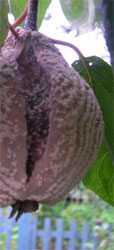
The first year our tree produced one small quince. It bore three last year and this year suddenly came into its own. The crop would be at least ten. The fruit are quite big so there would be enough to make more than jelly. Anne Mary and I poured over her old recipe books. We could make quince marmalade or try our hand at Membrillo. Greedily I watched the quinces mature and fatten. Imagine my horror when I noticed that the fruit was splitting and rotting on the tree. The cause, I discovered, was lack of water.

It’s easy to forget trees in a drought. Especially when they have done well in their first couple of years. Old established trees have much deeper roots and can find water more easily than younger, smaller trees. It would have been so easy to take a spur from the drip watering system in the kitchen garden to the quince tree. I just didn’t think.

Our poor pear harvest was probably due to lack of water. I am going to give both trees a dressing of rich compost from our composter and cosset them this winter. Hopefully the bees will boost the germination of the blossom next spring. Our bees arrived just as the blossom was going over this year.

I managed to harvest two half quinces and they are simmering on the stove as I write this. The aroma from the simmering quinces is richly fruity. We’ll be lucky to make a couple of small jars. One for Anne Mary and one for us, as an inspiration for next year.

Quince Jelly recipe (this works well with Japonica quinces too)

Ingredients:

  • 2 lbs of quinces
  • 1 lemon (just the juice, sieved)
  • white granulated sugar
  • water to cover

Method:

  1. Wash and roughly chop the quinces (no need to peel, decore or depip) and place in a heavy bottomed saucepan.
  2. Barely cover with water. Bring to the boil and simmer gently with a lid on until soft. If the quinces are very firm this could take several hours. Check it every now and then and add more water if necessary.
  3. Pour the cooked fruit through sterilised muslin into a large clean bucket or bowl (how do I sterilise muslin/the jelly bag? See tips and tricks below). The muslin is often referred to as a “jelly bag”. We use tall buckets to catch the drips from the jelly bags. Rather than hang the bags (conventional method-between the legs of an upturned stool) I find it easier to line a large plastic sieve with the muslin. This clips neatly onto the top of a clean bucket. The sieve is covered with a clean tea cloth to protect against flies.
  4. Leave the jelly bag to drip overnight (or about 12 hours).
  5. Measure the juice the next day.
  6. Pour the juice into a deep heavy bottomed saucepan and add 1lb/454g of white granulated sugar for each 1pt/570ml of juice.
  7. Add the lemon juice.
  8. Heat the juice and sugar gently stirring from time to time, so as to make sure that that all the sugar has dissolved before bringing the liquid slowly to the boil.
  9. Continue to boil for about 10 minutes before testing for a set. This is called a rolling boil. Test every 3 to 5 minutes until setting point is reached. (What is testing for a set? See tips and tricks below). Tossing in a nugget of butter towards the end will reduce the frothing that can occur.
  10. When jelly has reached setting point pour into warm sterilised jars using a funnel and ladle. (How do I sterilise jars? See tips and tricks below).
  11. Cover immediately with plastic lined screw top lids or waxed disks and cellophane tops secured with a rubber band. If you don’t think that the jelly has set properly, you can reboil it the next day. The boiling reduces the water in the jelly. I have done this in the past. Ideally you should try for the right set the first time.
  12. Label when cold and store in a cool, dark place. Away from damp.

Tips and tricks:

  • What is a jelly bag?
    A jelly bag is traditionally a piece of muslin but it can be cheesecloth, an old thin tea cloth or even a pillowcase. The piece needs to be about 18″ square. When your fruit is cooked and ready to be put in the jelly bag, lay your cloth over a large bowl. Pour the fruit into the centre of the cloth and tie the four corners together so that they can be slung on a stick to drip over the bowl. Traditionally a stool is turned upside down, the stick is rested on the wood between the legs and the jelly bag hangs over the bowl. We experimented and now line a sieve with muslin, place it over a bucket and cover the lot with clean tea cloths (against the flies).
  • How do I sterilise muslin/the jelly bag?
    Iron the clean jelly bag with a hot iron. This method will also sterilise tea cloths.
  • Jelly “set” or “setting point”?
    Getting the right set can be tricky. I have tried using a jam thermometer but find it easier to use the following method.
    Before you start to make the jelly, put a couple of plates in the fridge so that the warm jam can be drizzled onto a cold plate (when we make jam we often forget to return the plate to the fridge between tests, using two plates means that you have a spare cold plate). When testing for a set drizzle some jelly into the cold plateand return the plate to the fridge to cool for approx two minutes. It has set when you run your finger through it and leave a crinkly track mark. If after two minutes the cooled jam is too liquid, continue to boil the jelly, testing it every few minutes until you have the right set. The jelly is far more delicious if it is slightly runny. It does get firmer after a few months.
  • How do I sterilise the jars and lids?
    We collect jars all year round for our jelly, chutney and jam making sessions. I try to soak off labels and store the clean jars and metal plastic coated screw-top lids in an accessible place. The sterilising method that we use is simple. Just before making the jam, I quickly wash and rinse the jars and place them upside down in a cold oven. Set the temperature to 160c/140c for fan assisted. When the oven has reached the right temperature I turn off the heat. The jars will stay warm for quite a while. I only use plastic lined lids for preserves as the all-metal lids can go rusty. I boil these for five minutes in water to sterilise them. If I use Le Parfait jars, I do the same with the rubber rings.
Related Posts with Thumbnails
Cottage in IrelandThink of the beauty of the west of Ireland or the Scottish Highlands. Take a cottage by a loch, by woodland, by the sea. Peace and solitude in beautiful surroundings. It’s the most economical accommodation and standards are very high nowadays. Click here: Ireland Scotland

Coco Chanel and Igor Stravinsky

114 Comments so far

  1. tractorfactorsteveNo Gravatar on November 6th, 2006

    isn’t it the portuguese who gave us the original ‘marmalade’ which was made from quinces? i’ve made quince jelly, using the hard, japonica variety. it was very tangy, not unlike marmalade, and worked perfectly with good roast pork or sausages.

  2. LizONo Gravatar on September 8th, 2007

    I followed this recipe with some quinces that I was given, and having left them straining through a jelly bag overnight. The result is absolutely delicious and will go well with both meats and cheeses because it has a delightfully sweet/sharp flavour.
    Thank you again for the support of the Cottage Smallholder – I have definitely taken to good old jam and jelly making thanks to your support.
    The mad hedgerow collector, LizO :o )

  3. fnNo Gravatar on September 9th, 2007

    Hi LizO,

    Thanks so much for taking the trouble to leave a comment. Glad the recipe worked well for you. Quince jelly is superb.

    I love making jam and jelly. I find it very soothing.

  4. LizONo Gravatar on September 15th, 2007

    hi
    just to let you know that i made the quince jelly again – so easy and very successful that i now have some to give away to the lovely people who have given me fruit
    Am moving on to apples now – there will be lots of apple sauce in my freezer for the coming seasons. I presume that it will need freezing and wont keep for very long in jars? Can you confirm please
    LizO :o )

  5. fnNo Gravatar on September 15th, 2007

    Hi LizO,

    I have answered your question on the tangy apple sauce recipe post. You could try canning in small Le Parfait jars as I haven’t done this with apple sauce, I don’t know how it would work out. We have instructions on canning at of the end our Belgian Pears post, in the tricks and tips section.

  6. MariaNo Gravatar on September 15th, 2007

    Hi,

    I’ve got some really strange fruit, which are like a hard pear – yellow green and very hard – I am presuming they are the fabled quince everyone is talking about and there is a tree full – does anyone have a picture of one for identification as I am a soft fruit jam maker by preference, but would like to try my hand at quince jelly if I have correctly identified the fruit? I have the japonica version in profusion as well, so will be able to make either, but it would be nice to try them side by side.
    Maria

  7. fnNo Gravatar on September 15th, 2007

    Hi Maria,

    Quinces are great for jelly or membrillo (if you have them). Here is a link to quinces on a tree http://www3.unifi.it/ueresgen29/ph6-2.htm

    I hope that this helps.

    It would be great to hear how you get on!

  8. MariaNo Gravatar on September 16th, 2007

    That’s the ones I have………

    I’ve bought some lovely new jars – as I made so much damson cheese this year I’ve run out – so I’ll be boiling tomorrow

    I’ll tell you what the results are like

    Many thanks

    Maria

  9. fnNo Gravatar on September 16th, 2007

    Hi Maria,

    I will photograph the fruit on my own tree tomorrow to add to the reference on this site.

    Looking forward to hearing how you got on.

  10. joanneNo Gravatar on September 28th, 2007

    I spent all yesterday cutting and boiling quinces for jelly. Only to discover that the fruit when boiling has removed the non stick coating from the saucepan. I am left wondering if this will effect the juice and harm anyone eating the finished product. My husband pointed out that they would not put any dangerous non stick coating on the saucepan. They are ftrom America and called
    Commercial Aluminum Cookware Company. Toledo Ohio. U.S.A. not sure if to continue or throw all the juice away. After all my hard work it seems a pity not to continue. Joanne. Thanks for the recipe anyway.

  11. fnNo Gravatar on September 28th, 2007

    Hi Joanne,

    That is weird. I simmer my Quinces in a large non stick marmite and none of the coating has come off.

    It might be worth Googling the company and emailing them with the problem. You could freeze the juice until you find the answer.

  12. QuiltyNo Gravatar on September 28th, 2007

    I would like to try making japonica jelly this fall, and have located a neglected tree in my neighborhood that is great with produce. Does anyone know when the best time is to harvest japonica apples? Presently, they are hard and sour and slighly astringent, and I was wondering if perhaps they should be left to mature until the first slight frost in order to maximize their sweetness and softness. Or doesn’t it matter in the least? Thanks in advance for any advice.

  13. fnNo Gravatar on September 28th, 2007

    Hi Quilty,

    When quinces are softin the UK, they are generally going bad. I have just simmered quinces for jelly and cheese. After an hour they were soft but they were still a yellow colour, so I simmered them for a further four hours and eventually got the red colour. Presumably quinces from a later harbest would have this colour. I have seen recipes that stipulate windfall quinces. We have never had a windfall quince.

    All our fruit are plucked from the tree and make excellent jelly and membrillo. If they are rpe they should just drop into your hand with a light twist. If you have to tug, go back next week.

  14. SheilaNo Gravatar on September 30th, 2007

    Do you have have a tasty recipe for Quince Chutney please? I have to hand quinces, pears, onions, green tomatoes, fresh chillies, raisins,and demerara sugar, but the recipe I have uses pints of vinegar which I don’t fancy – any ideas please? Many thanks for your super website

  15. MildredNo Gravatar on September 30th, 2007

    Hi, we were given our quinces from a neighbour’s tree yesterday, I think if they’d been left for much longer they would have soon been over ripe! They came away from the tree with a slight twist.
    We made Q Jam, Q Cheese and Quince Jelly yesterday, and we loved the jelly so much we made another batch today! It is wonderful stuff!
    The jelly finished up pink, and the cheese/Membrillo a lovely dark red.
    I can hardly keep up with a supply of jam jars . . . I stockpile them through the year as well as collecting them up from friends and neighbours. Lakeland’s jars are ok, but I have found it is cheaper to buy mint sauce from tesco, throw it away and use those jars! I still have to buy new lids from Lakeland though otherwise everything would have a mint flavour! I wonder how other enthusiastic jam makers manage.
    It is so inspiring to read about everyone’s enthusiasm for quinces!!

  16. fnNo Gravatar on September 30th, 2007

    Hi Sheila,

    Chutney need vinegar or salt, or a combination of both as a preservative. I never use pickling vinegar as I don’t want to wait months for the chutney to mature. As I prefer a gentler taste, I use cider or white wine vinegar and this seems to do the trick.
    All I can suggest is to use a gentle vinegar with the ingredients that you have. A white wine vinegar would enhance the flavour of your quinces.
    Our Belgian Pear recipe just uses white wine vinegar, no water, and creates a perfect dessert. The secret is simmering time which should be long.
    So pleased that you are enjoying the site.
    Hi Mildred,

    Quinces are the dogs b******s as far as I am concerned. They make wonderful jelly, membrillo, jam and marmalade. In fact the first English marmalade was made with quinces.  And the flavour  and colour improves as the months go by.
    Jars. We save all our jars but are always scratching around for some more by this time of year. Local beekeepers are a great resource for jars. If you let them know that you will need jars they can increase their order and everyone benefits. We use new jars for presents. When I went back to my beekeeping suppliers a few weeks ago they were expecting me.
     

  17. maggieNo Gravatar on October 6th, 2007

    I have just boiled 3lb of small quince and let drip through a muslin cloth, the liquid appears to be cloudy – is there anything I can do?

  18. fnNo Gravatar on October 6th, 2007

    Hi Maggie,

    It might be worth letting the liquid drip through the muslin again (I have started to use double thickness muslin and this helps).

    Sometimes the cloudiness disappears during the jelly making process, keep on skimming the scum from the top as the sugar and juice are heating up. This is easiest to do by keeping the pan halfway on the hob, the scum will then collect just in one half of the pan.

    I hope that this helps.

  19. RobNo Gravatar on October 14th, 2007

    I thought a response from a male reader was needed. I recently discovered a Japanese Quince in our garden (it fruited for the first time this year and we are relatively new to the garden). We only got a small crop of approximately half a pound of fruit; the fruit smells like dolly mixtures by the way. This crop has produced one jar of a rich golden jelly and I am looking forward to trying it, maybe with this evenings lamb. Thanks for the recipe.

  20. KateNo Gravatar on October 14th, 2007

    Many thanks for all the useful tips. I bought some quinces from a farmer’s market recently and am using the recipe they gave me – the quinces are simmering as I type. (I have a huge number of recipe books but not one includes instructions for quince jelly!) I don’t think I had ever even seen a quince before. City girl.

  21. fnNo Gravatar on October 14th, 2007

    Hi Rob,

    Thanks for leaving a comment. I hope that the jelly went well with your lamb. The colour of quince jelly darkens over the months. I love this jelly and it is my favourite as it is so versatile. Great on toast for breakfast, it can lift an indifferent sauce for pork chops and it is great with bacon, ham and cheese.

    Hi Kate,

    Quinces. I only knew of the japonica fruit until a few years ago. Now I am infatuated.  They have that star quality. Perfect for preserving. Quinces are special.

  22. Robert LaneNo Gravatar on October 16th, 2007

    Hi, Who said “why should I get a computer”? ME!!!
    What would I do without one? Anyway following your instructions and my thanks for them, two saucepans of Quinces(or should that be Quinci?)
    are boiling away nicely,complete with skins and pips. PIPS!PIPS! are you sure about that, as I have just seen on another site, giving instructions on cultivating the plants, that the pips are poisonous! Oh my God ! All my friends are waiting for a pot !!! What should I do ? Cheers Rob.

  23. karenNo Gravatar on October 16th, 2007

    I make japonica quince jelly without putting in any lemon juice. Quarter the quinces, boil in 1pint water per two pounds of fruit until soft enough to mash. then strain. I squeeze the bag to get the last bits out. The liquid is cloudy but miraculously clears as soon as you add 1lb of sugar for every pint of liquid. hardly needs any more boiling to set. Made the mistake, once, of adding the sugar to the cold liquid and leaving it while i popped out. whole lot was solid jelly when i returned! Boiled it up before bottling, but some very firm jelly bits remained and gave jelly a jewelled appearance!

  24. fnNo Gravatar on October 16th, 2007

    Hi Rob,

    Don’t panic. The pips of loads of fruit (including apples) contain cyanogenic glycoside – a chemical that releases cyanide when it is digested. However these are only trace elements and pretty harmless in small quantities.

    However to be ultra safe you could remove the pips next time.

    The Romans used these poisons very effectively.

    Hi Karen

    Thanks for your recipe and the outline of your experiences. The lemon juice enhances the flavour (it’s good in apple jelly too) but doesn’t give a lemon flavour. Love the idea of a jewelled jelly!

  25. MonicaNo Gravatar on October 21st, 2007

    Thanks for all the advice. I have now got 6 beautiful kilner jars of quince jelly cooling down in the kitchen.A friend gave me a bag of quinces from her tree.They cooked down surprisingly quickly. I guess they went from tree to saucepan within the day,that might have helped.

  26. MikeNo Gravatar on October 21st, 2007

    Thanks for the quince recipe. Point about testing for ’set’ point out that the pan should be removed from the heat, otherwise the jelly or jam can over cook.

  27. fnNo Gravatar on October 21st, 2007

    Hi Monica,

    Great to hear that the jelly worked for you. I think that our UK quinces are smaller and slightly softer than the ones that come from abroad. Really fresh probably helps as well.

    Hi Mike,

    Good point about removing the pan from the heat when testing for a set. Thanks.

  28. MinamooNo Gravatar on October 22nd, 2007

    I made some of your quince jelly yesterday and it was beautiful! It is currently sitting on top of the fridge in our kitchen and my flatmates have commented on the colour with great surprise given how yellow the fruit itself is. They were also very confused by the strange jelly bag stand contraption stading in the corner of our kitchen with a giant plastic bowl beneath it catching the drips from the bag. I pushed al the pulp through a sieve and will be making the Q cheese in the next couple of days. As far as containers go though you mentioned using the little Gu pudding ramekins to store them. They would be a prefect size for me as I don’t eat things like that very quickly but would I have to keep them in the fridge? I have the plastic lids they come with. Is that what you used? Thanks!

  29. fnNo Gravatar on October 22nd, 2007

    Hi Minamoo,

    I used the Bonne Maman glass straight sided jars – I am sure that the Gu ones are similar. When I put the membrillo in the jars I sealed them immediately with cellophane jam lids (with rubber bands). I am storing these in the larder (cool and dry). Once they are opened they will go in the fridge. You could put your plastic lids over the cellophane ones.

    I bought membrillo from a Spanish deli in London. It came in a sealed plastic box with a plastic lid and wasn’t in the fridge area. I’ve kept in the fridge since I opened it.

    I don’t know what the normal procedure for storing membrillo is exactly. Perhaps someone out there can enlighten us?

  30. SibbyNo Gravatar on October 23rd, 2007

    I always cook the quince for 10 mins. in the pressure cooker, really quick and they come up lovely and soft and mushy. Then a few presses of the potato masher and they are ready to strain.
    Wondered about including the pips, do they add useful pectin? (I believe quince are a high pectin fruit anyway so maybe no advantage to including the pips)

  31. fnNo Gravatar on October 23rd, 2007

    Hi Sibby,

    Good idea using the pressure cooker but what colour is the pulp? I like to simmer mine for hours (conventionally) to get a deep pink colour. What colour is yours?

    I always include the pips (easier) but no need to as the quince is so high in pectin already.

    Thanks for dropping by.

  32. ginaNo Gravatar on October 26th, 2007

    Have 3 pots of wonderful fragrant and jewelicious jelly. Best advice ever was the 2 saucers and testing every couple of minutes (and lemon good too) as I’ve always set this too hard in the past. Though worryingly liquid when poured into jar, in 3 hours it had set to a lovely wobbly state. So don’t worry. Since we had at least fifty huge quinces this year from 2 trees, a successful easy method is welcome.

  33. fnNo Gravatar on October 26th, 2007

    Hi Gina,

    Jelly should always be a bit wobbly initally as it stiffens as the months drift by. So pleased that my tips came in handy.

  34. WendyNo Gravatar on October 28th, 2007

    I have a slight variation for this recipie that I made a few years ago in England. I am now in Portugal and about to make this years batch, I’ve been waiting for the mint to grow. Towards the end of boiling the final jelly I add a good handful of fresh finely chopped mint (works well with dried mint too)..this adds a hint of mint (not too strong) but it works beautifuly with the flavour and colour of the quince.

  35. fnNo Gravatar on October 28th, 2007

    Hi Wendy,

    This sounds like a great twist. Thanks for taking the time to drop by and share your recipe! I imagine that it looks pretty too.

  36. SibbyNo Gravatar on October 29th, 2007

    Hi fn,
    Just straining another batch now so had a look. The pulp is a marmalade/light rhubarb colour. The last batch I left to stand to reduce pressure gradually (maybe 30 mins) & I think that may have been better than todays where I reduced pressure immediately. Also this time I removed pips for a change and the liquid seems thinner than before – all these variables to contend with. It gets me quite agitated as I think Quince jelly deserves to be PERFECT!
    Any comments on pressure cooker method appreciated.

  37. fnNo Gravatar on October 30th, 2007

    Hi Sibby,

    Thanks for the update and the tips on pressure cooking. I can’t comment on the benefits of pressure cooking as I have never used a pressure cooker.

  38. VedaNo Gravatar on November 2nd, 2007

    Hi,
    A friend gave me some glass yoghurt jars with plastic tops, are these any good for storing Jellies and Jams?

  39. fnNo Gravatar on November 2nd, 2007

    Hi Veda,

    Yes, I think that these would be fine. Leave a small 1cm gap between the lid and the jam/jelly.

  40. VedaNo Gravatar on November 6th, 2007

    Thank you very much. By the way, the plastic tops don’t screw on, they are pressed on.

    Best wishes,

    Veda

  41. Colin RoweNo Gravatar on November 6th, 2007

    Love the site – very informative and inspirational. I’ve told a friend about it as he has just moved to a 21/2 acre place and needs some ideas.
    I was delighted to find some quinces today, amongst other things like crab apples and rose hips, so I will be using your recipe to make jelly. I spent this evening making sloe and apple jelly and now need about 20 more jam jars!

    Regards, Colin

  42. fnNo Gravatar on November 7th, 2007

    Hi Velda,

    I twigged that the plastic tops just press on but if you put them on when the jars are hot, you should create a vacuum.

    Hi Colin,

    Great that you are enjoying the site.

    A quince tree is a must for your friend. Also blackberries (wild – the cultivated ones don’t have the same flavour, and apple trees (cookers and eating) and dessert gooseberries (red and eaten straight from the bush. They also make a gooseberry gin to die for). Red currants a must (jelly and gin). Purple sprouting broccoli… I could go on for hours.

    Actually. Just walking on your land is an uneatable pleasure. The other things will happen in time.

    Jars. Always a problem! Either we are tripping over boxes of them or searching for anything that will do as a jar.

    Thanks for leaving a comment.

  43. AlexNo Gravatar on November 7th, 2007

    Hi all, I made some membrillo yesterday from a recipe on the waitrose website, it past muster with my Argentinian inlaws so must be OK – they eat tons of the stuff over there.
    I still have some fruit left and and came across your site whilst looking for a quince jelly recipe, thanks for all the tips!
    On a horticultural front; I wondered if anyone out there knows how to how to prevent the fruit developing brown spots in the flesh? These fruit don’t seem to keep well and are no good for baking or adding to apple pies…
    The tree also sufffers really badly from “brown rot” like the fruit in your photo at the top of the page, I have tried clearing up affected fruit and cutting back dead wood but it does not seem to make any difference – any advice welcome!
    Back to the preserving pan,,,

  44. fnNo Gravatar on November 7th, 2007

    Hi Alex,

    The problem of splitting and rotting is due to lack of water. A local farmer explained this to me in the summer of 2006. He had the choice, water his spuds or his pears. He chose the spuds and the pears split and rotted back from the splits.

    So now I try and water our tree is the soil looks a bit dry. Even though it was a wet summer our tree needed extra watering this year and we only had one quince that split and rotted, rather than the entire crop.

  45. Paul RidleyNo Gravatar on November 18th, 2007

    As I write the snow is falling over the Chilterns and 4Kg of quinces are on the hob. The house is snug and the smell from the simmering quices is wonderful. I’m looking forward to the results. Thanks for a great site.

  46. fnNo Gravatar on November 19th, 2007

    Hi Paul,

    When I read your comment last night it was just raining in East Anglia, very cold though.

    There is nothing like the smell of simmering quinces.

    Glad that you are enjoying the site.

  47. AnneNo Gravatar on November 28th, 2007

    Hi..

    I live on the North Norfolk coast, and have just picked some quices from my garden, they are a beautiful yellow but very hard, I was worried if I had picked them to early but after reading the comments on this wonderful site I now feel that I am prepared to have a go at making the jelly.

    Kind Regards

    Anne

  48. fnNo Gravatar on November 29th, 2007

    Hi Anne,

    I do hope that it goes well for you!

    Thanks for leaving a comment.

  49. Liz FlanaganNo Gravatar on November 29th, 2007

    I love cooking with children and the “magic” of jam and jelly making never ceases to intrigue them. Tonight Connor(aged 9) and I (aged 60) have just scrumped 2 kilo of quinces from my lovely neighbour’s bush. He was amazed by the toughness of the skin, the fascinating perfume and the sheer number of pips that tumbled everywhere. I showed him last year’s jar of quince jelly which inspired him to keep chopping.
    Now has anyone got a recipe for quince and cranberry chutney? I made it a couple of years ago and it was delicious. I thought it was Nigella’s but cant find it now. Help!
    Many thanks
    Liz

  50. fnNo Gravatar on November 30th, 2007

    Hi Liz,

    Great stuff introducing someone to jelly making so young. He’ll always remember it.

    I’m sorry but I haven’t got a recipe for quince and cranberry chutney and don’t know of one. If you do find it please pop back and leave a link to the recipe as I am sure people would be interested in this.

  51. Robert NormanNo Gravatar on December 3rd, 2007

    Hello All,
    I see that this is not exclusively a domain for the ladies but men are permitted providing they behave themselves.
    I am rather taken by all the mouthwatering descriptions of the Quince jelly production.My dear Mother used to make Quince jelly,Mint jelly,Apple jelly and many more.Quince was a particular favourite of mine.We have in the front garden two bushes which had small green fruits( about the size of a plum) which have now turned yellow.I was told that these were ornamental quince.Are these the same as Japonica and can they be used to make this jelly?
    Once stored in the jar can it be eaten fairly soon? I want to get simmering these fruits on the Rayburn.
    Many thanks in anticipation for any advice,
    Robert from Burley in the New Forest.

  52. fnNo Gravatar on December 3rd, 2007

    Hi Robert,

    You have quinces – the bushes are japonica quinces (also known as ornamental quinces) and the are ready to cook now.

    Hope the jelly making goes well.

  53. Liz FlanaganNo Gravatar on December 4th, 2007

    Thanks for the encouraging reply. I decided to be creative and put the cranberries, having soaked them first, just as the jelly was w`

  54. fnNo Gravatar on December 5th, 2007

    Hi Liz,

    I don’t know what happened but only some of your message got through. Tantalising.

  55. Robert NormanNo Gravatar on December 5th, 2007

    Hello fn
    I have begun the process today.The fruit was collected,washed,and mulched in the Kenwood blender.I have simmered it with water on the Rayburn for a couple of hours.It has then been strained through a large finemesh Jam sieve.The resulting liquid has the appearance of purified split peas ( light green).I was somewhat disappointed as I was hoping for a light reddish colouration.As yet no sugar has been added only the juice of one lemon.Should it be cooked for a further time before straining through muslin?
    I have used Japonica quinces.Any suggestions most welcome.

  56. fnNo Gravatar on December 5th, 2007

    Hi Robert,

    Your quince juice will change colour during the jelly making process! You will not be left with green jelly – but a pinkish amber colour.

    I simmer my quinces for a good four hours or so (sometimes the liquid need topping up) and eventually the quinces and juice become pink. This makes a stronger coloured jelly.

    Personally, I wouldn’t simmer the fruit for longer in this instance. There are Greek quinces in the market now and you could experiment with these at a later date (These big quinces keep for weeks in the fridge).

    The juice for my last batch of jelly was so intense that it set in 2 minutes!

  57. Robert NormanNo Gravatar on December 5th, 2007

    Hello Fn
    Many thanks for those words of comfort and the advice concerning Greek quinces.
    I shall persevere or if I was bottling fruit preserve.
    Sorry….

  58. fnNo Gravatar on December 5th, 2007

    Hi Robert

    Danny roared with laughter when he read your canny comment!

    Hope the jelly works out well. Don’t worry if the juice looks cloudy after straining through muslin, it will clear miraculously when you add the sugar and bring to a rolling boil.

  59. MinamooNo Gravatar on December 24th, 2007

    Hello Fiona,

    First of all….just wanted to wish you both a Very Merry Christmas! Secondly…….I stumbled upon an excellent use for this preserve that was a very pleasant surprise indeed. You know how your sloe and bramley jelly is such an excellent addition to casseroles and things? Well it turns out that quince jelly is just as sublime with the added bonus that the colour doesn’t make creamy coloured sauces look ever so slightly strangely coloured! I wanted to cook some quail last week but couldn’t find a recipe I liked so I made one up for baked quail with a quince and mushroom cream sauce (the recipe for which I can send to you if you like as it’s a bit long winded to put here) and it was truly astounding the difference adding a good dollop of quince jelly in as a random experiment made. I cannot recommend it enough!It added real depth to the flavour and I cannot remember the last time I have made something that rendered me totally speechless with just how good it was but this certainly did it!

  60. fnNo Gravatar on December 28th, 2007

    Hi Minamoo

    I do hope that you had a really good Christmas too.

    Your tip for quince jelly is great. Thank you so much. Thinking about it, you are so right, a pale tasty jelly would be perfect for pale coloured sauces. Brilliant. Thanks for sharing.

    I would love the recipe for quail with a mushroom and quince sauce when you have the time.

  61. Ann DicksonNo Gravatar on January 20th, 2008

    Many thanks for all the tips and ideas. I have never made anything with Quinces and as I am looking at approx. 30 or so on bush I am keen to have a go.

  62. fnNo Gravatar on January 21st, 2008

    Hi Ann

    Good luck with your quinces!

  63. SueNo Gravatar on May 15th, 2008

    Here in Australia it’s autumn and quinces are now in the shops, so I’m cooking some right now for jelly. Did you know that the residue can be served too? Apparently it’s quite delicious served with cream or ice cream or added to muffin mixes. As for jars, years ago when I was living in England I asked the local scout troop to collect them for me at a penny a jar (yes, it was a long time ago!!!), and that helped a lot – also by leaving signs in the local newsagent’s window I scored loads – people who are jam makers don’t usually throw them out but are happy to see them go to a good home. Sue

  64. fnNo Gravatar on May 16th, 2008

    Hi Sue

    Thanks so much for dropping by and leaving this handy advice. The idea of quince muffins is glorious!

    Great tips about the jam jars. Thanks.

    Good luck with your jelly making.

  65. MattNo Gravatar on September 19th, 2008

    Please be careful not to overcook.

    I bought 5 huge quinces from our local grocer yesterday and got all excited about making jelly. I simmered them for 6 hours, and had loads of lovely juice.

    Then I boiled it far too hard, for far too long to try to get to the setting point quickly, and now all I have is jars of dark purple treacle, which is solid and caramelised! It’s time to start again…

  66. fnNo Gravatar on September 22nd, 2008

    Hi Matt

    All is not lost. If you can get hold of some more quinces and get to the juice stage you will be able to mix this with your thick jelly – see this post http://www.cottagesmallholder.com/?p=514

    I did the same when I first made membrillo – making four giant boiled sweets!

  67. SaraNo Gravatar on September 23rd, 2008

    Just made my first ever batch of quince jelly from the quinces in my garden. Never even tried Quince jelly before. The smell round the house is delightful and I am looking at beautiful jars of amber nectar. Thanks for the recipe.

  68. fnNo Gravatar on September 23rd, 2008

    Hi Sara

    Great that it turned out well for you. Thanks for leaving a comment.

  69. alisonNo Gravatar on October 3rd, 2008

    Hi

    We made this for the first time last year and it is lovely, infact it was my first attempt at jelly/jam. I have been waiting it seems a life time for the quince this year, but guess what i will be doing this weekend…. Thanks for the recipe

  70. Andrea HosfeldNo Gravatar on October 5th, 2008

    Hi.

    I made a lot of jam over the summer. Onr batch was your blackberry and apple jam. Every year I am given a big bag of quinces by a man who works with my husband and for the last two years I’ve made jam because making jelly seemed complicated… letting it drip and sterilising muslin.. etc etc. But this year, I decided I would follow your recipe and give it a try. I was relieved at how little time it took to wash, and roughly chop the quinces. When I make the jam I peel them and core them and chop them into pieces. It takes forever because the quinces are so hard. Then I usually strain the resulting mush which is also another step. The jelly was much easier… After boiling the quinces for about an hour and 20 minutes, I rigged up a jelly bag with the help of my husband. Basically the issue was the muslin I had bought wasn’t wide enough to hold all the quince pulp. So in the end we did two bags and used his black and decker workmate to suspend them over a big pot seated on two boxes… Very cumbersome but worth it. It only took about 2 hours for the bags to completely stop dripping. I don’t know if this is normal. Why is it necessary to wait for 12 hours? Anyway, this morning I have made the most beautiful jewel tone quince jam you ever did see and you have converted me to jelly making despite the difficulty in straining. The nugget of butter idea worked like magic, and the set is better than any I’ve ever achieved. Thank you for your site and your time and your enthusiasm. Your online help has been much appreciated.

  71. Pete WraithNo Gravatar on October 8th, 2008

    Hi there. I have just made the QJ from this recipe which I stumbled on after getting loads of fruit from my Japanese Quince tree (small climber actually!) It looks fantastic & the smell while boiling mmm…… can’t wait to try it, but when? Do I have to leave it for a while? Thanks for a great site.

  72. [...] This is a fantastic Quince Jam recipe from Findon Village and this is the recipe for the Quince Jelly from The Cottage Smallholder.  The jam takes more effort to make but you get far more of it as you use the full quince not just it’s extract.  A mixture of both should sort everyones christmas pressies nicely! [...]

  73. KATIE WALLACENo Gravatar on October 10th, 2008

    my japonica quinces are really hard , do I use them now or wait a bit??
    I really love the site!
    thank you,

    x

  74. [...] To make the Jelly I am using Fiona’s recipe on the Cottage Smallholder at http://www.cottagesmallholder.com/?p=102. The fruit has been gently cooking on the stove all afternoon and I’ve ladled it into the muslin cloth to strain for the night. My faithful muslin cloth has now strained many types of fruit and washes up well every time. I would not dare suggest replacing it.   [...]

  75. DebbieNo Gravatar on October 17th, 2008

    I have just purchased a tefal jam maker and made my first ever jam/jelly – quince jelly. I used my neighbours quinces – her bush has given me 17/18lbs unbelievable! It had a slight scum to it and as I didn’t have a strainer I added a small amount of butter as suggested, so time will tell. I also noticed a lot of tiny bubbles – I potted up the jelly immediately and it was quite frothy – is it better to wait a few minutes before potting up?

    The jam maker steams the fruit and so I was left with a lot of lovely pulp; I looked at it thinking I should be able to do something with it but didn’t know what so I then threw it on the compost heap. Within the hour I had then discovered a use for it – membrillo – so that will be tried with the next batch! I so enjoyed my first foray into home preserving and can’t wait to do more – thank you so much for such a lovely website to help us all along the way.

    Now I’m just trying to get more jars of all sizes – easier said than done as we have a very efficient recycling service around here and no-one keeps them anymore, but I shall perservere with trying to convert friends and neighbours etc. Thanks again for all the help and advice.

  76. CatherineNo Gravatar on October 18th, 2008

    Thanks for your very useful instructions. I am busy killing time waiting for my baby to decide he wants to be born and thought I’d try using the Japonicas from my garden for the first time ever. I don’t have a very large bush so only got just under a pint of juice. The bit of jelly I put in the fridge to test the set tasted yummy so I am looking forward to enjoying my 1 jarful and hoping for a larger crop next year!

  77. Dorie in Garden ValleyNo Gravatar on November 2nd, 2008

    I am of English ancestry, and live in Northern California, USA. I am having a wonderful time on this site, which I found in my query for Quince Jelly. Aside from getting the anmswers I needed to make jelly, I have enjoyed all the conversations from so many nice folks! I feel like I am eavesdropping on you! Thank you so much!
    I have a shrub which we call flowering quince. Could this be the same as your Japonica Quince?

  78. SheenaNo Gravatar on November 6th, 2008

    Yesterday, I made some quince jelly. I’d bought the plants in the ‘nearly dead’ section of my local garden cenre a few years ago.The plants all did well and this year there were hundreds of fruits. The plants had no labels so I wasn’t sure what they were and for the last few years just let the fruits rot! This year I decided they were quinces, bought a jelly bag from Lakeland and have made the most delicious jelly.

  79. MediSinNo Gravatar on December 2nd, 2008

    Regarding the cyanogenic compounds in pips, don’t worry! Plenty of edible stuff contains this. For example, cassava, which makes lovely chips or the evil tapioca, contains loads of cyanide. The rats that eat it raw in the fields die from it (ha!), but it’s destroyed by heat so as long as it’s cooked properly you’ll be fine. Although I cite this as a valid reason to avoid tapioca (just in case…).

    Thanks for the recipes! I’m all inspired now, but I can’t find any quinces :(

  80. John JacksonNo Gravatar on December 11th, 2008

    Quinces have just appeared in some of the ethnic shops here in West Ealing!!

    Membrillo this morning and quince jelly in preparation right now!!!!

    GREAT for unusual Christmas presents, but don’t try telling your kids its better than an X-Box!!

  81. janeNo Gravatar on May 28th, 2009

    I’ve been given some quinces and will be making jelly today. When I was a child, we lived with my grandmother who was a wonderful jam maker; her blackberry jam was to die for!

    Next door had a quince tree which over-hung Grandma’s yard and she made quince jelly by the hundredweight. She also stewed the fruit for sweets-absolutely delicious with thick cream and/or icecream.

    Quinces used to be very popular and most people had a tree in their backyard (when a house block was 1/4 acre) along with grapes, citrus, stone fruit almonds, a big vegie garden and the ubiquitous Hills hoist. These days, you’d be lucky to fit a pot plant in back yards.

  82. fnNo Gravatar on May 29th, 2009

    Hello Jane

    Yes quince sweets (Membrillo) are to die for – great with cheese too :)

    It was the same in the UK. Most subsidised housing (rented from the government) came with at least a quarter of an acre of land. As the people that rented these properties needed to raise chickens and grow their own veg to survive.

    These used to be called council houses in the UK. Now they are called Housing Trust. But the new housing trust houses don’t have much land at all. The gardens and allotments were ploughed up to build more housing trust houses.

    Even deluxe houses have handkerchief gardens in the UK. With all the year round fresh vegetables in all our supermarkets we have become spoilt.

    However the recession has changed all this. In the UK there is now a big movement (from most bands in the poulation) for access to allotments.

    When I bought the cottage (15 years ago) everyone that I knew thought that I was mad as the land is a third of an acre. For the first eight years I only grew flowers but for the last eight I have been gradually experimenting with growing fruit and vegetables. D and I are so lucky we have land to grow stuff to eat.

    My friends with tiny gardens are now asking how to grow stuff in pots and wondering if we have any spare plants! It’s great that suddenly people are wanting to grow their own in the UK. Some will continue after this financial glitch as it’s fun and quite easy to grow a lot of your own veg.

    I just have one question. What is a Hill’s Hoist? I have an image in my mind that conjures every gardener is expecting bad back and investing in the hoist to get into bed at night :)

  83. ZosherooneyNo Gravatar on July 3rd, 2009

    I have made quince jelly but added just a few lavender flowers, and I mean just a few or it overpowers the quince. The jelly goes really well with lamb.

  84. fnNo Gravatar on July 5th, 2009

    Hi Zosherooney

    Thanks so much for sharing this twist. Can’t wait to try it in our autumn!

  85. Liz RothwellNo Gravatar on July 5th, 2009

    I made membrillo using your recipe. I found that it did not set enough for me to be able to cut it into thinnish slices for servinf with cheese. But I did a bit of research and found that if I tipped it from the containers onto baking paper on an oven tray and then put it back into the oven set to just 50C it dried out beautifully. I actually left for 24 hours. The original hint I found said to leave it in a gas oven with just the pilot light on but I dont have gas! I was really pleased with finished membrillo. It cuts well and has a lovely flavour. Is great hit with everyone and I am sure I havent made enough!

  86. B RobinsonNo Gravatar on September 23rd, 2009

    I made Quince jelly last year and have the jars kept in a dark place. They are well sealed. However, I went to get a jar today and they are turning dark on top??? Can anyone help me out? Are they bad…..Thanks for the help

  87. Bonnie GNo Gravatar on September 28th, 2009

    Just inherited some quince and have just simmered the fruit and hung it up in muslin to drip. Really glad to have found this site, particularly as I’m a new convert to jam-making about a year ago, and friends have been saving too many jars for me to keep up!

    I was initially put off by the whole muslin routine but am glad I went ahead and bought some. Even though most of the fruit were still green, after 3-4 hours of simmering the juice is a rosy pink colour. It probably won’t make much jelly but better than nowt… and if my appetite for quince jelly making has just been whetted at the beginning of the quince season, that’s all to the good.

    Does anyone know why it is that the pulp and juice turns pink? I wonder whether it’s to do with the pips.

  88. fnNo Gravatar on September 28th, 2009

    Hi Bonnie

    I don’t know why the flesh and juice turn pink – this would be a great topic to post on our new forum – go on be a dare devil and try making a post :)

    Don’t forget that you can use the left over pulp to make Membrillo (some people including me think that it’s even better than jelly)

    The recipe is here
    http://www.cottagesmallholder.com/easy-quince-cheese-recipe-membrillo-467

  89. Bonnie GNo Gravatar on September 29th, 2009

    Never fear, the pulp is in the fridge! Jelly just made. The colour is amazing. I debated about adding some extra sugar given that the fruit were mostly green to start with, but as I usually like less sugar in my jams than recipes call for I held off – we’ll see.

    Re my question – will look into the forum in a few days – am pushed enough for time to pack for a couple days away before my train!

    Thanks!

  90. RosemaryNo Gravatar on October 6th, 2009

    Hi My computer skills leave a lot to be desired but although I am going to be following your apple chutney recipe I cannot actually find your quince chutney recipe. Can you help.
    Thank You Rosemary

  91. fnNo Gravatar on October 7th, 2009

    Hi Bonnie

    The colour is amazing. The cheese is well worth making too. Quite often I freeze the pulp to use at a later date.

    Hello Rosemary

    I’m sorry but we don’t have a recipe for quince chutney.

  92. BonnieNo Gravatar on October 8th, 2009

    Great tip on freezing the pulp – will do that. And thanks to re-reading the comments today I’ve discovered my chewy apple and chili jelly from yesterday may be able to be resuscitated with some more juice, which is encouraging.

    I scored some lovely large quince this morning from our local market so batch no.2 simmering now! The quince I had before must have been ornamental – they were tiny compared to the fruit I bought today. The stallholder and another customer were asking me how to use quinces… suddenly after one week I’ve become an expert ;-)

    I also read somewhere else the suggestion not to squeeze juice out of the jelly bag as that is more likely to make the jelly cloudy… though I don’t think that was a problem with my jelly last week, and that was after squeezing every last drop out.

  93. drjulesNo Gravatar on October 12th, 2009

    Thanks to all the comments on the site, I made quince jelly and membrillo yesterday for the first time. It all seemed to go well, and I look forward to trying them soon (well, I did try a teeny bit of membrillo that didn’t fit in the last jar, with a slice of French Comte cheese which was hanging around the fridge). I also had some small guavas in the garden room, so have mixed them with apples, and made apple and guava jelly, a gorgeous pinky red.

  94. fnNo Gravatar on October 13th, 2009

    Hi Bonnie

    Isn’t it great when you can tell someone else how to cook quinces.

    Sadly they are not in the shops here, yet.

    I’ve never squeezed my jelly bags but other people do say that it doesn’t turn the jelly cloudy.

    Hi Dr Jules

    Brilliant that you found the site useful. Quince jelly is one of my favourites.

    The apple guava jelly sounds delish.

  95. Kate H.No Gravatar on October 16th, 2009

    For the first time, this year I have a whole slew of quinces off my Chaenomeles japonica and I’m going to try your recipe. :-) It sounds as if these fruit go a long way, which is a lovely thought.

    I like your blog and I’ve linked it to my own house and garden blog (“The Sow’s Ear) at http://www.sowsearhouse.blogspot.com/

    Cheers,
    Kate H.
    Southwestern Pennsylvania

  96. Modern manners: scrumping « 86'd on November 2nd, 2009

    [...] on my merry way, seething with lifestyle envy. About 10 minutes later, I found myself staring at a huge, yellow quince sitting pretty in the middle of the road. How it had migrated so far from the tree was a mystery, [...]

  97. [...] on my merry way, seething with lifestyle envy. About 10 minutes later, I found myself staring at a huge, yellow quince sitting pretty in the middle of the road. How it had migrated so far from the tree was a mystery, [...]

  98. EveNo Gravatar on November 4th, 2009

    Really informative forum on quinces which was just what I was after. Now off to boil up a very good crop of fruit from quite young bushes. Mostly greenish fruit with pink blush but also bright yellow small ones from another bush. I have had some success for 3 years now following your basic recipe but am very interested to read about making Membrillo from the pulp. Always seems a waste to discard it. Thanks again.

  99. fnNo Gravatar on November 5th, 2009

    Hi Eve

    Freeze some pulp too. Recipe coming soon for Seville orange marmalade with quince.

  100. MargaretNo Gravatar on November 9th, 2009

    Have been reading all the comments on quinces with interest. A couple of years ago a friend gave me a few quinces from her garden so I cut them up whole, just covered them with water and simmered them until very soft. I mashed up the softened fruit and then put it all in a jelly bag but got only about half a pint of juice so I added the same of apple juice that I had already frozen. I added 1lb sugar to the juice and boiled it until setting point was reached and then poured it into small sterile jars, having first put a teaspoon of calvados in the bottom of each jar. Purists will no doubt call this sacrilege but Wow! it is so good. I have since made a similar jelly using half quince and half apricot juice with honey and brandy instead of calvados. It’s worth trying a jar or two and, nicely labelled, makes a lovely small gift. About to try membrillo this year and thank you for all the great advice.

  101. fnNo Gravatar on November 10th, 2009

    Hello Margaret

    That sounds delicious – can’t wait to try it out. Thanks for sharing!

    Hope the membrillo turns out well.

  102. Hiding from the weather on November 14th, 2009

    [...] Cottage Smallholder, as always, has an easy to follow quince jelly recipe. Maybe the traditional ways are the best. [...]

  103. KateNo Gravatar on November 14th, 2009

    I’ve made quince jelly for the last few years & think it’s wonderful.
    Last year’s batch was not really set enough so this year I got a thermometer. I made lots yesterday & am now worrying that this may not be set firmly enough. Will it become firmer or should I try to remake it as I’ve seen on some websites? I don’t think I over-boiled it.

  104. fnNo Gravatar on November 15th, 2009

    Hello Kate

    Jelly does thicken slightly over time (like a month) especially if it has cellophane lids.

  105. SimonNo Gravatar on December 4th, 2009

    Hi there

    Have just made my first batch of Jelly and dare i say it…OMG ! bit long winded but well worth it in the end, I am also an avid chilli grower and made two jars with Apache Chillies finely chopped into them…If you are brave enough you have got to try this!!

  106. RichardNo Gravatar on December 5th, 2009

    Hi

    Picked quinces from my mother’s ornamental quince yesterday, all bright yellow fruits, some gone light brown (with frost damage I hope) mostly around 1.5cm – 4cm across.

    I discarded the ones which were mushy but decided to keep the others (only 10% of them at the most) which were still firm but looking slightly discoloured by the frost. I reckoned they were OK and as I was about to boil them for three hours, and then some, they would work fine.

    When trying to identify the type of quince I found out that the word marmalade comes from the Portugues for quince cheese. How interesting is that?! – We had a breakfast discussion about the difference between fruit conserve, marmalade and jam the other morning, this is a revelation. Mind you it came from Wikipedia so it might not be true! here’s the link…

    http://en.wikipedia.org/wiki/Quince_cheese

    Anyway – back to the plot… I read through the whole recipe for Membrillo and decided the pips had to come out if I was to use the pulp. 1kg of fruit took a good hour, they are quite fiddly, I will look for big quinces in the shops next year, or plant one! Brought them to the boil around 11.30 p.m. and had already decided they were to go in the oven. set the oven on timer for 3 hours, put the lid on the pan and crossed my fingers.

    If anyone knows that I didn’t have to remove the pips or knows any tricks I would be interested

    7:00 this morning – came down to a deliciously fragrant kitchen, checked the fruit – looks good, nice and soft slightly warm, now straining.

    Checked Larousse Gastronomique for Quince Cheese (Pate de Coings), I’m trying to find the recipe with the least sugar (and then I will probably subtract some!). The Larousse would have us using the liquor we cooked the Quinces in to boil up with the sieved quinces. Good idea, in some ways –
    – might make the membrillo more tasty,
    – no need to strain for 12 hours,
    – less washing up.
    But,
    – then you would have no quince jelly!!

    I have decided to go for the double whammy quince jelly and membrillo option! Mainly because I have never made either before, AND they both sound delicious. I love quince jelly, isn’t it funny how something which used to be very popular is now “out of fashion” except as a delicatassen item and amongst the cognoscenti.

    BTW – I made the spicy damson chutney (somewhere on this site) and it is delicious except it is probably too solid – I think I overboiled it, after watching like a hawk over a period of two days (of frequently interrupted cooking). I may reboil it with a couple of cinnamon sticks to re-enliven. Or I could relabel as “spicy damson cheese”! It is gorgeous with cheese or cold meat.

    Looking forward to steaming up the windows again later!

  107. fnNo Gravatar on December 6th, 2009

    Hi Richard

    Thanks for the link to Wikipedia. We make a Seville orange marmalade with added quince (the flesh left over from straining for jelly) – recipe coming soon.

    I put the cooked quinces through the food mill this takes out the pips easily. Well done going for the jelly and the quince cheese – I’m sure that you won’t be disappointed.

    You can always add a bit more water to the too solid chutney and reboil it. It’s difficult to know how solid it will be when it’s still hot. To get round this problem I now leave it in the saucepan to cool overnight if it’s the right consistency I gently bring it to boiling point and then pot it up.

  108. RichardNo Gravatar on December 6th, 2009

    Thanks for that hint at the end. I think I will. Also – just posted a comment under membrillo.
    Mariam’s and now your advice re the food mill is fantastic but too late for me! As I was sieving I thought there must be an easier way – and dreamt of my mothers old mouli-legumes (passe-vite).
    The membrillo is lovely – I need to lock it away. I am looking forward to making the jelly with the juice.
    And when i read all the comments on membrillo and quince jelly on here – the marmalade marmalada link was already there. So it must be true!

  109. fnNo Gravatar on December 7th, 2009

    Hi Richard

    To tell you the truth I sieved for years having forgotten that I had a mouli at the back of a store cupboard. This year when I found it my preserving life was transformed :)

    BTW the quince jelly often sets very quickly. If it sets too hard for you we have a post that tells you how to get over this problem http://www.cottagesmallholder.com/jelly-set-too-hard-514

  110. [...] has fewer ingredients. Thrift is my middle name at the moment! I came across this recipe from the cottahe small holder which I decided to try this time and I was easy to do and tastes good. I drew my label using my [...]

  111. DorinaNo Gravatar on December 16th, 2009

    I have put far too much water with the quinces at the initial boiling point. Is there anything I can do to rescue this? The quinces are still boiling as I’m writing!!! Any comments would be greatly appreciated.

  112. fnNo Gravatar on December 16th, 2009

    The rolling boil process removes the water so all is not lost. You’ll just have to wait for longer for it to set. I always find quince jelly sets very very fast so you won’t have to wait long. Test every five minutes on chilled plates and remove the saucepan from the stove when you are testing.

  113. DorinaNo Gravatar on December 16th, 2009

    Thank you, fn. Have let the quince boil for a lot longer than the 4 hrs recommended and am now straining the juice. Will see what happens when it gets put back to boil with the sugar tomorrow. I have never made quince jelly before – hope this setback won’t spoil it. But the colour to the juice looks good, so fingers crossed.

  114. fnNo Gravatar on December 17th, 2009

    Hi Dorina

    Good luck!

Leave a reply

Subscribe without commenting