The Bloggies, biodynamic gardening and the latest Cottage Smallholder Competition
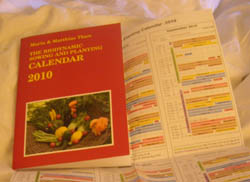
Photo: Biodynamic Planting Calendar 2010
I spent a happy hour in bed this morning – nominating all my favourite blogs for the Bloggies 2010. This is the most prestigious annual blogging award in the world and it’s now in its tenth year. You need to nominate three blogs in each category that you choose so I made a list of the relevant URLs and pasted them in. Lots of fun and a good positive start to the day!
Then the postman finally delivered my prize for the next Cottage Smallholder competition. As you know I’m using biodynamic techniques in the garden this year, and The Biodynamic Sowing and Planting Calendar 2010 by Maria and Matthais Thun is core to this system of gardening. In my haste to order a copy, I ordered two. So this is the prize for our first gardening competition of 2010.
Maria Thun has been practicing biodynamic farming for over 50 years and this calendar is the result of years of research and experience. There is also a handy pull out calendar for the garden shed. I have been reading as much I can on the Internet but there’s not a lot of information out there. There was an interesting experiment with tomato growing at Audley End. Magic Cochin visited the Elysia Biodynamic Garden and said that the vegetables were amazing. Chickens in The Road has a good post about planting by the moon here – the comments are worth reading too.
I had thought that it would be only relevant to countries in the Northern Hemisphere but there is a chart enabling it to be converted all over the world. So if you live in the Southern Hemisphere you can enter!
To enter the competition just leave a comment below outlining your best gardening tip for saving time and or money. You may enter as many times as you like with as many tips as you like. I want to post the prize fairly quickly so the winner can take advantage of its advice regarding the best times for sowing seeds. So the competition will run for just eight days and close at midnight Sunday 17th of January and the calendar will be posted to the winner on Monday 18th of January.
I can’t wait to read your tips. Best of luck to everyone who enters.

Comments(24)
Who is responsible for clearing the snow from the pavements in the UK??
Recipe for chicken, mushroom and tomato risotto
Thank you for your comments. And a bit of silly bath time fun with the Frothing Sea Monster trick!
Cutting energy costs
Recipe for sausages baked with herby garlic infused beans, bacon and tomato
Tracing some of my ancestors has taken me on a long journey
hi fiona buying cheap seeds or seed potatoes is not cost effective we tried it last year thinking there would be no difference in quality to the more expensive we were wrong especially regarding sedd potatoes we will be buying better quality this year.happy gardening.carole
A lot of the online garden shops do pre order mini plug plants for bumper amounts of summer bedding plants ( the mix is usually lobelia/busylizzie/pertunia/begonia) and if you order in autumn for the next spring they are about £20 for 560 plants. I always order 2 lots ( don’t ask how long it takes to plant them out but needless to say I spend almost a day in the greenhouse).
The first year I didn’t make as much profit as I brought french marigolds as well which I scampered round dead heading and keeping the seeds that summer, and of course I had to buy all the trays to plant them out in in the green house.
But I have the same people every year now who all have the same orders for their pots and hanging baskets and give me the plastic trays back each year. So what with only a huge bag of potting compost to buy ( about a tenner) my free french marigold seeds, and reused potting out trays I end up with around 75 trays of 20 bedding plants a year which cost me the princely sum of £50.
I keep some for my garden and sell the rest for £4 a tray, half the price of garden centre, beautifully cared for plants and delivered.
I make about £180 – £200 a year which I then splash out on shrubs and exotic plants for my own garden that I wouldn’t normally buy.
Maybe a tip for your gate stall fiona?
this tip is for newbies especially: after you have carefully drawn up your to-buy list, go over it & slash the total amount bought by 1/3, because your eyes are bigger than your garden! saves money & the heartbreak of having to thin out & toss your babies. yeah, yeah,*everyone* says this–& it’s true!
Last year i took advantage of the free veg seed offers in newspaper/gardening magazines, pay postage only of £ 1.99. I took advantage of three of these offers and have enough seed for my fairly large veg plot. All seeds where Thompson and Morgan. The offers provided a good range of herbs, salads, cabbages and root crops. I only had to buy peas and beans. Also it gave me the opportunity to try things that i wouldn’t of try if i had to pay full price for the packets. I’ve also got a few packets left for this year. They all had good use by dates. So my tip is to look for these offers before buying your seed, it will save you a fortune!!
My best tip came from my Dad: when planting the garden do not mark the rows with a stick instead trandsplant a flower. Young children like to pull up sticks but leave the pretty flowers alone. By midsummer your garden will be edged with flowers that those same small children can pick or smell without trampling the rest of the patch.
When visiting garden centres and nurseries check if they have a recycling bin for pots and seed trays. These are great after a good wash, my Mum and I raise seedlings and plants to sell to raise cash for Cancer Research each year and we almost never need to buy pots etc.
We live on one of the more remote islands in Orkney, so can’t just nip down to the local garden centre, when we need something for the garden. Recycling is a must here. Last year my husband spent ages thinning out individual plants into thin plastic trays, a lot of which ripped by the time the plants were ready to go in the garden. This year we have saved all the cardboard toilet roll tubes and cut them in half. These will be placed in a plastic tray lined with newspaper and filled with compost to be used for sewing seeds or individual seedlings. When the plants are ready, the tube can be planted in the garden in its entirety, The tube will decompose naturally, and we will have saved time and money.
tich
Tips off the top of my head:
-Plant red-leaved lettuces…the birds don’t like them as much so you have untouched lettuces to enjoy and your effort doesn’t go to waste.
-To get the best yield of potatoes in a small space, plant them in barrels or high tubs. When you plant them, start with only about 10 inches of soil in the bottom. Add another few inches every few days. By the time you get to the top and the potatoes are ready, they wil be growing all the way down the tub. I was amazed at how many I got from this method.
-When picking blackcurrants, if you’re limber enough, look up and under the branches. I thought I was getting them all and never realised how many I was missing until I fell over into the patch one day and looked up.
-Beer and slugs. They love it a bit too much as I found out when I left a can or twelve of beer in the garden after NYE. I woke up and they were full of pickled slugs. So, I started burying empty margarine containers around my vegetable patch and putting a little cheap beer in them each night. Empty pickled slugs, and repeat. After about a week, my garden is pretty much slug free. And the sad thing is, they can hold their booze better than I can. Also, it got rid of the cheap beer that someone left at my house. Slugs aren’t fussy.
-On the ocasion that I need to do something heavy that involves hiring a mulcher or something, I pool together with the neighbours and we do the whole lot over a day or weekend. It’s also a good time to trade seeds/plants/produce/tips/GOSSIP ((that’s the best part. You’ll never believe what the man at #38 has been doing to his blueberries!)
-Pretty as all those fancy gardening tools are, you don’t need them. I’ve been surviving with a ho, rake, spade and fork for years and have never needed anything else. If I need to lop things I bribe my parents with produce/preserves and borrow theirs. You can barter/trade/bribe/steal just about anything if you set your mind to it.
That’s it from me for now, but there will be more!
After all the good advice in the comments above – especially from Homojoe – I’m not sure what I can add!
For some crops it’s easy to save your own seed – veg that self pollinate (for cross pollinators it’s more tricky unless you are happy to get some weird crosses!). I see the Real Seed Company site has lots of advice, so do the Heritage Seed Library at Garden Organic. I save my own Broad Bean, Runner Bean, various favourite Climbing and Dwarf French Bean, Peas (including Purple Podded varieties of course!), Bunching Onions, Coriander.
And then Swap Seed – spare seed you’ve bought and seed you’ve saved can be swapped with fellow veg growers at organised Seed Swap days (search the web or look on village or allotment notice boards). Or be assertive and set up your own Seed Swap Day, serve some hot drinks and biscuits and have fun!
For containers in summer I use ornamental grasses, scented geraniums, pineapple sage, lavender, trailing sedums, geranium macrorrhizum. All are tolerant of drier conditions and can either be left out all winter or kept in a frost free greenhouse for next year. I don’t buy bedding plants.
Don’t be too hasty to get growing early in the season. Use your instincts – if we get a warm early spring then get sowing and planting, if it’s still cold don’t worry if you don’t sow and plant things until May. I usually plant Runner Beans directly in the ground in the second week of May. The saying – “don’t sow in soil you wouldn’t be happy to sit you’re bare bum on” is a wise one.
If you want to grow your own fruit and veg be accepting of having to use the same crop while it’s in season day after day, or freeze, preserve and dry it. Invest in a copy of Jane Grigson’s Fruit Book and her Vegetable Book. Try all the recipes – it will keep you going for years! And your bound to find a way to love even the veg you thought you didn’t like!
Don’t get talked into buying expensive equipment, gadgets, clothing, accessories, etc. In reality I only use a fork, a rake a hand fork, a hand hoe (for drawing a furrow to sow seed), a dibber, towel and secateurs. Oh, and an old kitchen knife. Look in second hand shops and on markets for reconditioned vintage garden tools – there’s a great stall on Saturdays in Saffron Walden Market for instance.
My best advice for the ornamental garden is to observe and note the conditions in each area you want to plant up. Do some homework about the sort of plants which like growing in those situations – look in neighbours gardens and nearby gardens open to the public. Find related plants and create an ecosystem that is happy just like plants in the wild – you’ll also attract native wildlife and create a naturally happy habitat.
If you like growing ornamental plants from seed and you’re in the UK and are a member of the RHS, remember that you can choose 20 packets of seed for an admin fee of £12. I’ve grown most of the perenniels in my garden this way. Local gardening clubs hold plant sales in spring – great for unusual bargains!
And lastly, don’t get downhearted if a crop fails. There are so many variables in gardening and they change every year – that makes it interesting. Build up gradually and don’t expect to be self-sufficient in you first year.
Here’s to a great growing season in 2010
Celia
You can find mulch free in the fall if you live in a four seasons area. Home owners are required to use paper bags for collecting leaves and garden debris and that is placed next to the garbage cans for city pickup. It isn’t illegal to do but its even better if you ask your neighbors for the sacks or offer to help them rake their gardens in exchange for the sacks of leaves.
Join the Cottage Garden Society! It costs £9 per year in the UK (20euros/£14 in Europe, $20 in the US). For this you get 4 magazines a year, and can participate in its seed distribution. For £4 you can request up to 15 varieties of seed, mostly flowers but there are herb and vegetable seeds too. If you contribute enough varieties of seed you can request more. The magazine has articles on a lot of topics, including growing veg, keeping poultry, book reviews, flower growing, recipes, garden pests…
I have been a member for about 18 months now, and am eagerly awaiting my first allocation of seeds. The list comes out in December, and last year it got mislaid in the pre-Christmas clear-up.
http://www.cottage-garden.org.uk
One essential tip is to not over complicate things when gardening, forget all the fancy books and tv programmes and stick to good, sound information from long term gardeners. I also find that accessing a good blog/forum (such as this one!) helps to save time and money when needing more information or advices.
Another tip is to stick to a good, basic gardening mags if you read them e.g Amateur Gardening as it is full of simple, common sense advice with ‘free’ seeds throughout the growing season.
I also use Freecycle for plants/equipment. So far I been gifted cabbage plants, cucumber seeds, a fuschia, pond plants, globe artichokes, 2 stone planters to name a few.
love reading all the tips.
Jane
I agree, Jane.
Not being a gardener myself, I was amazed at the voulme of useful info in all the comments. Every one of them makes perfect sense.
It is going to be hard for Fiona to pick a winner. Maybe she will have to bring in an independent arbitrator. (quite likely, actually).
We’ve been growing and selecting Alberto’s Locoto for a few years now – it’s a great chilli and particularly good for making chilli sauce as it’s quite large and fleshy. I posted a recipe for this recently – http://choclogblog.blogspot.com/2009/11/chilli-sauce.html
Another suggestion for those with small children – plant a cherry tomato plant on the edge of the garden, then they can help harvest without trampling the garden & in most seasons there will always be something for them to pick. Picking can keep small children busy long enough for quick garden checks or chores. Of course a good, sturdy, well anchored cage is very handy.
I always have trouble with my bean/pea supports falling down! Last year I made a frame by tying one peice of twine across 2 supports at either end, then using a baton of wood at the bottom, wound the string from the top support, round the bottom of the baton and then back up to the top, all the way to the end.Then bury the baton into the bed and it stays strong and sturdy even in the highest winds. You end up with a zigzag network of string, but it is pretty and beats tring to stand up falling over beans all summer!
On the website about the Elysia Biodynamic Garden, they name the plants used for composting, and they haven’t used sorrel – I thought that was an excellent plant for composting!
My suggestion would be to provide all the available ‘homes’ for beneficial insects, whether handmade or shop-bought, to provide your plot with natural predators.
To maximize your enjoyment in your gardening endeavours while husbanding all your resources, pick an appropriate number of your very favourite fruit, vegetables flowers or fruits which suit your conditions and lavish your care and attention on those few rather than the many.
I have two:
To keep down the insects and boost bee health, make sure you’re rotating your crops and that you have a good mix. Moving stuff around confounds the pests, and a multicrop planting rounds out bees diets and boosts their immunity.
The second one I learned from my ex-neighbor, who was the most amazing organic gardener- he planted his seed potatoes at the bottom of the planter, and then as they grew he added leaves instead of soil- the leaves would mold right there in the planter and be easy to dig the mature potatoes, and he grew lovely potatoes. Then he had a very rich bed for the next vegetable crop.
Being accident prone beyond belief, I have a set of tips especially designed to help those who are also accident prone, or were standing at the back of the queue when common sense was being handed out.
- Always wear clothes when making jam. Taking 20 minutes out to run your bellybutton under cold water wastes a lot of preserve-making time.
-When climbing to the top of the apple tree to retrieve the perfect apples, don’t forget to take the collecting bag with you. Also make sure any cats you own are inside.
-If you are forgetful, make sure you label everything in your vegetable garden. Until I was about 20 I thought broccoli looked like carrots…
-When leaving out beer for slugs, resist urge to ddrink said beer the next day. Having your stomach pumped is even more inconvenient than getting gooseberry jam out of your bellybutton.
-If you have a working bee, make sure to invite vaguely competent people – not just those who just want photos for facebook. It takes mor energy to supervise ten people in their tasks than it does to do them on your own. But, with a bunch of great people you can get heaps done. Also, providing beer (sans slugs) is a great motivator.
And there you have my should-be-obvious-but-every-single-one-is-based-on-my-experiences list of time and money savers!
HJ
Oh, homojoe, you win my vote – great stuff!
Ha ha – who’s a wally, then????
I said in an earlier comment that sorrel is a good plant for the compost ….. doh …. what I meant was comfrey. I bet you were all thinking ‘brightsprite’s off her trolley!” and you’d be right!!!
Further thoughts… Planting seeds directly in the garden sounds like a great time and money saver, but if I did that the slugs would get a feast and I’d get no veg. Starting seeds indoors/in a greenhouse takes time and space as well as compost, trays, pots, or whatever. Buying plug plants costs money, buying larger plants costs more per plant. I don’t know which of these saves most for anyone but me. But for anyone, buy plants grown as close to where you garden as possible so you don’t get a variety that will get a shock when planted because it has been raised somewhere warmer/dryer/wetter/less windy.
My tip is: plant some fruit bushes as well as your other veg. They require minimum care, just some pruning at the end of fruiting, and tying back any long stems. When the fruit arrives, the more you pick the more you get ! I would collect a bowl of tayberries every day last summer ! It was great to have fresh berries and still have time to care for my other fruit and veg. Perfect !