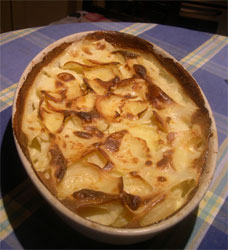
Danny’s Wonderful Gratin Dauphinoise Potatoes Recipe
Finally Danny announced that he would make his fabulous Gratin Dauphinoise Potatoes to accompany the roast beef this evening. These are a more traditional recipe than my Cheesy Dauphinoise Potatoes and are delicious.
Gratin dauphinoise reheat well. In fact, when I worked in a restaurant years ago, they were made in advance and reheated and browned under the grill on demand. Robert (pronounced Rob-bear) was French and longing to toss away his hat and paint (pictures) full time. He smoked cigars in the kitchen and cooked like a dream. His Dauphinoise were nearly as good as Danny’s. They included a layer of gruyere cheese, which was pretty good. Danny’s Dauphinoise have a softer, gentler taste. Robert’s Dauphinoise made their presence felt.
To make good Dauphinoise potatoes you need a large shallow dish (the oval ones are often referred to as a gratin dish). If you want to save time, invest in a mandolin. One Christmas it was Danny’s turn to choose the “useful present” from my mum. She rang us to verify
“Is this an Elizabethan guitar or a vegetable slicer?”
Danny was very quiet when he opened his present. Weeks later he was pale and totally silent when I drove him to outpatients. Be careful with the super sharp, state of the art Japanese mandolins and always use the protective attachments.
Danny’s Wonderful Gratin Dauphinoise Potatoes Recipe
Ingredients:
- 1 kilo of potatoes (we use Maris Piper)
- 2 medium cloves of garlic, crushed.
- 800 ml of milk and 200 ml single cream. Stirred together in a jug.
- 35g of butter
- Freshly ground black pepper
Method:
Set the oven for 190c (170c fan).
- Wash and peel the potatoes. Slice the potatoes thinly (2m), ideally using a mandolin.
- Butter a large gratin dish well.
- Divide the potatoes into four. Put a quarter onto the base of the dish and scatter with one third of the crushed garlic and a good few twists of ground black pepper. Repeat for the next two layers. The top level has no garlic or pepper.
- Pour on the milk and cream mixture and add the butter in 25 tiny nuggets (you need to use your fingers for this).
- Bake for an hour. If they are not golden, turn up the heat and bake them for an extra ten minutes at 210c (190c fan).
Online vouchers give you a discount at loads of shopping sites, like Tesco, Argos, Mothercare and lots of other online stores. Do not pass up this opportunity to keep costs down. Fantastic discounts! Click here now

Comments(23)
Thank you for your comments. And a bit of silly bath time fun with the Frothing Sea Monster trick!
Cutting energy costs
Recipe for sausages baked with herby garlic infused beans, bacon and tomato
Tracing some of my ancestors has taken me on a long journey
Recipe for lamb shanks braised in red wine with shallots: slow cooker/crockpot
The cupboard was bare – so what was The Contessa going to eat last night?
I love dauphinoise! It’s my favourite way to have spuds but it’s so rich and decadent that I only have it a few times a year. Goes fantastically with lamb or on it’s own!
They are an indulgent treat for us too. I agree Freya, dauphinoise go particularly well with lamb.
This is very similar to Delia Smith’s recipe that we cook as often as we can without feeling guilty. However Delia recommends that after slicing the the potatoes with a mandolin they are rinsed in cold water several times to wash out as much starch as possible. Then pat dry with a clean tea-towel.
Also, as well as the knobs of butter on top, I always grate quite a lot of nutmeg over it before exactly an hour at the top of the baking oven of our Aga. Mmmmm. Delicious.
Hi Chris, Thanks for dropping by. Danny changes his recipes a lot. This one was particularly good. Nutmeg sounds like a great idea.
Great recipe. Grated nutmeg does indeed work very well in gratin dauphinoise – I’d never do it without it. I’m curious to know, did Robert’s gratin have a layer of gruyere in the middle or on top?
Hi Valdaglerion
Robert’s gratin had gruyere sprinkled on each layer (just a little) and a small amount on the top.
Thanks for dropping by.
Can a potato dish like this be made in advance and frozen?? I would like to have it with Christmas dinner, but won’t have the time on the day!
Hi Siobhan
I’ve had a chat to Danny about this. He says that it would keep in the fridge for a couple of days and this would be your best option.
As it contains milk he reckons that it wouldn’t freeze very well – rather like fish pie made with milk.
Your other option is to prepare the potatoes and keep that in the fridge in salted cold water (so as not to discolour) and assemble the dish on the day.
Hope that this helps.
I agree Fi, it doesn’t freeze well.
I make ours the day before we want it (cooked until it is only just ‘done’) then pop it in the fridge overnight. I reheat it for about 40 mins, so it is golden and bubbling!
It goes very well with good sausages (cooked in the oven with lots of onions that end up all caramelly and chewy!), some in season veges and Elderberry Jelly. In fact, this is what we are having for our Christmas Dinner!
Hi Mildred,
Thanks for that!
I must try your sausage and onions recipe – it sounds wonderful.
Haven’t made Elderberry jelly. What’s it like?
Hi Fi, the Elderberry Jelly (we used half and half – apples and berries) is fantastic, a really rich deep crimson colour. I think it would be good with goose or any rich meat too. I wish we’d made more, it is our favourite of all the jellies we made! The hedges were laden with berries this year, it was a job to catch them before they ‘turned’, we were going out twice a day with buckets!!
For the sausages, we just pop them in a roomy roast pan, add a small drizzle of oil then tip 3 or 4 sliced onions (some red, some white)in. Cover with foil and cook for an hour (medium oven), uncover then finish off until they are nice and brown, yum!
Just a thought, I wonder what Elderflower Jelly would be like . . . . ?
Hi Mildred
I must make some elderberry jelly next year. We have elderberry wine on the go – tasting pretty good at the last racking.
The sausages sound very good indeed – love the idea of combining the red and white onions. Thanks for the recipe.
I reckon that elderflower jelly would be good – light and fragrant. We have a recipe for lime and elderflower jellies on the site http://www.cottagesmallholder.com/?p=328 which are stunning.
Hi Fi, your elderflower jelly looks wonderful! I am going to make a note on my 2008 calendar of all the things to make from hedgerow fruits/flowers!
A friend mentioned today that they have several Quince trees in their orchard along with some Medlars and that we are welcome to the fruit next year. Must out THAT on the calendar!
Hi Mildred,
The jellies were exquisite.
Lucky, luck you with access to quince and medlar trees next year!
Wow danny, i have to say my tastebuds have never been so tingled than by your fantastic dauphinoise potato recipe!! It must have taken years to perfect and let me tell you, I WILL be telling all my friends down at the allotment. Thanks again, Wilfred Peebles (chief stamp collector of the national stamp collectors society).
Fantastic, but a gratin without cheese is a bit odd methinks, or am I losing it??
Ingredients:
•1 kilo of potatoes (we use Maris Piper)
•2 medium cloves of garlic, crushed.
•800 ml of milk and 200 ml single cream. Stirred together in a jug.
•35g of butter
•Freshly ground black pepper
Method:
Set the oven for 190c (170c fan).
1.Wash and peel the potatoes. Slice the potatoes thinly (2mm), ideally using a mandolin.
2.Butter a large gratin dish well.
3.Divide the potatoes into four. Put a quarter onto the base of the dish and scatter with one third of the crushed garlic and a good few twists of ground black pepper. Repeat for the next two layers. The top level has no garlic or pepper.
4.Pour on the milk and cream mixture and add the butter in 25 tiny nuggets (you need to use your fingers for this).
5.Bake for an hour. If they are not golden, turn up the heat and bake them for an extra ten minutes at 210c (190c fan).
Well thank you very much for that glowing comment, Wilfred. We have not had this dish for many months but your comment and Peter’s have triggered an insatiable desire to cook it for Sunday lunch today.
Hello, Peter, and thank you for that very clear and simple recipe. I especially like the milk/cream ratio.
The cheese question is open to opinion I guess. Fiona loves gruyere in this but, while I love it as a cheese, the smell and flavour when used in cooking really turns me off. Yuck.
I looked up “gratin” and found a good explanation on the useful site eHow.com
What Is Gratin Dauphinois? (by Nancy Yos)
A gratin usually means that a dish, whether of potatoes, a vegetable or perhaps leftover meat, has been baked with a topping of bread crumbs or cheese and then browned. But it can also be a dish, probably one vegetable, that has been baked in cream and has been allowed to brown and form a crust. Au gratin means with bread crumbs or grated cheese; in French “le gratin” means crust and the verb “gratiner” means to brown, usually under a broiler or salamander. Gratin Dauphinois is a dish from the Dauphiné, a province in southeastern France near the Italian border.
Does anybody else have an opinion the use of cheese with gratin dauphinoise?
If you prefer cheese in, what cheese works best?
I used to put cheese in my gratin dauphinois, but I have reverted to the classic version and now actually prefer it cheeseless — the flavour is more refined, and you can taste the potatoes! This is how I do it:
http://www.larecettedujour.org/2007/03/le_vrai_gratin_dauphinois.php
If you are going to put cheese in it though, I think it has to be Gruyère, Comté or similar.
Hi
I made this dish to accompany Sunday lunch today and found it rather runny. There seemed to be alot more liquid caompared with Delia’s – where did I go wrong?
[...] Chops with Dauphinoise Potatoes from the Cottage Smallholder to which I added a sliced leek with the potatoes and my home-made mint [...]
This is a nice dish. I’ve done this in two different ways. One as detailed above but with a light sprinking of cheddar between the layers and on top which is always delicious!
The other way I’ve done it is to slice the potatoes a bit thicker and par-boil them in the milk / cream mixture with a bay leaf in there which gives it a nice flavour. You then assemble as normal (with or without cheese) and then use the Bay-y milk / cream mixture in the dish.
Hi Bis_Si
Great idea using the bay leaf – going to try that method next time. I love the dish with cheese too!
Hi Danny & Fiona:
Just dropped in (from France!) to say I really love your site which I’ve only recently discovered – living in the wilds of the countryside I’ve found foraging and cooking tips both are v. stimulating, love everyone’s useful comments! Re above recipe, we can’t easily get fresh cream or milk here, do you think it would be OK with the UHT versions? (P.S.: ‘received wisdom’ round here is that the Traditional Gratin shouldn’t have cheese – but could be cooked overnight… (?) )