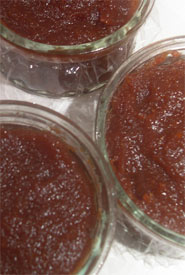
Easy quince cheese recipe (membrillo)
I’m back at the helm and it’s marvellous to be feeling well and chirpy and slimmer. Forget Champneys. A week in bed with a bug does wonders for the figure.
Danny put on his sensible parent hat this morning. He instructed me not to go to work, reasoning that more recuperation was required. He was right. I did feel weak.
This afternoon, he relented slightly.
“Why not go out foraging for an hour. You could do with some fresh air.”
He passed me the foraging stick, tossed me his car keys and disappeared upstairs.
I found some plump sloes and with the help of the walking stick accessed branches that only a seven foot giant could reach. The crab apple tree had a small final harvest. Being north facing its fruit had not spoiled. I tootled home and simmered the crab apples with chillies to make a hot jelly (recipe later this week if it turns out well).
My main aim today was to make some quince cheese. The quinces had been cooked and strained for jelly the week before last. The juice and flesh keep well in the fridge for up to two weeks. Today was the last day.
When I discovered membrillo at the Spanish Deli in Portobello Road I was delighted. I love the combination of membrillo and Manchego. Danny wasn’t impressed. His face crumpled when he tasted it.
“It’s so sweet. How can you like it?”
I was pretty sure that membrillo needn’t be so sweet. I looked at various recipes on the internet. The amount of sugar varied enormously. In the end I decided to plump for an equal volume of quince pulp to sugar. This has produced a membrillo that is sweet but tastes of quince. I reckon that one could get away with even less sugar in fact when I looked in my copy of Oded Schwartz, his recipe uses slightly less – 50g less. Adding the lemon juice made a difference too.
They key to this recipe is time. I simmered the quinces for at least three hours until they became a deep pink colour. The final stage is a long process too. The quince pulp and sugar was simmered gently (lowest setting) for a good 2-3 hours to intensify the colour and thicken the pulp to the right consistency. There is no need to bring the mixture to a rolling boil. This is a recipe that is spread over two evenings. One evening simmer the quinces and strain overnight. The next evening make the membrillo.
Danny tasted it gave the recipe the thumbs up, especially when he realised that the by product is the juice for quince jelly.
Easy quince cheese recipe (membrillo)
Ingredients:
For the quince pulp:
- 1 kilo of quinces
- Zest of half a lemon
- Water to cover
For the quince cheese:
- Quince pulp
- Juice of half a lemon
- Granulated (not castor) white sugar (equal volume to the pulp)
Method:
- Rub the down off the quinces and wash them. There is no need to peel or core the quinces.
- Chop the quinces carefully, as they are hard it is easy for the knife to slip. I chopped them into quarters and sliced them into 1cm slices.
- Place the quince slices in a large saucepan or casserole dish and add water so that they are just floating. Add the zest of half a lemon.
- Bring slowly to the boil and then turn the hob down to it’s lowest setting so that the quinces gently simmer (lid on). Simmer the fruit until very soft and the fruit has turned a deep pink colour. This took me about 3 hours. Check the quinces every now and then and top up the water if necessary.
- Strain the juice from the fruit overnight using a jelly bag or muslin square. Retain the juice to make quince jelly.
- I was loathe to spend hours pressing the quinces through a sieve so I put them through the Magimix
(medium grater blade) and then I sieved them.
- Measure the pulp using a measuring jug put the pulp into a large heavy bottomed saucepan or casserole dish and add an equal volume of white granulated sugar. Add the juice of half a lemon.
- Bring the pulp and sugar gradually to simmering point, stirring to dissolve the sugar and let it simmer, lowest setting for 2-3 hours, stirring every now and then to stop it sticking and burning. It will resemble gloopy mud. Gradually the colour will darken. Eventually the fruit will become very thick (I could stand my spoon up in mine).
- Spoon into well oiled sterilised straight sided jars and seal with cellophane lids. This will keep for months. Cut slices to eat with cheese or cold meat. Refrigerate after opening.

Comments(121)
Landscape, wildlife and memories – original prints, cards and gifts created in Celia Hart’s Suffolk studio
Fiona, I just love reading your posts! You always intrigue me and give me inspiration to want to try what you are cooking. But I don’t have a clue where to get quinces. Or the jars for making jelly. Back in the US I used to make all sorts of jams and jellies and can my garden produce, but here I don’t have a clue where to find the stuff I need. We all must do things totally differently. Thanks for a great read!!!
Your quince cheese looks great. I wish I could try it. I am definitely going to be trying this myself.
Great to read this, as I’ve been doing the same research to make less sweet membrillo, and simplify. I’ve got a slightly different idea than yours, and will do it later this week – there are quinces at the bottom of my garden, but it’s pouring with rain at the moment, first time for weeks, and it’s so cosy in the house
Pat, a very good starting point for most of what you want would be Lakeland, either one of their many shops, or through their very efficient mail order service. Everything. Jars, just lids, cellophane lids, jelly bags.
Joanna
joannasfood.blogspot.com
I have a Japanese quince which currently has about 100 fruit on it. They are small and green, with a bit of red blush, and very very hard. Can I use them in this recipe do you think?
Thanks!
Hi Pat, Waitrose should be getting their stock of quinces in anytime soon.
And I agrre with Joanna that Lakeland.com is great for jars etc. I also buy the little jars of ‘value’ mint sauce from tescos to use the empty, clean jars with the Lakeland gingham lids! That size makes a nice gift too!
Raining here too.
Quince jelly is such a treat – I wonder if I can find some quinces? Today’s the kind of wet dreary day when making preserves is the perfect thing to to – warm, satisfying and filling the house with a delicious aroma.
Hope the membrillo-making helped to make you feel recovered.
Celia
Do you water bath can your jams and jellies???? In the US, I would waterbath can anything that was very sweet or acidic,such as jams,jellies or tomatoes and pickles, everything else I would pressure can. When I say can, I used jars and lids. We were told not to use the oven canning method as it wasn’t safe. We had special jars and two part lids for canning. I have seen the jars and lids at lakeland, but the cellophane lids I haven’t used before. I may have to do an order soon. Also we were told not to reuse lids as they wouldn’t seal properly again. I do remember my grandmother using parafin wax to seal her jams and jellies.
I’m not too keen on membrillo, I first tried it in Spain and didn’t get it at all. That said I don’t like apple with cheese or brie and grape sandwiches, I think I prefer savoury with cheese. Though I quite like mango chutney with a mature cheddar…
I liked the little chat that went on in the comments today. I love Lakeland too!
Hope you’re 110% recoverd.
I love membrillo with cheese so i decided to make them.I get the recipe in the internet.You can buy quince from Greek,Cyprus shop.They are on season this time of the year.
Hi Pat,
Jars – check out tonight’s post.
Quinces seem a tricky fruit to bag but they’re not. Go to the market in Chelmsford and ask the fuit/veg stall when the will have quinces. I found them in Cambridge market last November. They will be happy to tell you. Genarally they are a pound (cost) a quince. Two quinces probably weigh a kilo.
Jars needn’t be a problem. Read my next post.
Sealing the jars. Read my next post in a few days time.
Thanks for dropping by. Always appreciate your visits.
Hi K.J.,
Go for it!
Hi Joanna,
Looking forward to your revelations. We are delighted with our membrillo but would like to make the perfect M.
Thanks for your comment about Lakeland.
Hi Jude,
Your fruit sound perfect for mermbrillo or quince jelly.
Quinces are very hard too but both make superb preserves.
Hi Mildred,
Thanks for joining in. I think that I have seen quinces at Waitrose already tis year (perhaps it was a dream), You are right Lakeland is a good place to start. Love your idea – Tesco mince sauce- dump, clean and voila fresh jars. Spot on.
Hi Celia,
I loved making our Membrillo. Cambridge market – quinces towards Christmas if not before.
Feeling great now and back at work.
Hi Pat,
I water bath my jars of fruit but not my preserves. More later in the week!
Hi Amanda,
It’s a magical combination for some but yuky for others. Thank goodness a few dislike membrillo – more for those who savour the treat.
Hi Tessie,
Thanks for your tip. Glad to hear that quinces are available at the Greek and Cypriot shops. Hope that your recipe works well for you.
Thanks Fiona, I am new to all this business having just moved from a tiny townhouse with no garden to a big semi with a dozen fruit trees and a vegetable patch bigger than my old house!
I will give the quinces ago – should I do this now or can I leave them on the bush a bit longer?
Also, sorry about the novice question but is there a particlar way to oil the jars for the membrillo? Or any particular oil I should use?
Thanks for the lovely site, I’ll be here a lot from now on!
Jude
Hi Jude,
You can use the quinces now or later.
I used olive oil, spread with a piece of kitchen roll. Groundnut oil is probably best as it is almost flavourless.
Glad that you are enjoying the site.
Hello! Type ‘quince’ into Ebay (UK), someone is selling them, but WHAT a price!
The Waitrose near us are still awaiting their delivery, they keep assuring me they WILL be in any day.
I feel sure that the quince will soon be discovered by TV chefs and will become a ‘trendy food’, and will then be more easily available.
Your Membrillo looks and sounds great Fi!
Hi Mildred,
I checked on eBay – Yes they are expensive but I bet they are selling them.
I think the problem with the availability of UK quinces is the picking cost. Also quince trees tend not to be grown on a grand scale.
Also loads of people just don’t know what to do with quinces. They are no longer part of our culture as they are on the continent.
Hi, Waitrose got a stock of quinces in! I bought all 14 . . . yesterday I cooked 6 and made jelly today, creating 7 small (8oz) jars. I have saved the pulp and will mix it with the pulp from 6 more, simmering today, to make the cheese tomorrow.
I am going to try the recipe for ‘braising’ the other 2 for our pudding tonight!
Can there be any greater joys than the wonderful scent of simmering quinces, and the resulting beautiful jelly?
Hi Mildred,
Great that you finally managed to find quinces. They have a wonderful scent when they are cooking and quince jelly is the best.
I made membrillo! It’s deep red and delicious. The quince jelly seemed to work too, though just three jars from six quinces. When you said to just cover with water, that’s what I did as I didn’t want to overdo it on the water after the last liquid to sugar ratio upset
This time, a great taste, it set and is lovely and pink. My second foray into preserve making and a much better result. And yes, I think the scent coming from cooking quinces is really quite lovely. I’m going to make some more
I thought this was rather interesting…
The modern name for quince originated in the 14th century as a plural of quoyn, via Old French cooin from Latin cotoneum malum/cydonium malum, ultimately from Greek kydonion malon “Kydonian apple” (in the figurative sense, similar to pomodoro – Italian word for tomato literally meaning “apple of gold”, pomme de terre – the French word for potato, literally meaning “apple of the ground”, and the classical “golden apple”).
The quince tree is native to Iran, Georgia, Armenia, Turkey, Albania, Macedonia, Greece, and Bulgaria, but the Greeks grafted from a superior strain from ancient Kydonia, now Khania, a port in Crete, whence both the common and better-preserved genus name. The Lydian name for the fruit was kodu.
Cultivation of quince may have preceded apple culture, and many references translated to “apple”, such as the fruit in Song of Solomon, may have been to a quince. Among the ancient Greeks, the quince was a ritual offering at weddings, for it had come from the Levant with Aphrodite and remained sacred to her. Plutarch reports that a Greek bride would nibble a quince to perfume her kiss before entering the bridal chamber, “in order that the first greeting may not be disagreeable nor unpleasant” (Roman Questions 3.65). It was a quince that Paris awarded Aphrodite. It was for a golden quince that Atalanta paused in her race. The Romans also used quinces; the Roman cookbook of Apicius gives recipes for stewing quince with honey, and even combining them, unexpectedly for us, with leeks. Pliny the Elder mentioned the one variety, Mulvian quince, that could be eaten raw. Columella mentioned three, one of which, the “golden apple” that may have been the paradisal fruit in the Garden of the Hesperides, has donated its name in Italian to the tomato, pomodoro. I’m wondering whether the apple in the bible was in fact a quince.
The term “marmalade”, originally meaning a quince jam, derives from the Portuguese word for this fruit marmelo.
The quince, used as a rootstock for grafted plants, has the property of dwarfing the growth of pears, of forcing them to produce more precociously, and relatively more fruit-bearing branches, instead of vegetative growth, and of accelerating the maturity of the fruit.
In parts of Afghanistan, the quince seeds are collected and boiled and then ingested to combat pneumonia. It is also a known remedy for lung disease.
Hi Seahorse,
It is good news that you have membrillo in your house and I am so pleased that the jelly worked for you.
You should have got more jelly from 6 quinces (depending on the size). Did you keep the lid on when simmering? And let the quinces just float in the water. Quinces are bursting with pectin and flavour that you can thin an over thick juice and it will still set. However, it is easy to over thin and get an oversweet jelly.
In the end you got good jelly and membrillo and that is the main thing.
Hi Ellie,
This is great information about the quince. Thank you so much for dropping by and leaving a comment. Really useful stuff.
hi all. there’s a greengrocers on rectory grove, leigh on sea, essex with fresh quinces for sale – £1 per lb. i asked where they were from and it transpires they come from a garden about 100 yards away – beat that for food miles! i made a batch of membrillo and am very happy with the results (i “greased” my container with glycerin which worked just fine).
Hi, thanks for the feedback. I’m so in love with quinces at the moment. Re volume – I could have added a bit more water at the start in retrospect, though the juice I got from the quinces just looked so thick and pink and gorgeous I held back the temptation to dilute it. Will be having another go. It’s such a pretty jelly. Got some little ornamental ones from a neighbour’s garden. I know they will be more sour but it’s worth a try just to experiment. Need them to ripen up first but it’s all happening at this end. Crab apples next.
Hi Robin,
Thanks for the tip. Interesting that glycerine worked for the jars.
Hi Seahorse,
Glad that the quince jelly worked for you.
The japonica quinces can be used now (hard) the resulting jelly will be almost the same.
Good luck with the crab apples.
Hmm yes. Crab apples. I actually unwittingly bought some small egremont russet. Completely different. Oh well, tarte tatin it is then
Hi Seahorse,
Bad luck.
I am sure that the tart tatin will be delicious. My favourite.
Hi,
Re japonica I have used them successfully in mixed jellies: crabapple and jajponica v good. Also used in my favourite hedgerow jelly. Do you make it? Varies every year depending on the fruit available.
I start earlier picking the elderberries and freezing them. Pick and freeze a mixture until the sloes and later fruits are ready. Any year can include the following: crabapples, blackberries, sloes, haws, rosehips, fuschia fruits, rowan berries, whitebeam berries, ornamental crabs, berberis (must be ripe berberis), windfall apples, elderberries, japonica juice of 1 or 2 lemons (optional). Usual jelly recipe. just cover with water & simmer till soft. Strain thru jelly bag etc overnight. 1lb sugar to each pint of juice. add knob of butter to jelly as boiling to get rid of any scum.
Does anyone else make this & do you use the left overs for fruit cheese? If so is it the same method as for making quince cheese?
Ianthe
Hi Ianthe,
Yes we do make hedgerow jelly but I haven’t been canny enough to gather the fruit over an extended period, freezing the fruit. Thanks for the tip.
Interesting that you include fuschia fruits. I have never heard of this and had no idea that they are edible.
I have started using all strained friut for fruit cheese. I use the same recipe as above. This weekend I am hoping to have the time to venture out and make fruit leather!
I am in the process of making the membrillo, I have hundreds of quinces in my garden. I have noticed the onces that look best on the tree are not always the best when you cut into them. If contain some brown inside can they still be used. This is not brusing as they are straight off the tree, can any only help? thanks
I cut out the good bits of quinces with brown inside and reject the brown bits. The brown is rot and is often cause by the quince splitting and rotting back from the split (the result of not enough water). Hope that this helps.
I have recently developed an obsession with quince. I tried making Membrillo, but it turned out pale pink and soft and sticky (delicious anyway, with cake or pancakes), rather than deeper red and cutable with a knife. I’m trying again today. Any idea what I should do different? I thought maybe I had the amount of sugar wrong, as the recipe I found said to use an equal weight to the quince, and in America we don’t really have kitchen scales. I’m going to try equal by volume today, and let each stage go for a while longer.
I asked all the grocery stores near here for quince, and they all ordered them–now there are piles of quince in all the stores, and they’re expensive. I hope someone else discovers them when they walk by and the fragrance arrests them.
Hi Claire, I too have fallen in love with quince fruit!
My second batch of Membrillo was a bit soft and squishy compared to my first attempt, so the next time I made it I simmered the pulp (after it had been through a fine sieve) for an hour without the sugar thus reducing it down a bit. I measured the pulp first and for every pint I added one pound of sugar (this is UK measurements) or as Fi says above, add equal volume of sugar to pulp. Then I simmered it WITH the sugar for almost 2 hours.
I also felt the overall texture improved if I put the cooked quince through a very fine sieve. Harder work but worth the effort!
I have a sneaky suspicion the Quince is going to be the next ‘big thing’ in the food world!
I made more and I think it worked!! I only used one quince and I cooked it much much longer after it had been pureed. I think I didn’t let it go far enough the first time because I was afraid of over cooking, but having done it correctly, I can see you can tell when it’s ready. Very excited. Not sure what to do with it now. I tried manchego and didn’t really like it. The membrillo is so pretty though, that I don’t even feel like I need to eat it to justify it’s existence.
Thanks, Mildred. I think you might be right about the quince becoming the next big thing. How could it not–it has such personality.
Hi Claire,
I find that an equal volume of pulp to sugar works best for me as it is not too sweet. The secret of the colour is long cooking time.
I am lucky having my own (young) quince tree and also I have a friend with a more mature tree.
Hi Mildred,
Yes I totally agree the fine sieve and the long cooking time make all the difference. Also a lot of recipes tell you to put it in treys to dry on a sunny windowsill and then cut the membrillo into squares. I wanted mine to be in little pots so I skipped this bit.
Hi Claire,
Great news that that you got a better membrillo. Manchego/Membrillo is an acquired taste. Danny isn’t keen either. Membrillo is great with yoghurt or soft goats cheese or just on its own, dried and cut up and rolled in sugar as a sweetmeat.
Hi,
Nice website, have just picked my japonica quince and am rarin’ to go, I’ll try the cheese too, it looks good. My last years jelly is just finished but this years crop wasn’t nearly so prolific and I doubt if it will last as long!! Also, I have just made crab apple jelly and chucked the pulp, oh no, don’t tell me I could have made cheese with it or I will be foraging in the bin! I have white berries in my rowan trees, can I make jelly from them as well as from the red ones, does anyone know?
Hi Irene,
Glad that you are enjoying the site. Our japonica quinces were not so good this year either but we had far more quinces on our young quince tree.
I have no idea whether white rowan berries are edible. I suspect they are but cannot find a definite answer. Sorry.
How nice to find other quince maniacs! Went to ludlow market in Shropshire yesterday and bought the whole box of quinces – it cost me £10 for the lot (about 5kilos) but worth every penny, I think!! They’re pretty small, but will still be fantastic I think. Have made jelly before, but never the membrillo – how do you get the pips/cores out – or do you just puree the lot in the magimix and then sieve it?? Also, I’ve seen (in France, I think) membrillo cut into cubes and dusted with caster sugar. do you think that if I made it now, and layered it carefully with greaseproof paper, it would keep til christmas for presents, or should I somehow freeze the pulp? Generally I think if there’s that much sugar, it should be ok and not go mouldy? I fancy boxing up the little cubes as a present for like-minded gourmands.
Today was Quince day in our part of Niccone Valley Umbria. I have made the jelly and a jar of cheese from the pulp. However I am wondering if I could use the paste in a stuffed boned chicken leg with some porchini…results later in the week.
Hi Clare,
I reckon that your quinces were a good buy.
I cut up the quinces cores and all and simmered them to strain for jelly. I put the strained pulp though the magimix before putting it through the sieve. Easy.
Yes, the membrillo can be poured into a tray (well greased) and covered with greaseproof paper to dry (in the oven) or on a sunny windowsill for a day. It is then cut up and dusted with sugar. Cover with greaseproof paper to dry It should keep for months in an airtight container with greaseproof paper in between the layers.
I just put it into jars as I wanted a softer membrillo to eat with savoury things.
Hi Sally,
I think that the membrillo would work well in your chicken and porcini dish. I’d love to hear how it works out.
Hi,
Well I’ve made the quince jelly – turned out perfect and I have made the Membrillo, pound for pound pulp and sugar with a little lemon juice and simmered for three hours, which turned out equally as good. I used oiled cling film on a baking tray on which I placed oiled chefs rings and then filled them with the Membrillo. Once the Membrillo was slightly set on top, I placed an oiled piece of cling film over it, in which to wrap the tower of Membrillo, turned the ring over and the small tower just slipped out of the ring and I now have these small towers of soft Membrillo, wrapped in film and ready to slice or freeze and with no jar to manoeuvre.
I was on a roll today and also made onion marmalade, chocolate brownies and pureed the last of my Grnadier cookers, now off to put my feet up and have a cup of tea!
Hi Irene
Thanks for dropping by.
What a great idea using the cling film! I love the idea of the towers.
Great to hear that you had a productive day in the kitchen. Onion marmalade is on my list too.
Can membrillo freeze? I had a good croop of quinces this year, and as my membrillo turns up beautifully well, I decided to make the lot and freeze if possible. Please help somebody!!!!
Hi Isabel,
Membrillo should have a shelf life of about 2 years if stored in an airtight container, according to Oded Schwartz. Perhaps you don’t need to freeze it?
Today was the quince day, that is making the jelly and now trying (as I type) to make a successful monbrillo. When we moved here we discovered 3 small but old looking quince trees. The fruits are the small apple shaped fruits, I think ‘Japonica’ or is it ‘Malformis’. Maybe these are the same anyway. This is the third year of being a ‘quinceaholic’, great tasting but very time consuming to make. It probably writes a day off for me. Slow or what? I do not put the jelly into jars but into little ‘tupperware’ like tubs. So far the jelly seems to keep well in these, well at leased for 5 months. Is this an accepted practice? By the way, great site!
Clare is too busy to post right now as she is drowning in quince pulp. She assures me that i will love the result, i really dont doubt it, though i do wonder how i will afford to pay the dental work afterwards.
We will endeavour to let you know how it turns out if we manage to avoid diabetic comas.
Hi Sailor Sam,
If you put your jelly into jars (with cellophane tops and a rubber band or screw top lids) it will last much longer. At least a year. The problem with plastic is that the flavour gradually leeches into the jelly or membrillo – probably sic months would be your limit before you notice this happening.
Sorry to put a dampener on your method. A friend ruined a batch of membrillo by storing it in a plastic container in the fridge.
Glad that you are enjoying the site. I would give my eye teeth for a day off too indulge in quince jelly/membrillo production!
Hi Clare’s Boyfriend,
The goverment should have taken membrillo into account before they slashed the quota for NHS dentists.
It would be great to hear how you get on!
Hello there.
Having moved into a house with a quince tree I came across your site while researching what to do with these glorious fruits. I’ve been following everyone’s progress with great interest and yesterday and today were my turn. I’ve never made jam or jelly before so there was a fair amount of trepidation but then I decided to treat it as a culinary adventure ….. and I’ve had great fun. My quince jelly is cooling in its jars and my membrillo is glooping away on the stove as I type this. Can’t wait to try it.
I’m putting my membrillo in little glass ramekin jars to give as gifts to friends (if it turns out alright!).
Clare’s boyfriend right – prepare for the sugar rush!!
Great site, by the way.
Hi Mrs P,
So pleased that you have been inspired to try your hand at quince jelly and membrillo making! It is fun and I find it relaxing too.
Glad that you are enjoying the site. Thanks for leaving a comment.
Some people earlier were wondering about jars. I have found that the cheapest and best jars can be found on Ebay. There are professional packaging companies on there, jars can be bought in reasonably large quantities and are shipped cheaply.
Hi Georgina,
Ebay is a great resource. I use it a lot but bizarrely have never used it for jars. Thanks for leaving this very useful tip.
Just made five jars of Quince Jelly and five jars of Membrillo after reading all the advice on this web site.I have my own Quince tree that I planted about ten years ago.This year is the best crop ever but I have never had much luck with my jelly making. Many thanks.
Hi Marilyn,
I am so pleased that our recipes worked for you! Thanks for taking the time to make a comment, much appreciated!
Hi
Thank you for the detailed method. I’m trying quinces for the first time this year as I planted the bush for the gorgeous red flowers and didn’t expect quite so many large fruit – a lovely bonus.
I found this site really interesting:
http://www.historicfood.com/Quinces Recipe.htm
You might like to try this tip from Greece – let a big handful of fresh basil leaves infuse in the hot quince juice before straining it to make jelly; it gives a really subtle flavour that complements the sweetness.
Hi Wendi
Thanks for leaving a comment and the link to a great site!
Hi Helen,
We’ve got lots of basil. I’ll try this twist. Thanks.
Greetings all-
Have just come upon your site in a Google search for quince recipes and am loving the conversation and information! I’d never heard of membrillo and thought I’d just be making quince jelly- now I plan to try this as well. I’m sure something interesting will come of it. My question is this- I don’t understand the oiling-the-jars bit when preserving the membrillo; can someone please explain the purpose of this? Is it just really sticky? The cooking down part sounds a lot like making apple butter, something I managed this year with good results by slow cooking the apple pulp in the oven and in an electric slow cooker (Crock pot). Do you think this would work as well with the membrillo?
Also love the idea of fresh basil in the quince jelly- unfortunately the first freeze has demolished my basil crop for the year. Next year, perhaps.
Thanks for any help you can give!
Hi Juanice,
The membrillo is very thick and is sliced. That is why it is best to use straight sided jars. Oiling the jars makes it easier to get the membrillo out of the jars.
Yes, I think that your cooking method would probably work, keep a beady eye on it though during the later stages as it needs to be firm but not solid.
Well, it’s taken a LONG time, but my membrillo is finally finished!
I let it blubber and splutter on the hob for a long long time, but I think we must have got rid of too much pectin (into the jelly) as it never really set firmly. I found a clean tea-towel over the top of the pan helped reduce the explosion of pulp onto the hob, splashbacks and any other available surface.
I eventually got a thick gloop I was happy with, so put some into jars for later and poured the rest into oven trays. I started with 2.5kg of pulp, so you can imagine how long it took to process the lot. I used a well-oiled swiss roll tin, and some smaller individual round tins. I “baked” them at a low low temperature for several hours, then turned them out and dried the other side. the final product is very sweet, very thick and slightly caramelised, but still beautifully fragrant. I’m not convinced it’ll stay delicately dusted with granulated sugar; I think the sugar wil dissolve, but I’ve packed it carefully in layers of greaseproof, and will probably re-dredge it before packing it up for gifts.
Next year, I’m going to get my Spanish friend’s granny’s recipe to try… will let you know what happens!
Hello Claire’s Boyfriend. When our Membrillo didn’t set too well, we called it Quince ‘Butter’!! Tastes just as nice and we are not bothered about slices! A dollop out the jar with some nice cheese and crusty bread – yum!
I honestly think the fruit varies, one batch we made set really easily . . . . the next (from a different source) was softer. All delicious though!
Hi, just to say thanks for such great information on quinces. I have to date made several jars of jelly, oodles of membrillo for Christmas and even poached a few left over ones last night (I like Clare above bought a box from a farmer’s market for a tenner). Highly recommend poaching. Rich ruby red quince halves in an absolutely divine syrup – instantly bottled for pouring over ice cream. On the tarte tatin front…My son and I loved our first tarte tatin so much we just made another, incorporating quince slices which really lifted the flavour – plus they go a delightful orange when nestled in amidst the apples. All lovely recipes and a great way to enjoy winter cooking
Hi Claire’s Boyfriend,
I agree with Mildred, some quinces seem to set more easily than others. This is quite an easy recipe for quince cheese. We have another recipe for damson cheese which is cooked on a much higher heat and is a much faster process but it’s quite easy to let it go over and set too hard http://www.cottagesmallholder.com/?p=45.
Thanks so much for the update.
Hi Mildred,
Spot on. The membrillo, like all jellies and jams will become more solid in time. It’s better to start out with something a little too soft than too hard, as there is no going back from that.
Hi Seahorse,
I’m really pleased that your quince forays were successful and, reading your post on quinces in your blog, it sounds as if you had fun.
What an inspiration to add quinces to your tart tatin, thanks for the tip. Also bottling the syrup to pour over ice cream is a great idea too.
Hi
I’ve just found this wonderful site after attempting to make my membrillo from my own quinces this afternoon. I’ve read all the posts and hope that what I’ve done will also work. I normally make jellies from quinces but thought this year I’d try membrillo.
I’ve cooked my mixture and got it a deep colour and quite thick. I wanted to be able to cut it so have put into my dehydrator to dry it further. I’ve just done it and therefore don’t know the results but will try and remember to come back to let you know.
If anyone doesn’t have a quince bush the japanese ones you can buy in the garden centre would be OK, but if you can take a cutting of a quince bush you should get your own in a few years. I once soaked some quince pips until several of them put out little white shoots in the water. I was also able to get a bush this way. But that was a long time ago in a different garden.
Hi
I’ve just made quince jelly and membrillo – from japonica quinces. Yesterday I picked some from a garden on my way back from getting the newspaper (I did ask) as mine grow in the shade and were very green. I haven’t used quite as much sugar as your recipes but everything seems to have set and turned pink!
Haven’t made jam for years but years ago made very succesful hedgerow jelly and rowan jelly – which was wonderful.
Thanks for the website – very interesting
Kate
Hi Riscagirl,
I’s love to hear how your membrillo turned out, dried in the dehydrator.
Thanks for your tips on quince cuttings and pips.
Hi Kate,
That’s interesting. I’d like to try less sugar next time. I haven’t made rowan jelly. Must give it a go.
Hello Fiona! It’s me again. I have finally got round to making my membrillo and I have 3 Bonne Mamman jars, 6 ramekins, and 1 teeny container full of it! It didn’t go as red as I thought it would…..more of a very deep, dark reddish brown. It tastes divine though! I ended up licking the spoon after every time I went to check on it and stir it and now I feel quite queasy! I zipped the quinces up with my hand blender and after extracting the juice I pushed the gloop through a very fine sieve. I was a bit worried about the pectin because I am planning to dilute the juice a bit this time so I can get a sweeter jelly (My last one was more of a quince marmalade than a quince jelly – really tart) so after I removed all the seeds (didn’t peel or core it, just picked out the seeds) I put them in the jelly bag and let them simmer with the fruit till it was ready. And that way I wouldn’t end up with flecks of pips in the pulp.
I had more membrillo than I had jars though so I ended up over filling them somewhat and although I don’t think that the lids have touched the gloop, it’s pretty damn close! lol!
I have managed to track down some manchego cheese at the farmers’ market near me but when I went last week he had just run out so I asked him to save me some. I was however able to taste some and it was incredible. Apparently it’s an award-winning manchego and unlike cheaper ones that are made out a blend of cow and ewe’s milk, this one is wholly ewe’s milk. It is VERY expensive though (£20 per kg) so I’m hoping that he will be okay with trading the little container of my membrillo for an extra 100gm or so of manchego (I’ve already asked for 200g which is all I can really afford) I hope he says yes!
Hi Minamoo,
Great to hear about your membrillo making experiences. Thanks for the tip about removing the seeds.
Great idea to trade membrillo for Manchego. I reckon your membrillo is worth more than 100g of cheese so he is bound to jump at the trade!
Sigh………I haven’t had much luck with the membrillo. It didn’t set at all last night so I decanted it back into the pot and recooked it today but despite the fact that it’s a LOT thicker this time it still hasn’t set. Do you have any ideas as to why? I did the recipe as equal volume of pulp to sugar (1.5l container of each) and boiled it for about 5 hours. It’s gone a beautiful deep red colour that’s almost black and it tastes divine but it still isn’t solid cut-it-with-a-knife consistency.
Hi Minamoo,
What a shame. I don’t know what went wrong. 1.5 litres is an awful lot of pulp to manage. The maximum amount I use is 0.5 litres. The smaller amount makes it easier to handle, I think.
It shouldn’t be boiled it should be simmered.
What I would do is spread some on a baking sheet/put it into ovenproof ramekins and dry it in a very low oven as an experiment. If this works try this method with the reset of the mixture. See the comments above for tips on this method – Claire’s Boyfriend was making the membrillo sweet meats.
Thinking about it, removing the pips might have affected the setting. Did you add the lemon juice? Ours is soft, not spreadable and is sliceable in a sticky sort of way. It will naturally dry in the pots over time.
I’d be interested to hear how you get on.
Just picked the last quince from the tree on the house and made the pulp for quince cheese.
First time I have tried this and it seems to be very fiddly having to peel and slice the quince. The simmering went OK but, using a jam thermometer, I had dfficulty in acheiving the ‘cut-with-a-knife’ consistency. It has set as a very tasty marmalade and I think I shall have to leave it there for this year.
Having read above the cost of quince I shall certainly nourish our japonica next year because we got at least 10 lbs this year having left the windfalls!
Hi Tony
There is no need to peel the quinces. The slow simmering process can take a few hours. We have a quicker method described in our damson cheese post http://www.cottagesmallholder.com/?p=45 but you can end up with an enormous boiled sweet if you let it boil for too long.
A Japonica quince or a quince tree is a source of valuable bounty!
I made the membrillo last night. I bought some manchego cheese and will trying it out this evening. Thanks for intruducing me to new foods!
How does one serve the cheese and quince? Is it sliced onto crackers or bread or eaten on its own?
Hi Sarah,
So pleased tat you tried this!
Loads of people just serve the cheese with the membrillo. I serve it with a dry but delux cracker. The combination is quite rich so I find that the cracker is the perfect balance.
There is probably an even more perfect balance to the cheese and membrillo. I just haven’t discovered it yet!
Hi
Just found the web site as am having a crisis with my first batch of quince cheese from home tree.Cooking and set were not a problem .Then spent sat am cutting and rolling cheese in sugar as suggested in preserving book and layered into an air tight box. Looked at box today and all the sugar has disolved what should I do ! Had wanted to keep it for christmas presents but not sure it will now last. Help.
Hi Alison,
I haven’t tried making these sort of sweetmeats but if I was you I would put yours on trays in the airing cupboard to dry out for a few days. When you think that they are ready put them in an airtight box with a sprinkling of sugar. The problem that you have is that your sweets contained too much moisture.
Hi. I’ve been eating quince cheese since a small child — my Hungarian grandmother made it and it was a great treat. I couldn’t find quinces for many years, but now shop at a large supermarket with many Latino customers (near Boston, Massachusetts, USA). They have quinces in the fall, $2.00 each, well worth the price. I make quince jam in jars (chop quinces with skin and seeds, cook until soft with very little water, put through food mill, cook pulp with same amount of sugar, and put in jars.) I have also cooked the same concoction for hours, over a flame-tamer, and eventually it becomes very stiff and is quince cheese. I just pour it into teacups or little bowls or whatever I have, tie muslin or another cloth over the top to keep the dust off, and it sits there for months or years, ready to slice and eat. One of my children LOVES it, one really doesn’t. But as far as it’s becoming trendy, I hadn’t seen it ever in Bon Appetit or Gourmet magazine here in the US ever, until the last year when it has shown up once or twice as an exotic. Being a flavor from my childhood, I am happy to see that others are being exposed to its wonderfulness.
Hi Melissa,
Thanks so much for dropping by and leaving a comment.
And thanks for the quince jam recipe!
We can buy (rarely) home grown quinces in the Autumn in the UK. Around this time of year we can buy imported quinces from Greece. Much larger but still very tasty!
I was very interested to see that your quince cheese keeps for years. I have read about this. I think we all may have become too obsessed with canning and bottling. I seal my quince cheese with cellophane lids and store them in the larder. Quince cheese does improve with age.
Quince jelly is superb and well worth trying.
Quince cheese, Membrillo, is a gem that has been forgotten for years in the UK. Now experiencing a grand revival.
I wish I’d found this website before I made my first ever batch ofquince cheese this evening. I think I may have done something wrong because my cheese is not coral pink as suggested elsewhere but a really dark brown. The recipe I followed said the fruit/sugar mixture should be boiled fior 45 minutes – but I wonder whether simmering would have improved the colour(?)
Hi Jinny
My quince cheese was dark red. My quince jelly was a pinkish amber colour.
Simmering the fruit rather than boiling makes the process easier to control. Perhaps your sugar burnt a bit?
What a fantastic site, so much information on the quince. Is it too late to obtain good fruit now? or would I be to late for this year? what is the difference if any between Quince cheese and Membrillo?
Hi Russell
You might be lucky and find quinces (from Greece) in the market now. It’s getting towards the end of the Greek quince season but worth having a look.
Quince cheese and membrillo are similar. Sometimes membrillo is dried out more, cut into squares, rolled in sugar and sreved as sweetmeats.
[...] April by casalba My favourite site is The Cottage Smallholder because it’s unpretentious, down to earth and full of common sense. It is difficult to choose a favourite post here, but it has to be the one on Quince Cheese, because this is the post that introduced me to blogging. Then again, it might be the recipe for Lemon Gin, because it’s downright eccentric – and I love a little bit of that. [...]
I have 2 rowan trees in my garden which produce lovely white berries! Are these edible, and if so, do you have any recipes?
I already make Rowan jelly with the red berries, but not sure if the white ones are edible.
Looking forward to hearing from you
Thanks
Sue
Hi Sue
I’m sorry but I have no idea. I imagine that they must be but can find no evidence as yet.
[...] “Have you ever tried Membrillo?” She shook her head. So we struck a deal. I’d harvest the fruit and return with jelly and Membrillo. You can’t beat really fresh quince jelly melting on a wedge of pork or lamb. [...]
wish I’d read this before chucking my quince pulp away after making jelly – would it be very wrong to retrieve it from the compost?
So glad I checked your site before doing quince jelly this year – I’m totally keeping the pulp for making cheese! But I’m wondering: it’s ok to leave the seeds in?
Does any know of a store or a farm in Leeds area who sells Quince
Goodness, aren’t search engines wonderful? I just typed in “Quince” and there you are. What a wonderful discovery. We live in Italy, and some lovely new friends appeared at our door yesterday with a trayful of “mele di cotogne” (quinces)and enthusiastic explanations of how to use them – I decided back up my dodgy Italian with hard facts and found you and the word I couldn’t bring to mind – membrillo. My little Italian kitchen will be full of new favours today, and I shall be using the big fat lemons another of my lovely neighbours brings me. We have a great arrangement here – the locals tell me how they cook things – game, vegetables, hedgerow fruits, etc., I tell them how the English cook them, they look sceptical and we all sample each others cooking. Jars of marmalade and hot cross buns have gone down well, but jugged hare was not well received – “You eat JAM with meat?” (redcurrant jelly)I can’t wait to know how the membrillo and quince jelly turn out. It’s a real recipe exchange club. In the meantime, I shall be putting the sounder fruit in with my freshly laundered linen and getting (so I am told) the real scent of the country through the house. Thankyou for your website – a real discovery. Have you any advice on how to cope with the massive harvest of sweet chestnuts?
I’ve enjoyed the Membrillo string of messages and am off now to turn my quinces into membrillo and jelly.
I’m surprised though that no one so far has mentioned using a pressure cooker to soften the fruit (no need to peel or core – just quarter and check there’s no brown on them). It’s the cooking method I’ve always used to cook oranges for marmalade (they go straight in whole into the pan to cook) and it’s failsafe for that.
The site has been an eyeopener for what quinces were selling for last year – £1 a quince or $2 a quince!! We were going to chop our over-large tree down but I think not now… Maybe we’ve found own personal answer to the recession?
Cook the quince in a 325 0ven and stir off and on. No splatters. I do all fruit butters on the oven.
srcy
Hi Rachel
I am very late in responding to your comment. But I wondering whether you retrieved your pulp? I don’t know what I would have done in your circumstances, probably left it as our compost bin is pretty yucky.
Hi Jubliant Cerise
Too late now again but yes as you have to sieve the ingredients.
Hi Dean
Sorry I don’t but loads of gardens have a japonica bush and these often have fruit. The japonica quince have fruit (smaller and roundish – like a small oddly formed apple) they taste just the same.
Hi Jan
Great that you are finding the site useful! Love the idea of putting the quinces in the linen cupboard and the reactions to the jelly!
Sweet chestnuts? We have a very good ‘jam’ – http://www.cottagesmallholder.com/?p=97
Hello Jane H
I think that your idea of a pressure cooker is a god one. Energy saving etc. I enjoy my slow cooker (crock pot) and the fragrance of the contents. Thanks for the tip on marmalade making!
Never cut down a quince tree. It gives you the best fruit. From membrillo to marmalade and jelly. A monarch in the real sense of the word. Loved the idea of surviving the credit crunch but seriously ring around local greengrocers and butcher’s shops. They might welcome you with open arms.
Hi aarcymorgan
Great idea. I must try this. Thanks for dropping by.
OK, finally got around to doing something with the quince i carefully quartered and slow cooked last week. I decided to have a go at the quince cheese, (membrillo) it seemed easy enough to follow. I didn’t quite see the need to press the cooked pieces through a sieve so i got out an electric mixer and beat it up to a smooth paste, like cake mixture then added the sugar and lemon juice and simmered for 2 and half hours, it resembled thick dark red goo, i spooned into ramekins and covered with a greaseproof paper disc until cool then put into the fridge to keep, i couldn’t wait to have a prod this morning and wow it worked, nicely set and ready to slice as i need it… thanks.
We have an abundance of quince. The trees are so full the limbs are drooping and the quince are large. We have made quince jelly and quince cake from them. I was searching for more ways to use the quince. (other than letting the deer eat them all. I found your recipe and I am set to give it a try come morning. Thanks to you and the reader comments Thanks.
Just thought I would check Quince recipes as I have made quince jelly for years. Sadly always thrown the pulp away. My quinces are simmering on the cooker as we speak. Instead of making quince jelly with the strained juices I make a blended jelly, with apples & cranberries. Absolutely delicious at Christmas with the turkey! As an added extra some Port is good
Question…When you make the cheese/membrillo what is the best way to store? I see the wrapped in muslin method but do you need anything else, eg sealed box etc
Have just aquired a small amount of quince(s) for the first time, don’t know if there’s enough to make the cheese but will have a go! The jelly mixture with apple and cranberries sounds a really interesting alternative to cranberry jelly so will definitely try it! How easy would it be to grow quince from some of the seeds, or suggestions to improve my chances??
Cheers!
I finally tried your recipe. It’s the best yet – and I’ve tried a few.
However, I’ll remove the pips next time because tiny particles of the husks went through the seive. Also added a bit more lemon juice, but that’s just a taste thing.
[...] using the oven method, but it didn’t work out too well. I searched the net and found Easy Quince Cheese by The Cottage Smallholder. This is the site which introduced me to blogs; I’ve loved it [...]
I have just boiled and left this years decorative quince for jelly but was wondering how to make membrillo. Found your site – fantastic I only put in membrillo! Anyway, I just boil all the fruit so would this be ok for membrillo? and do I need any of the liquid? and will the outcome be changed because of skin and seeds? I will delay making my jelly for a day or to and see what you think. But will probably just have a go. Love the site
Searched for “Quince recipes” as I am bonked on the head with ripe quince every time I go in the back yard this week. I wanted this tree; I planted this tree; now I have fruit on this tree, and no clue what to do with it. This is a great thread, and has given me several ideas! Wish I were on the same continent as those of you who can’t get them—I’d be more than happy to share!
Jane, thanks for posting about the pressure cooker—I use mine for everything else, but didn’t think of using it on the quince. Glad to know they don’t have to be peeled and cut, as I did that 2 years ago, and it was a nightmare. I’ll have a go with the whole ones in the pressure cooker and see how it all turns out!
Belated greetings to this thread from Australia. I have a row of 15 quince trees currently groaning under their loads of fruit. Just picked a basket of the first early ones to make jelly. I’m shocked at how expensive quinces are in England! Here, I plead with people to come and take them away free.
Quinces are a popular fruit here for making jellies and what we call quince paste or quince cheese. I was cruising the web looking for inspiration for using them in other ways. I’m potty about the perfume and flavour of quinces.
I poach them with water and sugar and eat with cream, add them to apple pies and make straight quince pies from the poached quinces (drain some of the syrup off first before filling the pastry case). Quince tatin is a dream made from lightly pre-cooked quinces and especially good if you add light brown sugar or a dash of honey to the fruit when adding it to the tatin pan.
TIPS: To make the best jelly, it should be made early in the quince season when there is still a slight light green flush to the lemon coloured quinces. You can still make membrillo from the pulp and it will be not so cloyingly sweet as when made from golden ripe fruit.
To obtain the ruby red colour in cooked quinces, you should remove the central core, pips and washed peelings (if you peeled the fruit), I don’t peel), place them in a tied piece of muslin and cook with the quinces through both stages of boiling – i.e. with and without the sugar. The central core is rich in pectin and contains the natural elements that impart the ruby colour.
If you only have golden aged quinces, then add extra lemon juice for added pectin.
Remember to cook the fruit and juices gently or they will caramelize and go dark in colour instead of ruby red.
If your want dryer membrillo or quince cheese which keeps for years, spread your membrillo on an oven tray lined with baking paper and leave in an oven that is barely turned on, for 12-24 hours. I leave mine in overnight. The oven is just barely warm.
Suggestions for other things to do with quinces:
1. When making Jelly, leave a small quantity in the pot after bottling the bulk of the jelly. To this add an extra squeeze of lemon juice, a dash of cider or light balsamic vinegar and a few generous sprigs of rosemary which has been quickly heated in a little butter and drained on kitchen paper. Remove the rosemary after it has infused for a while in the hot jelly. Don’t worry if the leaves drop off. Leave them and remove the twiggy bits. Reheat the jelly gently until it has sterilized again and bottle into small hot jars. Seal with screw lids whilst the jelly is still hot. You can use other herbs like tarragon, thyme, lemon thyme, oregano etc., to replace the rosemary. A little grated orange or lemon zest adds extra piquancy too. Lovely with all hot and cold meats except fish, and a dollop adds another hidden dimension to a casserole.
2. Stir a tablespoon of Rosewater or Orange Flower water to your quince jelly just before you are about to bottle it. A few drops of lemon oil is another nice addition, but not in conjunction with the Rosewater or Orange Flower water.
3. Bake ripe quince wedges alongside your roast of pork and serve as an extra roast vegie. They are tart and refreshing and cut the richness of the pork.
please can you tell me where I can buy quinces
many thanks
Mo
Hi Mo
They are in season in the UK from October to Christmas.
Fiona,
Fascinating site and great discussion. Do you have any advice on when ripe and ready to pick? We live in Lewisham (south east London) and have a quince tree that’s barely a sapling but has 9 heavy quinces bowing it down (seems wrong, like a pregnant ten-year-old). Or do you think ripeness is not critical? I note that you originally posted in October. We are determined to make membrillo this year rather than the last few years when we left them too long and they rotted.
I harvested the quinces in October. But pick up the windfalls and simmer them in a little water (cut up but with peel cores and pips) and freeze them for later. Also japonica quinces can be treated in this way.
Sometimes I see English quinces in the shops in October. Otherwise the Greek ones arrive in November/December and are often available in markets.
Also freeze some to make our Quince and Seville Orange Marmalade – recipe to appear soon (when I find it!)
Hello everyone,
What a lovely site. How nice to see that so many others love quince and other old-fashioned fruit. I am salivating just reading it this.
I fell in love with quince a few years ago and begged my then-boyfriend for a tree of my own. The sapling happily flowered in a pot on our terrace and since I moved to Liverpool now has doubled in size in the ground. It was covered in flowers this spring but sadly there are no quince at all (although now five years old). My neighbour has a small ornamental quince bush which sounds very much like the ones you describe above- I will try to beg some from her in return for jelly and membrillo if it works I never seem to see any quince for sale in the area where I live!
My boyfriend and I split up two years ago- then sadly he was killed in a car accident last year. One day I will move away from here, my heart already aches when I think I may have to leave the tree behind. It has come to mean more to me than the promise of fruit.
Take care everyone,
Thanks. Helen
Hello Helcatmichael
Oh that’s such a moving comment – it brought a tear to my eye.
What a shame that your tree has never bourn fruit. We lost our quince tree this year and I’m definitely going to get another one.
Quinces are hard to find around here. I’ve found them in markets but only the Greek ones around Christmas time.
Thanks for all the great ideas and links everybody. Here in Portugal Marmelos…quinces are in abundance and everyone is busy making marmalada…I wish I could pop by with boxes full for all of ye with supply problems!!!
I will be trying jelly this week, having read your great tips for using a sieve and a bucket…an excellent and relativeley little person proof (touch wood to appease the tree spirits!) way to be able tuck it out the way!!!
I have been using a very simple and fast technique to make sliceable marmalada/membrillo, although it turns out an amber colour…if you want deep red use a pressure cooker…
Simply wash and core the quinces and chop into small pieces cutting out any brown bits.
Weigh the chopped fruit and add 75% of the weight in sugar. Pop the chopped fruit and sugar into heavy bottomed (pref.stainless steel)pan and bring slowly to boil then simmer until friut is soft…takes about 2 hours..or 35-40 mins in the pressure cooker…I love using my mother-in-laws as the resultant colour is just gorgeous!
Remove from heat and blend…I just use a hand held blender…straight into the pan.
Once the liquid is smooth, ladle it into small bowls..(oh how I am yearning for the good old charity chops which grown with pretty little glass and ceramic bowls for 20p a piece!!)and leave to cool.(I’m now thinking about using a shaped item or mould to set patterns in the top..great for gifts!!)
Here in portugal people just pop a piece of papel vegetal..like tracing paper cut to size on the top…then they leave it out in the sun…or on a sunny windowsill to get it as firm as possible!
I hope this is helpful to people with too many quinces to process in more artful ways, it really is so simple and easy to do whilst multi tasking!
I’m off now with a lovely long list of yummy ideas to experiment with…thanks again folks.
Warm regards H XX
This has given me some really good ideas thanks ! I have been out and found a lot of wiled pears so going to try the cheese and jelly with them ! Lets hope it turns out ok
regards Jon
Hello Haery Faery
Dont forget to freeze at least 650g of quince pulp. We have a wonderful quince and Seville orange marmalade recipe in the pipeline. We have feasted all year on this combination
Hi Tink
If you are going to use pears instead of quinces they will need some help. Quinces are packed with flavour and pears are delicately flavoured. Check out our recipe for pear butter http://www.cottagesmallholder.com/pear-butter-recipe-4148 (no butter in it but the result is intense pear flavours). The nutmeg and orange transform the pears. If you still want to continue with this recipe I’d advise adding them both or the juice and zest of a whole chunky lemon – if you go down any of these routes I’d love to hear how you get on.
OOh that sounds great…how far down the pipeline is the recipe as I have big fat last years oranges on the trees that have just come juicy again…but no freezer!XX
Hello Haery Faery
I’m having a real sort out his weekend and hopefully I’ll find it.
Hello all you quince lovers, I feel right at home!! I have just made my first ever batch of membrillo, and it seems ok- though not as firm as I’d like it to be!!! Many thanks for all the advice, I’m off to turn the oven on! Am going to try and make lemon quince marmalade next week, yum!
Hi, Ive been reading with interest all the posts over the last 2 years! Its so brilliant to see everyone enjoying making quince jelly.
This is my first year making jam and jelly. Ive made 2 batches of quince jelly now, and am about to make membrillo this afternoon.
Quinces can be bought from Cross Lanes Fruit Farm, Mapledurum, Reading, Berkshire. (0118 9723167.) Its a 25 acre farm just outside of Reading (4 miles) but they also do lots of farmers markets as well. They have them now, the best time to get them is from say mid October onwards. But you can place orders for next year if they run out.
Best wishes!
Jo
I am portuguese, live in Portugal, make quince cheese every year as have my mother , grandmothers and great grandmothers… I was going to say I am an authority on the subject of “marmelada” but please take it with a huge pinch of salt. By the way, you may also add a pinch of salt to your quince cheese, it makes the flavour a little more intense !
Untreated quince are best for this cheese, because they have a tartness and pectin level that makes the cheese set almost as soon as it is poured into the bowls ( we keep it in bowls, covered with parchment paper – the kind used for cooking purposes ).
I have found over the years that quince sold in the supermarkets have no pectin left in them and the resulting cheese is gooey and will not set – it takes a good 6 months of letting it dry ( stored atop chests of drawers and wardrobes) for it to be able to cut into decent slices. It is still good, and the way I deal with this setback is as follows: I pour the cooked marmelada / membrillo paste into shallow trays about 1″ high, brush with strong spirit like vodka or cognac to delay mould appearance, cover with parchment paper and let it sit in the windowsills for a month catching the last of the autumn sun to speed up drying. Then store atop kitchen cabinets or an airy cupboard. In the UK, the airing cupboard, where you have your water heaters, would be my place of choice for this.
For quick processing and a nicely red quince cheese (marmelada) , this is what we are doing over here these days :
1 to 1.5 Kg of peeled cleaned diced uncooked quince into a pressure cooker big enough so that the quince do not reach up more than 1/3 of the height of the pan; plus 2 tablespoons of water; plus same amount of sugar as there is of quince, or less – I personally use 60% only, which means, if I have 1 Kg of quince I use 600 gram white cane sugar, if there are 1,5Kg I use 900 gram of white cane sugar.
You can get the job done with as low as 50% sugar – 500 grs sugar to 1 kilo prepared raw quince. Less would be tricky – it may not set and may also allow mould to develop.
Close your pressure cooker, set on low gas, when the valve starts turning and letting off steam, adjust gas if necessary to have a steady but low release of steam, and start the timer – you need 20 minutes from this moment until you take it off the stove.
Open pressure cooker in your usual manner but make it happen pretty soon – pouring this very hot into the final containers helps sterilize the container. Please follow makers instructions – opening an old style pressure cooker soon after it has left the stove is not for the foolish nor the fainthearted. There are pressure cookers these days for sale that are all about safety and have a button that you press to release steam safely and open the pan soon after. But my pressure cookes are all old style and I do as I saw my mother doing:
I take it off the stove straight into the sink, open the cold water tap on top of the lid avoiding the valve area, let the water run until the valve releases no more steam when prodded. Open the lid, blend to a silky paste with a handheld blender (we call this a Magic Wand and it certainly does magic with very little mess!) , add a good handful of chopped walnuts and 2 tablespoons of strong spirit per initial kilo of quince if you are so inclined, if not leave as is, pour , cover, enjoy.
Marmelada The Old Way: quince were boiled in quarters, unpeeled, pips and all on, they were then poured into a fabric bag and hung overnight from a hook under the kitchen table to strain the juices for jelly.
The remaining mass was then rid of peel and pips, by hand, and then pulped in a “passe vite” – please google it in french for pictures – twice, until very fine, then an equal amount of sugar (weight) was made into a strong syrup with some regular water, as soon as the syrup was the right temperature, the pan would be set on the floor on a heavy rug to prevent it skidding, the pulp at room temp was dumped inside, and we would then beat this mass with considerable vigour and strength until there were no lumps and it looked shiny silky smooth. Next, pour into bowls, do the sunshine routine, cover on the third day. This cheese’s colour os considerably whiter – pinker than the previous quick version. It is also very time consuming and you need experience with sugar syrup temperatures – not recommended for modern times. But it is one of my fondest childhood memories at my grandmother’s – the smell of boiling marmelada and eating the soft sweet warm marmelada left on the pan walls .
I hope this helps. If you have wild quince trees or garden variety, please use them – they are far better then supermarket battery grown ones.
Quince cheese / marmelada is winter comfort food. One of our most loved desserts is “Romeo and Juliet” : a thick slice each of strong cured (dairy) cheese and quince cheese !
Happy hours of quince cheese making and eating to all of you.
Hello everyrone
Have just discovered this site and reading with interest all the articles. Have been desperately trying to find quinces to make membrillo in my part of the world, which is Leicestershire,UK but with no success! Is there any smallholder or farmer or anyone out there who would be able to sell me some?
Hello Dan’s Mummy
Why not follow Mariam’s method below for drying out the membrillo. Lemon and quince marmalade sounds divine.
Hi Jo
Thanks for the info on buying quinces!
Hope your membrillo turned out well.
Hello Miriam
A huge thank you for posting your recipe and method! Can’t wait to test it out.
Hi Gwen
I do hope that you find some. Quinces generally start arriving in fruit markets in December (from Greece).
As an update on jars……I have found Morrisons Value Marmalade in 1lb jars, which cost 27p each…..cheaper than Lakeland I think or indeed my local cookware shop….so I have decanted the marmalade into plastic tubs for the freezer (it is great for marmalade cake and spreading on the wasp catchers in summer…….otherwise it isn’t that great!) and re use the jars. The lids are fine. I make wee gingham lid covers and tie with raffia onto which I tie a slice of dried quince, which look great when thinly sliced (tricky as they are hard)- great presents and school tombola prizes etc.
Otherwise their jam is 32p and lemon curd 28p……..I am loathe to buy the full jars but if they are cheaper then it has to be.
Shirl
Hi Fiona,
I feel like a regular now
The lovely lady at a local organic fruit shop managed to get some beautiful quince for me. My jelly set so quickly- I fear it may even be a little too firm and I may have to boil it up again with fresh juice…
I eagerly anticipate your quince and seville orange marmelade combination!!!! Any heads-up?? I will go so far as to freeze some pulp anyway, I trust you…
Helen
Would it work with lemon too?
I read all the comments in here a while back. I started my membrillo by boiling the quinces over Friday night, Saturday morning, made it today (Sunday). while I was waiting for the cheese to “simmer down” I read all the posts that had been entered recently. If only I had read Mariam’s post from Nov 5th I would have saved myself a lot of effort! Nothing lost except an hour or two of effort.
The membrillo is exquisite in texture and in flavour – though I say it myself! SO thanks to those who put the recipe here.
Next task is to keep some for Christmas and impress my sister!!
Oh yes, and to make the quince jelly!
Hi Richard
Homemade membrillo is wonderful. Good that you had a go. Thanks for leaving a comment.
Further to my (first) post – my quince paste is made in the same way as Mariam – in a very large shallow tray, and about 1″ thick. This is not kept in the fridge, but continues to crystallise and eventually, if it lasts long enough, forms a crunchy sugary crust. To serve, thin slices accompany the meats. I have enjoyed some recently with a hot sausage sandwich. Anything goes!
Mmmm – membrillo.
Successful and some given away. Mine is obviously not as “dry” as the Portugues version. So I might try drying some.
I only have one jar plus a bit so I might dry the bit! Should be interesting, but I am still concerned the flavours will evaporate! We shall see. It’s gorgeous with sharp cheese, however I prefer the spicy damson chutney with cold meat. Each to their own.