Foraging for hedgerow fruit. How to identify wild (cherry) plums, bullaces and wild damsons
Finally I got fed up with the bully at work.
I threw down my brush, jumped into Jalopy and we rumbled towards my old hedgerow fruit hunting grounds. I was out for lunch half an hour early but what the heck. I can make up the time at the end of the day when the bully has gone home.
I had a suspicion that things were not right hedgerow-wise. I pulled up beside my main hunting ground, grabbed an old carrier bag and discovered that the trees were bare. Industrial hedge trimmers had hacked the branches. I gazed dismayed at yards of naked bare twigs. I scrambled into the woods and looked up. Nothing, apart from a handful of unripe fly infested fruit. Jalopy and I motored to the secret spot where I normally find plump juicy bullaces. It took me a few minutes to find some. They were tiny, only a few ripening, at least a month early.
Jalopy nosed towards the secondary hunting stretch. The same ripped branches. Hedge trimmer had visited shortly before.
Two years ago I found a tree covered with deep red succulent wild plums, also known as cherry plums. These were the Veuve Cliquot of wild plums in our area. Over a two week period I gathered 26 lbs of fruit from this small tree. Last year someone discovered this tree before me.
I decided to drive past it today. Joy of joys, it was heavy with fruit. Jalopy waited patiently as I harvested a carrier bag full. Lovely sweet fruit with a sharp edge. Perfect for our chutney or damson cheese. And they were ripe and ready to pick (when do you know when hedgerow fruit is ready to pick? See Tricks and tips below). Suddenly the sun shone gloriously for me.
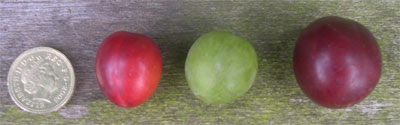
The picture above shows, right to left, a wild (cherry) plum, bullace and a wild damson. The latter will ripen to a dark red/back colour. The bullace is usually much bigger and plumper and is just like a small greengage. Wild plums are not a standard size, this is a large and particularly delicious one from my favourite tree.
Tricks and tips:
When do you know when hedgerow fruit is ready to pick?
This is easy and so heartening. When the fruit is ready to pick you just need to touch the fruit and it will fall into your hand. Picking with the gentlest touch.
You can pick unripe fruit and it will ripen in a bowl at home. I found unripe damsons today and as they are so rare, picked them to ripen on a windowsill. However they are at their best ripened on the tree.
When you (or a smoker you know) decides to kick the habit it makes sense get the best aids to help you succeed. Nobacc gives you two big advantages. It is something to hold and handle instead of a cigarette and the menthol hit kills the pangs. Click here to stop smoking

Comments(50)
Recipe for chicken, mushroom and tomato risotto
Thank you for your comments. And a bit of silly bath time fun with the Frothing Sea Monster trick!
Cutting energy costs
Recipe for sausages baked with herby garlic infused beans, bacon and tomato
Tracing some of my ancestors has taken me on a long journey
Recipe for lamb shanks braised in red wine with shallots: slow cooker/crockpot
I’ve been foraging like mad the last few days, havent found any of the above fruit yet, but have collected blackberries, elderberries and a few secret apple trees in a very overgrown Victorian cemetary. Still on the hunt for sloes and sweet chestnuts. Thanks for the comparison above.
Thanks for the info on the different plums!!! What are the little yellow ones called? I have found a tree I will be visiting next year for sure to get some of these.
I love going out and picking from hedgerows. I am going out today to pick sloes. Might make some sloe jelly, but will definitely make some sloe gin. See my blog for details when done.
I thought you had to wait for sloes? I’ve always waited until after the first frost for sloes…
Our damsons (down in Surrey) are already lovely and dark black – I’ve found a secret stash and am off to get more at the weekend!
Your tricks and tips are a great help.
Sara from farmingfriends
Glad you were able to find something. Last year was excellent for foraging. We haven’t seen nearly as much this year. We’re going for a long walk at the weekend to see if we can discover anything else.
Re: what Richard said about waiting for the frost for sloes. I get over excited and impatient and can’t wait that long.
Glas you were able to escape.
Our ponies have a taste for the sloes in our hedgerows….we will need to go further afield to locate a decent crop (or perhaps I need to look higher up as our Shetlands can only reach the fruit lower than 4 foot).
Yes you are best to wait for frost before gathering sloes.The golden ones are another version of cherry or myrobalan plums.
I don’t know what sloes are like in your respective areas, but where I am they are hanging like grapes this year – I’ve never seen so many.
I think the frost thing is the same as for parsnips – the cold weather turns more of the starch into sugar and improves the flavour, though I’m sure some chemist will come along and prove me wrong…
Thanks for the plum information, very useful. This year the sloes are so early that there’s no chance of waiting for a frost to improve their flavour …
Joanna
joannasfood.blogspot.com
Ah, that sounds lovely. Not here … we get thrilled to pick Saskatoon berries or chokecherries. There are no wild fruits growing … unless I start stealing into gardens late at night!
There is a couple of bullace trees in a hedgerow I know, and there are masses this year. The damsons (quite common around here) are delicious right now and I have to fight the dogs off to get to them before they do! As for the sloes – the bushes are laden with them, as large as grapes and with that beautiful blue bloom.
There is nothing better than chilling and foraging for fruit!
Tonya, I loved reading about your foraging. Secret apple tress in the cemetery… there are probably blackberries too.
I agree with Rosemary, Pat. These are yellow cherry plums. Why not pick them and turn them into something special.
Hello Matron. You can’t beat sloe gin!
Hi Richard,
Lucky you finding a damson tree. I am drinking damson gin whilst I reply to your comment. Pretty good stuff.
Hi Amanda,
I get over enthusiasic about sloes too. So many people are foraging early this year that we have to pick early too.
Hi Sara,
Glad the tips and tricks come in handy.
Absolutely spot on Rosemary. However if we waited until the first frosts we would find nothing on the bushes. We gather and freeze the fruit when it is ripe.
Hi Joanna,
So you have found the same scenario as us. Ripe sloes now and none after the first frosts!
Hi Kate,
If you ever travel to England we’d love to enjoy a glass of fruit gin with you.
Oh Jan,
Where do you live? I need the postcode so I can whistle up and pick like mad. Bullaces are my favourite wild fruit.
hi a friend put me on to this site, I have just moved to leverkusen in germany and whilst out walking the dog on a common there are loads of trees with what look like black wild cherry, how can I double check that these are edible. theres also loads of rose hips and blackburry but I know what to do with those?
Sorry,
I do nt think your illustration is of bullace – Shepherd’s Bullace has white fruit while the Black Bullace is dark purple.
Black Bullace see http://botanical.com/botanical/mgmh/b/bullac86.html
Hi Hogbear,
If I was you I would ask the older people (60 ) on the common at the risk of appearing totally mad. They will know whether the fruit is edible or not. They will have lived through the post war times when everything that was edible was eaten.
My parents were posted to Germany, just after WW2. Most gardens had been dug up and dedicated to growing vegetables and fruit. So older people would know if the cherries are edible. If you are too shy to ask, librarians are generally very approachable. Again, chose an older one at a quiet time of day, well away from the checkout section.
Incidentally, we have great blackberry and rosehip recipes on this site.
Hi Sheena,
We both are right. I have only just discovered there are 2,000 different types of plums. There are several bullaces amongst these 2,000 varieties. They are sometimes black, white or green. I have made bullace vodka with bullaces from Kent (small and black) and also from local bullaces, thee are like the one in the photo, small wild greengages. The latter is the fruit that Richard Maybe describes as bullace, illustration page 41, Collins, Food for Free.
Thanks so much for dropping by and adding useful information to the site.
I went to my usual damson foraging spot in East Kent, last week only to discover that the bushes which last year, were heavy with luscious fruit, were completely bare. There are only ever two fruiting bushes amongst a group of several in this area but none of the others have produced any fruit either. There is no evidence of hedge trimmers or any other damage to the bushes.
Does anyone have any possible explanation for the disappearing damsons? I can’t recall any sharp frosts at all this Spring (remember April?) and some other contributors to this site, seem to have collected a bumper harvest this year.
Looks as if I’ll miss my usual jam and gin !
Hi Sarah,
I can’t offer an explanation but this has happened to me in the past. I have found new places to forage by walking in other areas. We have lots of wild (cherry) plums around here (Suffolk/Cambridgeshire border) but you can only easy see the plums on foot or on a bike.
I noted the spring blossom this year and now have a map of possible hunting grounds within 20 minutes of the cottage.
Hi again
Any tips for identifying whether I’ve picked Mirabelles or bullaces? We have a few trees in our hedgerow here in mid wales. The one’s I’ve picked are definitely green but some of the others I noticed on nearby trees – v high up are definitely more of an apricot yellow colour. I first thought they were mirabelles and feel a bit of a wally as I told the farmer that this morning but looking at your pic above, think they’re bullaces. Any recommendations for good books / sites with pictures to identify?
I spose I can still go ahead with my jam making whichever they are?
Thanks!
Hi Plumsource,
If you can take a photo you can email me through the contact us page. If I can’t identify the fruit there are a lot of regulars on the site who will be able to do this. Mirabelles and bullaces would need different types of treatment if you are going to turn them into preserves.
Mirabelle plums are very tart. The bullaces that we pick around here are closely akin to the greengage so are very sweet.
I have never picked bullaces before but last week I found loads! I tried to make jam but it didn’t set so it’s more of a sauce really. I tried whipping some of my ‘sauce’ together with double cream and natural yoghurt and freezing it. It’s absolutely delicious! Please let me know if any of you decide to try making it, I feel rather proud of my invention!
Hi Helen,
This sounds like a wonderful dessert! Thanks for sharing.
Hi
Just been out foraging for fruit in what can only be described as an orchard of cherry plum trees, yellow red and orange, some had already drooped their fruit while others were still heavily ladened, we filled a bag and 4 2l ice cream containers.. but hers the quandry what do i do with it all?
I usually only pick blackberries and mulberries which i freeze and use throughout the year, how do i store these cherry plums? I have seen some jam making recipies however i will want to go collect more fruit to make the process cost effective. Can i not freeze these plums and add them to the next batch ?
Hi Jem
Yes those are cherry plums. They freeze well – just bung them in a plastic bag or a box.
We have recipes for wild plum jam http://www.cottagesmallholder.com/?p=38
and a lovely plum chutney
http://www.cottagesmallholder.com/?p=70
and also a great fairly tart jelly for lamb or game
http://www.cottagesmallholder.com/?p=19
If you try the jelly you can make wild plum butter with the remains of the fruit.
.
hello there
last year I found a plum tree whilst out foraging for crab apples and this year it is laden with beautiful small yellow plums. Are thee a form of mirabelles? They are bout an inch long and oval in shape, although anearby tree that is not so advanced (fruit still entirely green and hard has more egg shaped fruit).
Whatever they are, I hope no-one else picks them, before they are ready.
I remember eating bottled plums, as a child – does anyone have a good method for this? Also, at what stage should plums be picked for bottling?
Any tips or notions would be appreciated, many thanks.
Hello!
I’ve been trying to identify a tree that I planted in my garden a couple of years ago. My mother found a little seedling growing in her garden, nurtured it in a pot and gave it to me. It was pretty and I thought nothing more about it. It grew like mad and is easily 15 foot high now. This year, I noticed little fruits weighing the branches down that looked delicious. Imagine my utter delight to find that this tiny little seedling has grown into the most gorgeous and fruitful wild plum tree! Your picture above has confirmed it for me. I am going to make plum jam this very afternoon!
Thankyou for helping identify it!
Regarding sloes and not to pick them till first frost pick them now and put in your freezer for 24 hours take them out let thaw bingo they have had the first frost hope this helps
While picking some crab apple apples this week, I came across a tree with fruit that I initially assumed were damsons. However after picking about a pound of them I noticed that a tree the other side of the crab apple tree had smaller (2cm) much more oval fruit which looked much more like the damsons I remembered as a child. I therefore decided the larger (3cm) rounder fruit may be bullaces. An extensive internet search only served to create more confusion over which was which as some sites say bullaces are smaller than damsons. Some sites say that bullaces ripen later than damsons but both of these fruits were fully ripe. I have also read about ‘stone release’ and the smaller fruit’s stones can be removed more easily. As far as taste goes, the flesh is fairly similar plummy sweet/sharpness in both. I fancy the smaller fruit may have a slightly more bitter skin but am not sure if that is just because I am expecting damson skin to be bitter. So I guess the question is do I assume these fruits are essentially one and the same and put them in the same gin pot or do I keep them apart and label one damson gin and the other bullace gin??
Life is too short-I’d just call them the same!The fruits could be smaller just because it’s a tree on drier ground/ that has smaller fruit/that had later flowers….
As most of your readers do I enjoy foraging for wild fruit in the hedgerows.which I have done all my life. I am now a pensioner. Last Sunday my wife and I stopped in a lane to pick damsons growing in the hedgerow from outside the field, I would never go into a field without the owners permission. We were soon accosted by the farmer passing who sceamed that we were stealing as the tree grew on his land, even though he clearly neither picked them or bothered to clear them from the footpath as this was smothed in rotting fruit. Can you tell me do the public have the right to forage the hedgerows or is this apparently very mean-minded farmer right.
Hello Nick
I’ve been searching for an answer but sadly have drawn a blank.
I do know that if my neighbours fruit hangs over into my garden that fruit belongs to my neighbour not me. So probably the fruit belongs to the farmer.
I always forage on footpath and roadside hedges. If a hedge runs along a footpath you have the right to forage for fruit on the footpath side. Foraging on the roadside seems to be a rather misty area. I’d try and find somewhere else to go if I was you.
Hi
Hubby has just brought a pumpkin from the garden,I have never cooked one before,after reading the recipe i’m going to make it now for lunch.
Thankyou
I have today picked 20lbs of the wonderful cherry sizes plums, they have made a wonderful jam, once the pips were strained it ended more like a jelly than a jam. A bit tart but wonderful.
Hi , I have today picked something that looks like the middle picture, some are hard and green, about the colour of a green tomato and the size of a large cherry. Others which are getting ripe because nthey are soft are a tad more golded with a blush. I have looked up Bullace and Mirabelles . Bullace says ripens in October but hw we are In July and this fruit is dropping from the tree and some id definately ripening.Does anyone have any idea what it is. Cutting one open shows me a plum stone not a cherry. Thank you.Oh I am in Canada
Hello, nice to be in cotact again. Was out walking on hills near home and came across great swathes of bilberries ready to be picked. One lady was picking some and told me that she made bilberry wine for her sons wedding last year! Internet says they are insipid and need to be incoporated with a carrier such as apples. Has anyone used this fruit for anything other than wine? Recipes please!
Hi, I stumbled (purely by accident)to your website today and i have to say- what a delight! I’[m also a very keen forager but i tend to only pick things like blackberries and rosehips. However, i have noticed that down at my local park there are a few trees which i’m guessing are plums (although perhaps damsons)! However, they are all different and was wondering if there is anything growing in the UK which could be at all poisonous or should i just go out and pick them as nobody else seems to be! Also, there are many apple trees but i’m not sure if these are edible either. Any helpful hints would be much appreciated! I’m off now to make some of your delicious blackberry and apple jam- i hope it turns out ok! x
Went foraging yesterday and collected some lovely cherry plums along part of the Staffordshire way. Also found some small wild damsons and some small yellow plums. Sloes are not so easy to find at the moment, but I am going to persist. I would like to collest sweet chestnuts but am not sure when they would be ready and can anyone give me a recipe idea for them?
Hi Anjijag
I do have a recipe for sweet chestnuts here http://www.cottagesmallholder.com/sweet-chestnut-jam-recipe-97, they ripen in late Autumn I think.
I have just found this great site, and it has made me feel a whole lot better – to explain, I found a whole area full of lovely looking fruit, the yellow fruit I am quite sure are some sort of plums, but some are smaller and red and some trees have really purple coloured fruit, sort of sloe colour, (I know them, tons about this year). All look like some sort of plums so I have made a mountain of plum jam, so my question is (before I poison everone) are there any poisonous fruits that I could have instead of plums? the stones inside are like plum stones with a ridge and not round like a cherry.
By the way I used my cherry/olive stoner to de stone them, so easy.
Thanks for the great site it has really helped us identify our “plums”!
This year we were bombarded with massive amounts of red yellow and
purple berries from our next door neighbour’s trees. He planted them on
his boundary about forty years ago before our bungalow was built.
The mess they made was quite annoying as they landed on our path and
drive and they had to be brushed up regularly before they trod into the
house.
We never dreamed of eating them but after checking this website we
gather them every day or so and just put them in the microwave with a
cup of sweetner or sugar to taste. Mmmm great with ice-cream!
I suppose we’re stealing them from our neighbour so must take him the
odd dessert bowl full for his tea time treat occasionally! Mind the
stones!
Chris
Last year I moved to a new house, near a farm. Having made friends with the farmer I have picked kilos and kilos of wild cherry plums (of all colours!), more kilos of elderberries and blackberries and am now harvesting hips, haws and what might be sloes but are more likely bullaces. My dog is a great fruit eater and strips hawthorn berries and sloes (as well as the gooseberries and plums in my garden) from the trees. I have made about 200 jars of jam now which is all sold to raise money for a local charity. Great fun making them all and tasting the products! Fortunately I used to spend summer holidays with my grandmother in the country and she taught me how to recognize the wild food. I’m amazed how much just goes to waste ‘cos people can’t be bothered or don’t know what can be eaten!
I would like to know how to prun and get bigger cherry plums of my tree. It has several branches that the children have played on and now wont grow. Desperate please help
Hi Anna
You need a tree specialist to help you with the pruning.
The size of cherry plums will always be small.
I have spotted a plum tree on some waste land near me. I’ll be going and checking how the fruit is doing again soon – but want to know how to id what type it is.
Have just picked a small bag of what I have identified now as wild plums from a tree overhanging from a garden round the corner. Only went back to pick them – there are masses on the pavement and street – when I saw someone else picking and eating them. I hate waste so I feel very justified in making use of them rather than them rotting on the pavement.
Finally decided to try and find out what the tree in our garden is. Was thought to be ornamental cherry or similar, but thanks to this article, I see it’s a cherry plum. In fact on further research, it’s a purple cherry plum. I had planned on foraging for sloes locally and freezing them, but now I can start on the garden plums first. Result! Thanks Fiona
)
All this talk of wild fruit…. makes me wonder what the advantage is over the culitvated sort (except price?)?
or to put it another way… are bullace actually better than victoria plums? or cherry plums better than greengrocer damsons?
The reason is that I have both easily pickable up here in sunny yorkshire, and quite frankly the cultivated varieties are better and have a better flavour!
[...] the different kinds of plums, damsons and bullaces that are around in our orchards and hedgrows. http://www.cottagesmallholder.com/foraging-for-hedgerow-fruit-how-to-identify-wild-cherry-plums-bull... Advertisement LD_AddCustomAttr("AdOpt", "0"); LD_AddCustomAttr("Origin", "other"); [...]
Hi can you help me identify this fruit, I thought it was a type if crabapple but when I cut it in half across the middle the core was divided into four, I thought that apples only divided into a five segment core.
The lead looks very much like an apple or plum leaf and the fruit grows in large clusters of perhaps 15 to 20 fruits.
I have permission to pick them but obviously I need to know they are edible.
I will try to attach a photo to help.
Thanks in anticipation. :0)
Just been to collect some feral cherry plums. I usually go on Boxing Day, but they seem to be ripening earlier this year. Not quite ripe enough yet, but will try again in a week.