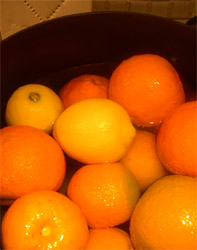
Perfect Seville orange marmalade recipe
As the topping for the best slice of toast of the day, good marmalade is a joy. We like it dark, chunky, hand cut and never in moderation.
Marmalade was the first preserve that we made. We were so proud of it that we could hardly bear to move it from the worktop to the larder, let alone eat it. Eventually we opened the first jar and lavished it on slice after slice of hot buttered toast.
We immediately christened it Intellectual Marmalade as so much ground work, research and care had gone into its manufacture. Visitors who spotted the label were wary of it at breakfast. Would it somehow have an effect on the brain? When they saw us slopping it onto our toast they happily did the same. No one ever mentioned the name.
We like dark old fashioned marmalade. We couldn’t find a recipe for this so we based our recipe on the classic Seville Orange Marmalade in Delia’s Complete Illustrated Cookery Course. We ignored the rolling boil stage and then let it simmer slowly for hours to achieve the dark colour and depth of taste. We tested it for set every twenty minutes. It nearly killed me (I was up for most of the night). Simmering for hours was a key tip from my mother whose marmalade is excellent (I suspect that her inspiration is Mrs Beeton, with knobs on). She wasn’t forthcoming when we dared to ask for the recipe. Update: my mother uses a Pru Leith recipe and adds a couple of tablespoonfuls of molasses to get the dark colour. We recommend the Delia recipe – but simmered very gently for a good six hours to achieve the dark colour and depth of taste naturally. However, I would recommend tasting it every hour or so. When you get the flavour that suits your palate bring the marmalade to a rolling boil immediately and test every 15 minutes for set.
Marmalade can be a bit of a palaver. It starts with hunting down and bagging the fruit. Despite many forays I couldn’t find any Seville oranges this year. Just as I was about to give up I saw them twinkling out in the Cambridge market on Monday. Investing my small change in three kilos of the fruit, I staggered back to the car park with just enough cash to release Jalopy from the gloomy depths.
Having made no notes on the timings of our Intellectual Marmalade recipe, I couldn’t face another day/night of babysitting the bubbling vats. I was determined to find the best old fashioned marmalade recipe, with proper timings. A couple of days ago I discovered a Dark Chunky Marmalade recipe on Delia Online. It’s made in two steps, so it’s great if you are working full time as you can spread the process over two evenings (I would recommend a spreading the task over a weekend unless your evening starts at 15.00 hours). Seville oranges will survive happily in the fridge for at least a week. They keep for months in the freezer and, if you have the room, you can stash them and make fresh marmalade throughout the year.
We have finally made Delia’s Dark Chunky Marmalade. We combined her recipe with our method and simmered ours for a good six hours before setting point was reached. It looks divine and tastes even better than my mum’s. I’m amazed that Paddington Bear hasn’t dropped by.
N.B. If you try this recipe, the poaching liquid is used in the final marmalade. The recipe isn’t very clear on this point and I found the answer in the DeliaOnline forum (press the Community button on her site to access this great resource). Also you need a very large pot! To stop all the peel rising to the top of the jars let the marmalade cool a little before bottling in sterlised jars.
Cottage Smallholder highly recommends Faraway Furniture to supply your garden (and indoor) teak furniture. Check out their web site for a lovely product range, fantastic 10-year guarantee and kosher Green policies about sustainable teak harvesting. Click here for Garden Furniture

Comments(236)
Harvesting bags
R.I.P. Alfonso and Massimo. Could you eat your own chickens?
Belly of Pork with Morello cherries recipe
Dead fish stink
Biodynamic gardening update: July 2010
A grand day out
I’ll have to return to read more on your interesting web page but I have to go now to make my marmalade. Found my mislaid recipé.
webcrone@cybersquibbs.com
This has turned out a real disappointment for me: Delia’s recipe requires that impossible business of squeezing pulp through muslin, and I can’t do it. I’m 64, I have arthritis in my hands and I just CAN’T DO IT. Why doesn’t anyone make marmalade that adds pectin if necessary but doesn’t require the cook to do that painful task?!
Hi Margaret-Rose,
If you tie the corners of the muslin and insert the handle of a wooden spoon, and turn it gently, there is no need to squeeze.
I do hope that this helps.
Marmalade is my favourite preserve! The Sevilles are not in stock as I write, not long to go now though! To keep my ‘hand in’ I did a refresher course of marmalade making today using four fruits – 2 red grapefruits, a big orange, a lemon and 2 limes. 3lbs of fruit in all.
I squeezed and chopped it all up yesterday, putting it (and the pith and pips and bits tied up in a muslin bag) into the pan with 3 pints of cold water to sit overnight. The juice from squeezing the fruit went in the fridge.
I simmered it this morning until the rind was soft, it took about 2 hours and the limes took the longest (I put the lid on half way through, I don’t simmer it in my maslin pan as too much water evaporates and my roll of tinfoil isn’t wide enough to make a temporary lid). Then I squeezed the muslin bag of bits (using your tip above Fi, thank you!) and added the juice from the fruit, plus 3lbs granulated sugar, heating slowly until it was all disolved (in the jam pan now).
I brought it to the boil and checked for setting point after 30 mins, it was almost there. 10 minutes later it was in the jars with a sample bit left over – we tested it at lunchtime and declared it a winner! Really rich, orangey and tangy. The nicest marmalade I have made since the Seville last year! I love Delia’s method too, it works very well.
I know what you mean Fi, whether it is your first batch (or 21st batch) of marmalade, you have to keep a jar on the table to look at, it’s a work of art!!
Hi Mildred
A huge thank you for sharing this marmalade recipe!
It’s great to have a good one to make when Seville oranges are not in season.
My husband turned up from our local market yesterday with a huge amount of seville oranges pounds and pounds of them, and announced as I liked jam making I could give marmalade ago. I have never made marmalade before, until yesterday, put in jars this morning and it was great it worked, I now am looking for wonderful additions to my marmalade, like whisky, ginger, etc any ideas would really be welcomed, as I have another 15lbs to get through. Kate
Hi Kate,
I’m sorry but I can’t help you as I’ve only made traditional marmalade. It might be worth looking at the marmalade recipes on Delia’s site as she has a few.
Seville oranges freeze well if you run out of puff!
Kate, I did some with whisky, I just added a couple of teaspoons to the clean jar before adding the hot marmalade (I think Delia recommends that method). It worked very nicely! I expect rum or brandy wold be nice too.
Waitrose now have their Seville oranges in stock, guess what we will be making this weekend
oops, I posted my comment above using hubby’s name! Sorry Ian.
And I meant to add thank you Fi for reminding us that we can freeze the oranges.
Hi Mildred
Thanks for the tips on boozy marmalade! I’m going to freeze some Seville oranges as they are great for making liqueurs as well as marmalade.
Nigella also has a really easy one in How to eat. Oranges and water, poach, remove fruit and chop up, return to liquid add sugar (from memory). Bingo!
Hello Alison
Thanks for the tip!
Do you all know about the Marmalade Festival, held in Cumbria ? There’s an article about it in teh Telegraph at http://www.telegraph.co.uk/arts/main.jhtml;jsessionid=V4YYHY5BTCTMRQFIQMFSFF4AVCBQ0IV0?xml=/arts/2008/01/05/sm_marmalade105.xml, a website about it at http://www.marmaladefestival.com/ and info about the charity which benefits from this event at http://www.hospiceathome.co.uk/
The marmalade festival looks good fun, and for a good cause too.
I just came across a lady (on a forum elsewhere) who makes 110lbs of Seville Marmalade every year, just for her and her hubby!
I don’t feel quite so guilty now . . . I made 10lbs of Seville marmalade yesterday and I’ll probably make another couple of batches during the week. 30lbs somehow doesn’t sound anywhere near enough!
Hi aiiiiCaramba
Thanks for this information and links. I didn’t know that there is a Marmalade Festival in Cumbria.
Hi Mildred
Wow that lady must be a marmalade enthusiast or her fingers slipped on the keys!
I make marmalade every other year as our recipe matures well, unlike most other recipes. I’m going to make some Seville Orange gin though so as to keep some coming up through the ranks. It takes 2-3 years to mature!
When I made my marmalade today I used the Delia method, simmering (well, poaching really) the fruit whole and then slicing it up etc.
The other day, I sliced it all up first and then simmered it.
I like the results from both methods.
Does anyone have a preference I wonder and are there any advantages cooking it before slicing?
Hi Mildred
I was told that it much easier to slice them when they are cooked.
If you can’t be bothered with all the chopping and slicing then you can mince the skins or put them through a food processor slicer. It can make the marmalade a bit cloudy but save a lot of energy. I have a handy old fashioned gadget that is part of my mincer which slices it perfectly (and is also good for slicing large quantities of carrots and potatoes too …).
Also you can speed the sugar melting up by putting it in the bottom of a low oven in a shallow dish or in the microwave for a minute or so
Hi Kate
Thanks do much for leaving these tips. Both very handy.
That mincer attachment sounds great.
Great tips for marmalade. Thank you. I have added Curacao and Quantro liqueur to my marmalade and just a hint of powdered cloves and it was wonderful.
Hi Iona
Thanks for leaving a comment.
Brilliant tips. The liqueurs would add a great twist and the cloves!
Hope anyone can join in….!
I have just made a James Martin recipe where you magimix the pips and flesh then put through a sieve instead of the usual muslin etc. It is really very good and easy. Does anyone know of any other recipes like this? I have never seen it before. The marmalade is very delicately flavoured but great.
Thanks.
Hi Rachel
Of course you can join in. Thanks for your input. I haven’t heard of this method but have only got my Magimix relatively recently so would have flipped over ‘Magimix’ related recipes.
Thanks for leaving a comment.
There was a feature on today’s ‘Woman’s Hour’, on Radio 4, about Seville Orange Marmalade. There are 2 recipes on their website here:
http://www.bbc.co.uk/radio4/womanshour/03/2008_04_thu.shtml
The first recipe simply adds the finely cut peel just for the boiling with sugar part . . . do you think it would soften sufficiently? I usually simmer my fruit for 2 hours, and lemon peel takes even longer than that sometimes! Maybe it is ok if you cut it very, very finely . . . it is a lot of work (and expense) though if it doesn’t work!
I agree you would probably have to cut it very finely indeed. I’ve just picked a load of tiny oranges from my ornamental orange tree and I think I shall see what I can do with them- they are large marble sized so I think I’ll try marmelading them just cut in half,with the left-over clementines from christmas ,should make a couple of jars worth- I like the idea of adding some cloves too.
Hi Kate, how exciting using your own mini oranges!
Cardamom is nice in marmalade too…
I bought two 13 kilo boxes of seville oranges and two boxes of lemons from my local fruit and veg supplier in Edinburgh called Total Produce. Plus 72 kilos of sugar!! Collect the jars from friends and get down to mass production! Remembering to give them marmalade/chutney etc as a bribe!
Place the quantity for each batch (3lbs oranges three lemons)into separate plastic bags, ready for your production line. Put two batches in the oven at Gas 3 for 30mins. Then cut in half in a bowl keeping juice as it dribbles out. Squeeze juice using Braun squeezer. Having been in the oven the pith comes off easily. Using 4 orange peels at a time cut them in four. Liquidize with a total of one and a half pints of water. Put the pips and gunge that remains into a jiffy bag! Tie tightly! Now put the liquidized peel, juice and bag of pips into a pressure cooker and cook! Length of time? Use you nouse! Now you have reduced all that boring waiting to soften the peel! Put 4 kilo bags of sugar in the oven for 30 mins at Gas 3! Add sugar and allow to dissolve slowly then bring to the boil and continue as per normal recipe for marmalade.
Believe you me you won’t waste your time!
Provided you keep the production line moving,have the energy and all the jars ready to go you can make approx 8 batches a day. Lunch will be a standup affair!
Keep at it!
Jane Butters
Remember each batch uses 3 lbs of oranges.
Hi Mildred
Thanks for the link to the recipes! I reckon that they need to be chopped very fine to work.
Hi Kate
I agree with Mildred, you are so lucky to have your own tiny oranges. They’ll look so pretty halved in the jar.
Hi Clare
Cardamom, nice twist.
Hi Jane,
Wow that’s a wonderful recipe for marmalade and a great method for producing large quantities. Thanks for dropping by to leave a comment.
do you have to do anything special to the oranges to freeze them or just lob them in whole??
Hi Jane
Just put them in freezer bags and pop them in the freezer.
thank you! Does freezing them effect the setting of the marmalade that you make with the frozen oranges? Sorry to be stupid but until reading this forum I didn’t realise that it was possible to freeze oranges!
Hi Jane
Freezing them makes no difference to the setting time. They are soft when unfrozen, and easier to cut up.
Hi.Many thanks…will give it a try
Hi Jane
I do hope that it works out well for you. There’s nothing like homemade marmalade.
Do you mind a query from a novice? I’m recently retired, and having made wonderful orange wine many years ago with Seville oranges, I decided this year to try marmalade. My first recipe was from Videojug, and I ended up with beautifully coloured and tasting marmalade, but it didn’t behave like marmalade – it was runny and obviously hadn’t set properly. My next two attempts were from Delia’s ‘Complete Cookery Course’, but the outcome was the same. My fourth (and final, according to my wife) attempt today used Diana Henry’s recipe from Market Kitchen last week, in which she mentioned the setting point is at 106 degrees. I used a meat thermometer in the absence of a sugar thermometer, but couldn’t get a higher temp than 100 degrees. The final result is as the previous three. I guess I’m not getting that setting point, despite following the recipes to the letter. How can this be? Any suggestions will be gratefully received. Also, any ideas what I can do with 26 jars of runny, but beautiful, marmalade?
Hi Willie M, it is so annoying when marmalade doesn’t set! There are lots of tips I, and I am sure others, can offer you, and we probably all swear our own personal method is the best.
I always add a couple of lemons. If, after the first attempt it doesn’t set fully, when I make another batch I use the special sugar with pectin added! I can’t face all that cutting of the peel only to have a less than perfect product!
Here is how I do it:
I start the night before so I can sit and relax while I prepare everything.
Take 3lbs of seville oranges and 2 big lemons.
Cut the fruit in half and squeeze the juice and bits out – pour the resulting liquid through a sieve and place the juice in the fridge.
Put the pips and bits in a square of muslin ready to tie up later.
Cut the orange and lemon peel very finely and leave overnight in 5 pints of cold water. Put any bits in the muslin bag and then tie it up.
The next morning simmer the peel very slowly in a lidded pan with the muslin bag of pips in.
Check it is very soft after 2 hours.
The contents of the pan will be reduced by about half at the most.
Cool slightly and then squeeze every bit of ‘gunk’ out of the muslin bag into the pan.
Add the juice saved in the fridge and also 6lbs of sugar. Stir gently and allow the sugar to dissolve.
Place back on the heat and bring it up to a rolling boil. Don’t overstir it from this stage.
From when it starts to boil I set the timer for 15 to 20 minutes. When the time is up I perform a ’setting test’.
The temp will be 104c and when I hold the wooden spoon over the pan it will definately look like a jelly drip on the edge of the spoon.
If it doesn’t set the timer for another 5 minutes, boil until then and check again.
And a third time of necessary.
I always think it changes how it boils when it reaches the perfect setting point.
Remove from the heat and allow to cool for 10 mins before pouring into sterilised jars.
Store for 2 weeks before using.
As I said before, that is just my method . . . I am not familiar with the recipes you mentioned. I have tried a few different ways though and this is the one I prefer.
I also think you have to go into the job with a really confident attitude! Don’t let the little orange fruits beat you!! Good luck.
Just re reading your comment Willie M I would also suggest buying a jam thermometer so you can be sure to reach 104c. If you are certain your meat thermo is spot on then can you turn your cooker up hotter? It really won’t set unless it reaches that magical 104c.
As for the jars of un set marmalade . . . I honestly feel it is a waste of time trying anything; it is so frustrating if you try to remedy a poor batch, and then it doesn’t work (I am talking from experience here and I am afraid I have little patience!). Once you get a batch that HAS set you will soon forget the rest! This is of course only my opinion!
Thank you, Mildred. I do appreciate your advice – and the time you must have taken to write what you have. I’m keen to get it right, and I shall heed your advice, but I don’t think, after four attempts, this is the moment. (I now have a wife who is taking notes about my strange marmalade-making behaviour and I can see it being used against me when I start doing other ’strange’ things.)
Tomorrow is market day, and if there are still Seville oranges to be had, I shall buy some more, hide them in the freezer, and bring them out when she visits daughter for a few days. I am determined to get it right, and with your help, I must be a lot closer. I never knew marmalade-making would be so exciting.
By the way, one of the arguments I have used to support my perseverance is this. I grew up near Paisley, Scotland, the home of Robertson’s Golly Marmalade. I have told my wife often in the past weeks that if Mrs Robertson had given up after her first few attempts in the wash-house copper in her backyard, we would never have had her world-famous marmalade, and phrases like ‘Golden Shred’ and Silver Shred’ would be totally unknown.
And finally, last week at the market, I was telling my veg lady my troubles and asking what I could do with all these jars of runny marmalade, and she advised using it in bread and butter puddings – and it works a treat.
Hi Willie M,
Luckily Mildred had pipped me to the post. She has the expertise that I long for.
Just wanted to say. If you do the setting test on a deeply chilled plate results should be clear within seconds. If you use the sugar with added pectin-it works fast but it also adds an ‘artificial’ flavour to your preserves, in my opionion. I just sent round a wheelbarrow load to a neighbour as I didn’t want to use it again but also didn’t want to throw it away.
Great idea using the runny marmalade in bread and butter pud!
Hi Mildred,
A huge thank you for your input! Once again you saved the day, thanks and your recipe looks great too.
Hello Willie M, I still have my Golly broach – he is pinned on the front of my dresser and must be almost 30 or 40 years old!
I agree with you and Fi, marmalade B&B pud is lovely, and it is nice in a steamed sponge pud too (!).
And Fi, you are exactly right re the setting test on a cold plate. After a minute, when the little drop of marmalade is cold, and you push it with a finger it crinkles on top and feels set!
I was also thinking about how I would advise someone who hasn’t even made marmalade how to proceed . . . . I would say go get 2 pink grapefruits, a lemon and an orange – all medium sized. Follow my processing details as before but using 2.2pints of water and then 2.2lbs of granulated sugar. This quantity is more managable, the pan can often be heated better on the hob compared to a huge maslin pan, and the chopping up stage isn’t such a drag! Funnily enough, this is also my favourite marmalade!
Hi Mildred
We used to collect the golly badges when we were children too. I don’t know what happened to them all as I haven’t seen them for years. They are quite collectible nowadays, I expect.
You are spot on with quantities. Smaller to begin with is so much easier than sweating over a vast vat and not feeling confident about what you are doing. The process should be fun!
I have just finished my first marmalade attempt.
I have 6 one pound jars of very heavy, far too rich marmalade.
I cannot handle the metric scale, and all the recipes are metric. I must have got my conversion calculations wrong.
I sliced evry single one of the Seville oranges very finely. Is this correct, or should I have cut just half or threequarters of them? It took hours!
I have read every one of the comments and pieces of advice on this web page, – all good stuff.
I would appreciate some advice too. Can I use my stock of far too rich marmalade in some way. I don,t want to throw it out. Can I rectify it and reduce the richness?
I would appreciate some help.
Hi James, how very frustrating for you. I know from experience how it feels after all that careful chopping and cooking – you would expect it to behave just as the recipe suggests!
First of all, you can use your marmalade up in puddings – steamed sponge and bread and butter are always a popular treat! Also it is nice with a banana baked in the oven – just put a tablespoon on a sliced in half banana, add a dot or two of butter and pop in the oven for 15 minutes – check it and turn the bananas in the syrup as it becomes more liquid. I am sure there are good savoury recipes too, I wonder if it would work with duck for example.
The only real solution is to simply get back in the pan and make some more! Try a small quantity (see my suggestion on the previous comment, above Fi, using grapefruit etc). Read the recipe thoroughly (you will see more advice in another post earlier still) to ensure you understand exactly what is involved and what stages to expect the marmalade making process to pass through – it really is a bit like Chemistry. Once you know how it should work it seems much easier . . . . to give you additional confidence, use half sugar with pectin added to ensure a nice set.
We have all had our preserving disasters – I still have some Damson Cheese stuck solid in a jar to remind me that fruit and sugar can sometimes make a superb art noveau paperweight.
Hi James
I agree with Mildred. You can’t remake your spoilt marmalade. But you can use it for other things. The juice is great as a sauce for roast pork, for instance.
As we make our marmalade very slowly it is much easier to preempt disasters. But the result is a strong dark marmalade that doesn’t suit all tastes.
Hi Mildred
Thanks for your help!
Love the idea of the damson cheese paperweight…
Hi Mildred – Thanks for the advice, which I will certainly follow.
Just the one question, Do you slice all the oranges, or just half or threequarters of them.
Jim
Hi Jim, I slice them all up BUT I tend to chop the ends off and any marked bits and pop them in the muslin bag (cut up small) that way all the pith can help with the pectin level (I sometimes use 2 muslin bags if there’s a lot). When you cut the fruits in half and ‘reamer’ them to remove the juice, a lot of the pith a bits comes out then too which goes in the muslin bag (see all the details above anyway, in 2 or 3 different comments!). Also, when it is a nice small quantity I take my time to cut the peel up very thin. Finally, DO ensure you really squidge the muslin bag hard (after that first simmering) to remove every bit of gunge – you will notice it is thick and jelly like, this is the pectin. And lastly (!) when you add the sugar and it has disolved and you bring it up to the boil, don’t stir it too much, just once or twice (gently) to check it isn’t sticking on the bottom of the pan.
It is funny, when you make jams etc regularly, you take it for granted really. Now I am writing it down I keep remembering lots of little things I do by instinct. Good luck!!
I have a really easy microwave marmalade recipe.Half and squeeze juice of two lemons into a large bowl.Remove outer rind not pith of 2lb. of oranges, shred and reserve. In a food processor chop oranges including the pips. Add mixture to lemon juice with one and a half pints boiling water. Cover and cook for 14 mins. at power level 7. Tip into sieve and press out all juice using wooden spoon.Discard contents of sieve.Add orange rind to juice and cook for 13-15 mins. stirring occasionally until rind is tender. Add 2lbs sugar and stir until dissolved. Cook uncovered for about 10 mins. stirring once or twice until setting point is reached. Stir in knob of butter then remove any scum. Allow marmalade to cool for about 15 mins. then pot and cover. This is the easiest recipe I have ever used.
Mildred – Thanks again for your help. I am going to have a second shot at it!
I found a Whisky Marmalade Bread and Butter pudding recipe in a Daily Telegraph magazine today, and as had no whisky, I substituted Rum. The result was superb. Thank you for the recipe!
Jim
Hazel – Thanks for the microwave recipe. I didn’t think it would be possible to do that, and I must to try it.
Jim
Hi Mildred
A huge thank you for all your help!
Hi Hazel
Thank you so much for sharing this recipe. Very handy for busy people.
Hi Jim
I’d love to hear how your marmalade turns out!
Everybody seems to be able to make proper marmalade except me! I’d never have thought of using the microwave, although somebody I spoke to the other day told me I could use the bread-making machine – was she serious? Anyway, well done everybody, and I’ll keep trying.
Found another use for my runny marmalade – ‘Seville Souffle’. I made an ordinary souffle, with the addition of some grated orange zest, and put the souffle mixture into ramekins with a couple of spoonfuls of my patented runny marmalade in the bottom. The result? Marvellous – we’ll be doing this again.
Hi Willie M
Don’t give up!
Either making marmalade or experimenting with your runny batch. Thanks for sharing the soufflé recipe, sounds delicious.
Mine has come out runny, I guess not enough pectin as I did use a thermometer and got it to the right temperature. What would happen if put it all back and boiled it up again with more lemon juice? Is there any chance it would set?
Hi Fionah, I once put my runny marmalade back in the pan with the juice of a big lemon (to about 3lbs marm) and it worked! I brought it up to the boil and kept it at that magical 104/105c for about 15 mins. Worth a try!
Hi – what a great site! I came here inadvertantly, trying to find some clue as to why my lovely new batch of lemon marmalade has gone cloudy. I made a batch from a new recipe last week and it tasted as though I had sligthly overcooked it – dark in colour, slightly toasty in flavour. My guests have unanimously agreed it was the best marmalade they have ever tasted – it was fabulous! Then, a few days later it looks slightly cloudy and sort of “candied” on the top. I dish out my jams into crystal dishes at breakfast time – perhaps there has been too much air exposure? Light? Any clues? It is also in a very large wide jar with screw top lid, which is what made me think of the air thing.
I have a very prolific lemon tree so can easily make more but I don’t want to waste too many batches.
Thanks for any advice and keep up the good work!
Sonia
Matildas of Ranelagh
Heritage Accommodation
Huon Valley, Tasmania
Hi Fionah
I think that Mildred has answered your question already. I hope that you managed to fix your runny batch.
Hi Mildred
Thanks as always for your help.
Hi Sonia
I don’t know why this is happening to your marmalade. I only make one type of marmalade (Delia’s recipe with tweaks) and it always works well for me.
Perhaps someone else knows?
I’m rapidly coming to the conclusion that there is more to this marmalade-making than meets the eye. The more I learn, the more it seems I still have to learn. For example, in your reply, Mildred, to Fionah, you said that you brought your batch up to temperature, 104/5c, for about 15 minutes. When you bring it up to temperature, do you have to maintain it at that temperature for about 15 minutes? If that’s the case, I think I’ve been taking it off the heat too soon – as soon as it reaches temperature.
Hi Willie
Yes, you have to keep the marmalade simmering at 104/5c for fifteen minutes. That’s where you have been going wrong, I think.
Hi Everyone,
First I do have to say I admide all of you for trying to do marmalade, I haven’t got past blackberry jam yet!
For the folks that have the marmalade that didn’t come out quite right, I have another sugestion for using it up.
I glaze ham with marmalade and a little chili powder, or cayanne powder. I apply it in the last half hour and it turns out wonderful. The thin ones you could thicken up with a little corn starch and the thick ones could be thinned with a little juice and then baste on.
Just a thought…
Hi Fi and Willie, I describe it as ‘a rolling boil’, which is 104/5c.
Great ideas for using up the marmalade, thanks Michelle, we are doing a ham tomorrow so I can use your suggestion!
Hi Michelle
Thank you for a brilliant suggestion for glazing ham.
Hi Mildred,
Yes, of course this is a rolling boil! Thanks so much for sharing.
I’m sorry to come back to you yet again, but I’m confused again. Is this correct? I should bring the marmalade up to 104/5 degrees, and then maintain that temperature for 15 minutes – and that’s the process which is known as a ‘rolling boil’? Does that mean that it’s more of a ’simmer’ since we don’t want the temperature to go higher than 104/5? And am I right in thinking that a good set will be achieved at the end of that 15 minutes?
Yes Willie, I myself would call 104/5 a Rolling Boil . . . you would have a job to make it go higher! Watch it in the pan as the 15 minutes passes, don’t stir, and you will see it changes. It is hard to describe and it took me a few times to gather what was meant by this. Slide it off the heat and perform a setting test – a cold saucer (I actually get a jar of jam out of the fridge and use the cold base!). Use a desert spoon and carefully spoon some boiling marm out and drop some onto the cold surface. While it cools, a minute or so, I like to examine the spoon, turning it over to see how set it looks on it, and allowing a drip to gather at the edge, you can look at how it gathers a drips off, if it IS going to set it ‘hangs’ on the edge. After examining the spoon go back to your saucer test, push the marm with your little finger, if it IS going to set it will crinkle slightly and it holds the path your finger makes through it . . . and if it is NOT going to set it will remain runny
If it doesn’t appear to look like it will set pop it back on the heat and bring up to that rolling boil, then set the timer for 5 minutes, then test again. Sometimes you have to do this 3 or even 4 times.
I wish I could nip round and show you! And keep asking questions if you are not sure! Good luck!!
I meant to also say (!) we opened a new jar of ‘3 Fruits’ for breakfast – it is still my fvaourite marms AND one of the easiest to make (well, I think so . . . ).
I mentioned it in an earlier comment(Feb 5th): 2 pink grapefruits, a lemon and an orange – all medium sized. Made with 2.2pints of water and 2.2lbs of granulated sugar. My method, the one I usually use, is also above (Jan 3rd). Those quantities are manageable, and I can say in all honesty that it has always set
Mildred, you’re marvellous. Thank you very much. I’m keen to have a go at your grapefruit marmalade, but I have been forbidden to do any more marmalade until we have emptied some of the two dozen jars of ‘Orange Dipping Sauce’ that I’ve already made. So, I’m eating it all the time – I think there was one meal last week where we didn’t have marmalade with something. However, following your last response, I have received a dispensation to go ahead with your recipe at the weekend.
I have a batch of Seville oranges in the deep freeze, but I’ll keep them to the summer. I’ll try your two grapefruit, orange and lemon. However, one, hopefully final, question. I used preserving sugar with my last batch and it was marginally better than when using ordinary granulated sugar, but the outcome might have had nothing to do with the sugar. What type of sugar do you recommend?
So, once more, into the breach. Have (new) sugar thermometer – will succeed – this time.
Many thanks again, Mildred – and thanks to you, Fiona, for making all this possible.
Hello Willie, good idea to save the Sevilles – something to look forward to
I had discussions with my friend Sylvia about using different types of sugar last ’season, and followed her recommendation to use Cane Sugar. Until then I’d simply used Granulated Sugar, not checking whether it was cane or beet sugar, or even fully appreciating the difference. Now after many and varied batches(producing various jams, jellies and Marmalades) I would tend to agree with Sylvia, Cane sugar does seem to give better results! BUT, it really is okay to use whatever you have – Caster, Granulated etc! (I seem to think that Tate & Lyle is the only company that produce cane sugar, although I may be wrong. It could simply be that our local our shops are a bit ‘lacking’!).
Another tip to give you a little extra confidence and assist in achieving a good set – use half ’sugar with added Pectin’ and half granulated – still following the instructions above – not necessariy those on the bag of sugar! It is the pectin in the fruit that results in a good set, so sugar with extra pectin really can help.
Marmalade making is a bit like bread making and much else in life, once you become comfortable with the process and have achieved a measure of consistent success, you can do it with your eyes closed (but I wouldn’t recommend it!)
I made a batch of marmalade and it didn’t set so I boiled it again with 2 lemons and although it’s better its runnier than shop marmalade-should that be?
Hi Willie M
Fingers crossed that your marmalade works this time!
Hi Mildred
Thanks again for all your help.
Hi Linda
The longer that you boil the marmalade, the thicker it will be as the boiling process gradually removes the water.
There’s a jolly little marmalade experience, written by Tim Hayword, in today’s Guardian G2 section. Everyone is Marmalade-ing now!
I live in California, and have made mixed citrus and kumquat marmalade, but this is the first time I have seen (in this land of citrus!) Seville oranges in the store, so I bought some and found your fascinating comments when googling for a recipe. You don’t seem to have much discussion about quantities — the recipes I found elsewhere seem to use more sugar than other marmalades — do the proportions of about twice as much sugar as peel (in water to cover) juice sound about right? Do you have to add lemon to get it to gel adequately — I am afraid I am not a purist; I add pectin to my kumquat marmalade, though not to the mixed citrus.
Hi Mildred
Thanks for this tip.
Hi Alison
If you follow the link in the post above to Delia’s recipe she gives a good balance of sugar to fruit. There are also lots of recipes included in the comments section of this post.
I am not a experienced enough marmalade maker to give you the balance of quantities myself!
Hi Mildred
I did tip the marmalade back with the juice of another lemon, and gave it another 15 minutes as you suggested. It worked a treat and I now have 6 jars of proper marmalade. thanks!
Oh Fionah, I am so glad it worked – well worth the effort
Thanks for letting us know!
Hi Fiona and Mildred. Like Fionah I too have had success at last – and I can empathise with Fionah’s excitement and sense of achievement. I used Mildred’s Jan 4th recipe and was grateful for Fiona’s tip from last July about squeezing the muslin bag. I must say I didn’t find my new thermometer very helpful – it confirmed that I was as hot as I was going to get, and that was that. Any offers for a ‘used-only-once’ sugar thermometer? However, it did take 40 minutes to get to the ’stiffening’ stage. I was beginning to get worried. Any ideas why it would have taken so long? Anyway, the result is a beautifully tasting and perfectly set marmalade, different from the Seville orange taste – a bit sharper, but really gorgeous.
I believe that experience can be one of our wisest teachers, so I want to learn from my five attempts if I possibly can. Are there elements in the different recipes and ways of doing things that are purely subjective, for example, based on no more than the personal preference of the marmalade-maker, or are there some commonsensical things that we should always adhere to? For example, I would welcome comments on the following:
My first recipe from Videojug (an internet recipe site) had me cutting the rind and pith off the oranges before they were squeezed. Rind and pith were cut as usual, juice went into the water, and flesh and pips went into the muslin bag. This was a straightforward preparation. Yet, my fourth recipe, from Diana Henry in Market Kitchen (a uktvfood programme), had me halving the oranges and lemon, squeezing out the juice, putting the pips only into the muslin bag, and cutting all the skin, with attached pith and flesh and putting it all into the water with the juice. I must say, Diana Henry’s recipe was easier to do and suprisingly gave as clear a marmalade as any of the other recipes I used, despite puttin all the pith and squeezed flesh into the water.
Your recipe, Mildred, and Delia’s seem to me to be somewhere in between, cutting up the rind and pith, and putting all the flesh and pips in the muslin bag.
And then, into the marmalade melting-pot yesterday fell Tim Hayward’s article in the Guardian. He poached the oranges whole for 30 minutes and allowed to cool, but he didn’t add the cut-up rind until the sugar stage – would the rind be soft enough after only half-an-hour poaching?
And finally, why in your recipe, Mildred, do you hold back the fruit juice until the sugar stage? (I was surprised that I got a full pint of juice in your recipe.) Other recipes would have me add the juice to the water at the beginning.
I’d be interested in folk’s observations about the different recipes and ways of doing things.
What an odyssey this has been. And the really helpful and pleasant company I’ve had during my odyssey has made all the difference. When my grandchildren ask me what was the most exciting thing I did in my retirement, I shall tell them it was learning to make proper marmalade with the experts. Many thanks to you all.
Now, roll on the summer when I can get to those Seville oranges in the freezer.
Congratulations Willie, I am as excited about your marmalade as you are!
I can answer some of your queries, and maybe Fi or another contributor will be able to offer some input as well.
Firstly, The G2 article yesterday: I agree with you, how can the peel be cooked in half an hour? I have cooked the fruit whole several times to see what I thought, but I still prefer to slice it first as related in my method above, and it has always needed 2 hours of gentle simmering. Again, it just shows how confusing it can be when information such as this is given. Maybe there is a valid answer . . .
Next, the fruit juice: yes! I add it along with the sugar as per my recipe, it seems to improve the flavour adding at that stage, in my opinion!
Next, getting the pan contents up to temp: This can depend on the cooker partly, does the hob really get hot enough? But mainly, I think, it is the pan – the size and construction of its base. I must admit to being a big fan of Mauviel copper pans, indeed they are the only ones that really ‘work’ with our cooker, an electric range with big square hotplates. I always turn it up a couple of hours before I start marmalading to get it really hot! Test your pan, half fill it with cold water and if it doesn’t bring it to the boil quite quickly (and I haven’t ever timed it, you just have to judge it) then it isn’t going to get the marm up to the boil very well. And now I wonder how full is the pan when the marmalade (ie the sugar, fruit and water) is in the pan? Too full and it won’t heat up and boil correctly. That is why Maslin Pans are wide and open (and the Mauviel one is almost 40 cm across the top). This way, when everything is in they are not too full and there is plenty of area to allow it to boil rapidly.
There is ONE thing I am sure of, experience! Keep making it and really concentrate on what is happening during the vital last stages. Certainly, it is difficult to detail every little thing, as I have said before there are little things that you do and just take for granted, and maybe they are not conveyed in the final recipe. One thing comes to mind, don’t stir it too much once the sugar has dissolved (and it MUST be dissolved before the marm is heated too much). I don’t like to get any sugar crystals on the sides of the pan even, if I do I make sure they are washed back down with some of the liquid in the pan. An adequate thermometer is useful (mine is a Salton clip on the pan sort), and I always check the temp even when I am sure it has reached 104c. And you will need one when you make toffee!
So, to conclude (!!) Keep making your marmalade and enjoy it! And when the time comes try making some jams and jellies if you don’t already do so. What could be better than seeing a row of jewel coloured jars of delicious home-made preserves, and waking up to some delicious toast spread thickly with your very own marmalade?
Thank you for sharing your experiences , I have really enjoyed reading your account
Hi Willie
You can use your jam thermometer to make home made yoghurt http://www.cottagesmallholder.com/?p=594 Very easy and good fun. I like you bought a jam thermometer and it just had the one outing.
You are now more of an expert in the marmalade making stakes than I am so I can’t answer your questions. We just make the same recipe each year and it works each time – but it is a long slow process!
Making jams and jellies is much easier and I think that you’d enjoy the process.
Hi Mildred
I have enjoyed reading your comments as Willie’s odyssey progressed and learnt a lot too!
Thank you so much for all your help. Between you, you have created a brilliant archive on the pitfalls and successes of marmalade making.
Good point about the thermometer. I haven’t made toffee yet and must give it a go!
this is obviously the discussion to join for marmaladology. Help – I’ve left it late & can’t find Seville oranges. Mildred’s recipe for grapefruit orange & lemon looks like a delicious alternative but I’d still like to try & find Seville oranges Does anyone know where I can, in and around London UK?
Hi Pauline
I no longer live in your neck of the woods but it might be worth trying Borough Market. Someone came on the blog a week ago who had found quinces there so you never know. It’s worth a trip anyway.
Their website has a list of the stands and contact details so you can let your fingers do the walking
Pauline, if you can’t get Seville oranges, you could do a lot worse than follow Mildred’s grapefruit, orange, lemon and limes recipe. We have been so taken with it that I made another batch yesterday. It is so tangy and fruity, with a refreshing sharpness that I don’t quite find in Seville orange marmalade. Well worth a try. I think it might become our marmalade of choice.
Hi Willie, making ANOTHER batch – you sound to be in full production mode now!! Wonderful! I knew you would enjoy it once you got ‘it cracked’. I have to agree too, we are enjoying our 3 (or 4) fruits marmalade more than the Seville at present. I would add though that I felt the Seville oranges this year were not quite as good as last year (in my opinion).
Do you make your own bread I wonder . . .
Thanks fn, will try Borough Market – Brindisia Shop (Spanish) looks very likely and as you say the Market is worth a visit. Also, Willie M, I take your point about the three-fruiter from Mildred and will definitely have a go. I take comfort that Mildred thinks this year’s Sevilles are less good than other years’ anyway… What a find this site is!
Hi Willie
Thanks for rubber stamping Mildred’s recipe. I’m impressed that you are making another batch.
I admire you for cracking the marmalade conundrum!
Hi Mildred
We haven’t made marmalade this year as we have so much left from last year. It’ll be summer before we need to make some more and I’m definitely going to try your recipe then!
Hi Pauline
I’d love to hear how you get on!
I’ve tried ways. 1) boil for 2 hours with rinds – left a very bitter taste but did set; 2) boil for 2 hours with no rinds – never did set but tastes good.
so, what does it take to reach the 104C point? I live at 5,000 ft, does that make a difference – or is it merely the pectin?
Marsha
Hi Marsha
I don’t think that living at 5,000 ft should make a difference. The setting agent is the pectin.
hi help my marmalade tastes great but runny going to try adding lemon juice as sugested ,but could l just add pectin powder and boil again .
Hi Sue, I once tried adding that pectin powder . . . it was awful! Not sure why . . . .
It sounds as though others have had success with the added lemon juice. A bit of a faff I know, but worth it if it works
Good luck!
Be warned, Sue Mac. I had quite a number of runny jars – we called it our ‘Orange Dipping Sauce’ – beautifully clear and tasted wonderful, but it just hadn’t set. With hindsight, I wish I had kept it at that. However, I decided to do what Fionah did on 21st Feb – emptied them all into a pot, added lemon juice, and got it up to the boil, remembering the advice not to stir. I was aware that the window of the kitchen door needed a clean, so I did a bit of multi-tasking and started to clean the window while I was waiting for a set. The next-door neighbour appeared and started chatting. When I went back to my pot, it had caught on the bottom and was more of a toffee consistency. I tried to save it by cutting all the black bits of the rind before potting, but then later discovered that I couldn’t get it out of the pots – it was a gooey, gluey mess. So it all had to go out.
Good luck, Sue Mac, but leave the window-washing for another day. If you decide to try it, I’d love to know how it turns out.
I’ve enjoyed the cameraderie that comes with marmalade-making – I give a jar of my decent marmalade to family or friends, and blow me, do they not give me a jar of theirs in return. Having sampled a few different marmalades over the past few weeks, I have invented a new measure for marmalade – I call it the ‘dripping factor’: that is, the degree (on a ten point scale) to which it is wise to hold your toast spread with marmalade over the plate while you are eating – in order that the plate will catch the drips. I am pleased to say that my most recent dripping factor is zero, but a neighbour’s has proved to be more around 6 or 7 – i.e. I must hold the toast over the plate or there’s every chance a dollop will fall on the table cover.
We are still so enjoying Mildred’s mixed fruits marmalade of January 3rd recipe. Thank you, Mildred: I’m so grateful for this site and discovering your tangy spicy marmalade.
Mildred, you asked about bread-making – I’m not sure if a marmalade site is the place to discuss this, Fiona? But yes, I used to make my own bread about 30 years ago. I mixed stoneground wholemeal flour with chapatti flour (I lived in the Midlands then and could get it easily). It was really tasty, everything about it was wonderful, and I did this for a number of years every Saturday morning. I tried making bread again a few months ago, but I seem to have lost the knack. What flour(s) would you recommend to make bread worthy of the wonderful marmalade this site has enabled and encouraged me to make?
Hi Sue Mac
I agree with Mildred, adding pectin gives the marmalade a horrid taste. I would try the lemon juice trick myself.
Hi Mildred
I even avoid ‘jam’ and ‘preserving’ sugar these days as both seem to give the preserve a synthetic taste.
Hi Willie M
Thank you so much for sharing your marmalade making experiences. Loved the tale of the neighbour calling and the effect on the marmalade.
Re bread. Mildred’s Undercover Bread recipe http://www.cottagesmallholder.com/?p=496 is worth checking out. I use Marriages and Doves strong flour for bread making. The Waitrose strong Canadian flour is good too.
Mildred recommends two good books (in the post and in the comments section). She is an experienced bread maker and hopefully can advise you in much more depth than I can.
Hi Willie, lovely to hear from you again. As I sit typing I am awaiting a sourdough apple and oat loaf to come out of the oven, then a potato bread will be ready to go in. I really love the sourdough method now . . . but would certainly advise getting ‘back into’ breadmaking by using Baker’s yeast (fresh or dried). Hope to see you on Fi’s Bread Page!
Hi, I am a marmalade novice but I an ornamental orange tree with lots of fruit, could you share your recipe for marmalade using them?
Thank you
Hi Chrissie
I am sorry but I don’t have a recipe for oranges from an ornamental tree.
Good luck in finding a recipe.
IF SEVILLE ORANGES ARE UNAVAILABLE WHICH VARIETY COULD BE USED AS SUBSTITUTE
Hi Mike
I don’t know the answer to this question, I’m afraid.
I’ve heard of people making grapefruit, lemon and lime marmalade and this could be an alternative option. Might be worth looking on the BBC site.
Hi
Just made Delia’s seville orange marmalade on a winter afternoon in Sydney, Australia. The colour and flavour is great but it is stretchy and thick and still has tiny air bubbles. Did I squeeze too much pectin out of the bag, cook it too long or stir too much at the end? Any ideas welcome.
I just tried some of batch one. It has the texture of stick-jaw toffee which is yummy but not great for spreading on my (gluten free) toast. It only made four jars so perhaps it reduced too much during the rind simmering stage. Batch two is on the stove now and I have put a lid on the saucepan for a while.
Hi Bronwyn
It sounds to me as if the marmalade was cooked for too long at too higher temperature. The simmer needs to be barely discernable if you are going for a dark marmalade.
Kep testing for a set. This will tell you immediately if you have teeth breaking stuff.
It’s worth reading the comments on this post. Loads of useful information!
Thought you might like to know that I had success with the next two batches. Texture is perfect, it looks stunning and the taste is really intense.I used ‘fish bags’(muslin bags with draw strings) from the local Asian grocery shop for all my pulp and seeds. Stood up to kneading really well. The friend who gave me the oranges has given one of her jars to me. She used her mother’s recipe and included more of the pulp in the pot. Still tastes good.
There are two kinds of people in this world. Those who love marmalade and those who hate it. Have fun with the next season.
Hi Bronwyn
Great to hear that your marmalade turned out well! Thanks for the update, much appreciated.
Has anyone made marmalade by slow cooking overnight in an electric oven using frozen sevilles? I was told to put them whole into a caserolle and slow cook at 60celcius.
It has been inspiring to read everyones marmalade journeys!
I have a large cross to bear, my mother is a marmaholic, consequently, I have never made marmalade before, as mine would never have stood up to her wonderful amber concoction,(however I have made other jams and jellies – and she approved!). But as I now live in Australia, (hello Bronwyn!), I have had to ‘bite the bullet’ and start myself.
I am using Mothers recipe, basically 2 lbs sevilles, 4 pts water, 4 lbs sugar. This is for a really ‘fresh tasting zingy,orangy amber marmalade’, not a dark one. Note, no lemon used, and the pith/peel slices plus muslin bag of pips are boiled in the water until reduced by at least 2/3rds, the fresh juice is added just before the sugar, not at the reducing stage.
But I do need help, Bronwyn, you may be able to advise! My Australian oranges were bought as Seville Oranges, however they are different to the Sevilles I know from the UK. They are large, each weighs 8oz!, very juicy, with not many pips, but with very tough membranes. I have made a very sucessful batch of marmalade with them, it has set lightly – which is what I am after, but its almost too ‘zingy’! But it tastes just great!
Any advice out there? Perhaps I am being impatient, give it time and my batch will mature?
All comments welcome
I was given the bag of homegrown seville oranges and yes they were very large. I only needed two and a half or three for a batch. I squeezed the halves and then scooped out all the membranes and seeds with a spoon before slicing the rind finely. Some of the photos on the internet had more seeds. I am enjoying my marmalade which is quite zingy.
Hi Janet
Hoped that Bronwyn would get back to you as I only make our dark marmalade and have never made anything else.
Hi Bronwyn,
Thanks for helping out!
Interesting to read the trials of Bronwyn. I’ve just finished my Delia recipe, adapted at this time of the year (for the northern hemisphere) and containing, limes, grapefruit, orange, and other citrus fruits. Trouble is it is clearly about to set real hard. This happened a few years back, and is a bit depressing after the work and costs involved. I used the same adapted recipe earlier this year and the results were fine. Could someone advise me where I am going wrong – most of the comments in this thread are about marmalade not setting, rather than it setting like boiled sugar, which I suspect is what is happening.
Paul
Hi Paul
You can turn around an overset marmalade. See this post http://www.cottagesmallholder.com/?p=514
It works for jelly, jam and chutney. Why not for marmalade?
If your marmalade/jelly/jam sets too hard you are boiling it for too long. The boiling process removes the water until you reach the setting stage. The final stages are the make or break point. I’m assuming that you know about testing for a set – ice cold plate and removing the pan from the heat when you are testing for a set as the final stages can be very quick. I’ve been caught be a quick setting point. With quinces it can be a matter of seconds. Pulling the saucepan off the heat is the key. The few minutes waiting for your sample to set can ruin your entire btach if it’s left to bubble away on the stove top.
If you are using preserving sugar it accelerates the setting process and gives the marmalade a nasty, scented taste. But it will generally set well.
I need a bit more information for a prognosis on your spevcific problem. I am not wildly experienced when it comes to marmalade making. But I’ll always have a go!
Hi all.
What a fasinating site and full of committed marmaloligists!
Briefly, myself and partner have been experimenting (with marmalade recipes, that is) cos we’re retiring to Seville next year.
With an abundant supply of fresh ingredients and lots of time on our hands, we thought it would be a good idea to start a cottage industry. Is this a good idea or best left to the big companies?
(We hope to export in bulkish back to England evenually.)
Any tips/suggestions out there? Looking forward to hearing your comments. Thanks.
Hi everyone what fascinating reading. I want to make some kind of marmalade but I don’t want it too sweet as we prefer reduced sugar jams and marmalades. Will reducing the amount of sugar still work and by how much do you think?
Hi Ed
Many apologies, I missed your comment in September. I can’t give you any advice re making marmalade in bulk as I only make one type of marmalade – a very dark bitter one that we can’t by in the shops. We love it but most people find it too bitter for their taste.
Good luck with your project.
Hi Rosie
Our marmalade isn’t too sweet as it is cooked for hours to bring out the bitterness. I’m not an experienced marmalade maker so can’t help you re reducing the sugar.
If you Google reduced sugar marmarlade I’m sure that you’ll find the answer.
Where can you buy Seville oranges in South East London? The supermarkets don’t have them and the well run fruit and vegetable shop I used to buy from has closed. I drew a blank last year as well. Is this the beginning of the end of private marmalade production?!!
hello,
I entend to go on the mass production orange marmalade business, the type of orange intended for use grow in darfur,sudan. Seedless, very sweet, with no addetives eccept water and suger the sample test result was greate, because of the hall orange used no bectin was added,but for mass production I need to know the % of bectin addihion/gm as well as the sodium bensuate as preservative.I would be grateful if you could help on this
Hi Abdel
I’m sorry but I can’t advise you. I have no experience with the ingredients that you mention.
To Gretta Blacknell,
Seville oranges in S.E.London.
1. Try Waitrose Supermarkets.
2. Borough Market at London Bridge.
3. East Street Market, Croydon.
Make sure you are getting “Seville” Oranges,
and not “Marmalade” Oranges. Both make perfectly
good Marmalade, but “Seville” is considered to be
“Haute de Cuisine”, in the orange marmalade world.
Please help as I have overboiled my marmalade. It tastes really good but is too solid. Can I put it all back in the pan and add a little water to soften it?
Hello JA
I do not have an enormous amount of experience with making marmalade but you can revive jelly that has see too hard see here http://www.cottagesmallholder.com/?p=514
So you could try this method with your marmalade. I’d try a small batch first to see how it works out.
Does anyone know whether it really makes a difference to the quality of the marmalade if you leave the cut oranges soaking in water overnight? I made my first batch this weekend and for the first time I cut them and cooked them immediately….
Can I boil my liquid then leave till the morning before adding sugar and achieving setting point?
Hi Andrea
I have no idea! We poach our oranges and leave them to soak over night and this makes them easier to cut up.
Hello Lindy Lou
Again I don’t know. But we poach our oranges and leave them to cool overnight so I’m pretty sure that your method would work as a two stage procedure.
Hi
Thanks. Would you know if it makes a difference with what sugar you use as I was told cane sugar was required but I see Sainsbury have stopped selling Tate & Lyle which is cane sugar. I have used Silver Spoon white sugar this year as I don’t bother to buy the sugar with added pectin as don’t feel it is necessary and of course is more expensive!
Hello Andrea
Most sugar is cane sugar. I never use the sugar with added pectin as I think it gives the preserves a nasty synthetic taste. I just use granulated sugar and it works fine.
I’m in the middle of making my first ever batch of marmalade and am using a recipe from “The Cordon Bleu Book of Jams Pickles and Preserves”. So far I have quartered the fruit, removed and saved the pips, shredded the fruit finely and left the whole lot (inc pips) plus 3.5 pints of water per pound of pulp for 24 hours. Today I am simmering it all until the peel is thoroughly soft and my recipe says this will take 4 to 5 hours – does this sound too long as other recipes I’ve looked at on here don’t stste that length of time. Has currently been simmering for 1 hour… I’d appreciate any advice!
Hi Lindsey
I don’t know the book or the recipe but some marmalade does take quite a few hours. We simmer ours very gently for hours and hours to get a good dark mature flavour and colour. So I’d just go with the flow if I was you.
Thanks very much, I think I’m just lacking in confidence! Do you think I should cover it whilst its simmering as my recipe doesn’t state??
Normally leave it uncovered unless instructed otherwise. But simmer very slowly.
I can not find a selville orange for love or money in Kent. Where are they all? The stuff I made last year is down to half a jar. Personally I can’t get close enough to it to eat it but the hubby loves it. Thick cut only.
Hello Salli
It might be worth telephoning your local Waitrose to find out when the next btach may be in.
Otherwise try local markets (cheaper).
Good luck with your search.
Hi,
After rave reviews over Christmas about the Apple Chutney and Apple and Chilli jelly I made using your recipes, I am about to embark on Seville orange marmalade.
I looked at the Delia recipe for Dark Chunky Marmalade. Can you clarify what to do with the poaching liquid? Do you use 1pt to simmer with the fruit to get the pectin out and then use the rest of the 5pts in the final stages with the peel and sugar to make the marmalade.
Very confused and don’t want to muck it up after searching for Seville’s all over Durham today…
Ps,
To those people searching for Seville’s, Tesco seem to have them in stock but they are charging £2.99 for 1.5kg – which I think is exhorbitant, finally got mine from a local market.
Hi Kate
The poaching liquid is used in the marmalade. See the last paragraph of my article.
Do hope that your marmalade works out well for you.
Well, I’m just about to take the plunge with 1.5kg of oranges and three variations on a theme:
1) with curacao added at the end
2) with treacle (dark old-fashioned result – cooked separately)
3) with cardamom (added at end)
This discussion has been very interesting to read. I still love your site Fi, and have had many happy days making preserves (last lot was pear chutney).
Here’s hoping my marmalade works out!
Hello Seahorse
How are you?
Love the three treatments!
Your marmalade should work out. If you have taken the trouble to find 3 good recipes.
Hope so, doing the long slow simmer. Whilst it’s cooking I’m trying to work out how to do labels! All very exciting. Perfect pursuit for a winter’s afternoon
Can you simmer the fruit in a slow cooker over night.
Hi Seahorse
There’s free label software on the Avery label site http://www.cottagesmallholder.com/?p=94
Hello Janet
I don’t see why not. If you do this I’d love to hear how you get on.
Made the marmalade – all went well but its very rich and bitter, slightly more than my palate prefers.
Think I might mix some sweet oranges into the next batch to lighten it slightly – I have a book that suggests 1 sweet orange for every 2 sevilles.
Hi
When making my Seville marmalade I always use a pressure cooker. 1 kg of Sevilles, 1 and a half pints of water, 1 Sweet Orange, 2 Lemons and 1 teaspoon of ground coriander, bring up to a head of steam for 25 minutes.
Then cut up skins to thickness put pulp and pips into seive and using a pestle or spoon push the pulp through the seive till no more will go through. Add 2 ks of sugar. bring slowly to the boil. When setting point is reached, I look for wrinkles at the sides of the preserve pan. put into clean jars via a jug (laddle marmalade into jug)& add tops.
Variations
Dark – Add 2 tablesppons Black Treacle, 1kg Gran. Sugar & 1kg of Demerara Sugar.
Spirit – Add teaspoon of Whisky, Gin, Rum to jar before marmalade goes in.
Chocolate – Use 100g of 70 – 85% Chocolate and stir in at the set stage (tastes like Choc Orange)
Ginger – Add 2 teaspoons Ground Ginger & 100gms Crystal Ginger at Sugar stage.
I also make Rum & Rasin and Xmas Pudding Marmalade but thats for another day.
I make about 200 lbs per year.
Regards
Mighty Mort
Thanks Fi – downloaded label software. Marmalade with curacao is a winner! Used a combo of methods…Delia tomorrow as today i forgot a vital stage so did something a bit simpler.
May I recommend, by accident rather than design, boiling the lemon peel with the orange peel and then removing it and squidging it in a jelly bag. You get tons of pectin in addition to that from the pips (if you add pips in muslin that is).
Kate – I wonder too how to change the taste once the sugar is added. Any suggestions Fi? How can you tell if it’s too bitter and at what stage… If you make it too sweet my guess is it’s too late. Anyway, Kate may I suggest adding booze? It gives it a fabulous edge. Curacao is great, or try whisky or rum. You could boil up the batch and just turn it off, add 75cl (per 1kg oranges used) stir it in then rebottle it.
Wow Mighty Mort that’s a great collection. I’m hooked having just branched out into marmalade. So far so good. If I wanted to make a sweeter batch does adding a sweet orange help with flavour? I like it bitter, but not everyone I’m making for does.
i made my first batch of sweet orange and Cointreau marmarlade as christmas gifts and was suprised how nice it was and that it set. Now I am hooked…. Riverford Organic has delivered an exciting package of serville oranges and Blood oranges. My only question is do I leave the pith in the serville marmarlade? will it set without it? will it be too bitter with it? Also is soaking the fruit overnight a good and necessary thing? For Christmas i also made a Winter Jam which was 1.5Kg of pears, one orange, one grapefruit and one lemon with 300g of raisens sliced the day before and covered with water, then simmered for an hour or so till rind was soft then 1.5Kg of warm sugar added and boiled to setting point. Whisky was added before placing in jars – delicious. suprising how quickly 18 jars are given away.
Hi Kate
Our version of the marmalade is quite bitter. We love this but have found that most people prefer a sweeter brew.
Hello Mighty Mort
Thank you so much for your recipe, method and all these ideas.
200 lbs a year! Wow.
Hello Seahorse
Great that the label software is useful
Good tip to add booze to sweeten the bitter marmalade. Ideally you should taste the marmalade every half an hour or so until it reaches the depth of flavour that you like. When this has happened, bring it up to a rolling boil to set.
Thanks slso for your tips on natural pectin.
Hello Emily
Yes you leave the pith under the skin of the Seville oranges. This is how you get the chunks. It won’t taste like pith when it’s cooked. If you don’t want your marmalade to be too bitter follow the Delia timings. The longer you simmer it the more bitter it will be. If you want a darker colour add a couple af tablespoons of molasses or dark treacle.
Your winter jam sounds great. Thanks for leaving the recipe!
Hi I get lovely organic sevilles from Ludlow shropshire. Would like to try grapefruit marmalade does it set well? or does it need lemon or orange as well any ideas. = Winter Jam sounds ummy!
Hi
I found some Damsons in the freezer & came across a receipe for Damson & Walnut Jam.
Just Damsons, Sugar and chopped Walnuts. It set very well.
Hi to all,
Last year I made a batch of Seville orange marmalade using the slow 6 hour simmering method (quite by accident I might add, as I went out and forgot I’d left the cooker on – oops!)then put in only half the quantity of sugar recommended.
It was absolutely the best marmalade I’d ever tasted and everyone who tried it agreed. I cut up a Pomelo (large grapefruity type thing I found in Lidl) and used that for the pectin side of things.
It was all rather hit and miss, more luck than judgement I’d have to say, but am just about to embark on the marmalade again and will try to do exactly the same!.
Good luck to all.
I have, for several years used my Mahu steamer to soften the seville oranges for six hours. It certainly does produce quality marmalade. Lakeland do an updated version of this. They also do a dedicated jam maker. Has anyone tried this?
Hello Etty
I have no idea but I presume that it does as my client was making garpefruit and orange marmalade today.
Hi Mighty Mort
This sound delicious. Thanks for sharing.
Hello Hilary
Thanks for sharing your recipe. Much appreciated.
Hi Ronald
I’ve heard of the Mahu but haven’t tried one (yet!). Thanks for the feedback.
Hello Salli in Kent
The Orchard Farm Shop on the A21 past Flimwell towards Hastings has Seville Oranges, I’ve bough 3 kilos this morning! They are £1.50 a kilo. Hope that helps!
Just to let you all know that the Lakeland version of the Mahu Steamer that Ronald Hayes mentioned a few days ago is half price at £36.20 at the moment. My friend in Canada has something similar and used to make the most amazing jellies and cordials (which she used to make iced tea) with it. She won prizes at the Cobble Hill Fall Fair as her jellies were so clear!
Hello everybody, just to let to know I cooked my whole oranges with their 2 pints of water in the slow cooker overnight, and made rhe marmalade the next morning. The only different is the peel melts in your mouth, rather then al dente.
Do you put the lids on after its cool? or after it goes on the jars, when it is still hot? l put the lid on when it is hot is this right or wrong?
The lids go on when it’s hot to ensure a good seal. A wax disc is sometimes used as well, but more commonly with cellophane tops, I think…
JA and anyone else with overboiled marmalade:
I’ve been there too, and got round it quite easily. Just add some hot water to the jar and use a knife [to make holes in the marmalade] as necessary to get it to mix together; time helps too.
If its really stiff like mine, you’ll need about 3 tablespoons of the hot water (I think), maybe more.
Thanks for all the good advice, and fun contributions! (I think Willie M should have a prize for perseverance!)
John
WOW!!! Lakeland preserving juice extractor half price. I urge you to grab it pronto..the best kitchen investment you will make. Into fruit jellies..no more drip drip through muslin. Pure hot sterilized juice straight from the extractor. Into soups. steam your bacon joint and drain from the extractor your stock for Potato and leek soup. Into wine making, again hot sterilized juice from your grapes. Here is my recipe for the marmalade I have just made. 3lbs of seville oranges..Two lemons and a pink grapefruit. Cut into halves and place in the steamer cut side down. Steam for two hours. Let cool. Take out all inside from the skins. Place this into a large saucepan. Simmer this for half an hour to extract all the pectin. This avoids the messy pipps in a muzlin bag. Strain and seive the pulp and add to juice from extractor. Should be about three pints, maybe less. make up to five pints. Cut peel to size required. Place all in preserving pan. Add six pounds of sugar and stir in. bring to rolling boil until set. This quantity might mean two goes in the pan. Adjust quantities as required.
Thank you Seahorse thats what I was doing. But I was reading on one site, you wait until it was cold, before putting your disc, and lid on.
Ronald, re the juice extractor; I’ve just looked at the Lakeland website, but do you know what the extractor is made from as it doesn’t say. Is it any different to a regular 3 tier steaming system apart from the tap? I wanted to know whether I can utilise the steamer I already have.
Many thanks.
hi and thanks for all fabulous tips and ideas; have just jarred first ever batch and feel very proud! Your advice helped me realise how crucial the last stages were – hopefully in time !
)
Wanted to mention River Nene Organics (also Riverford their sister company in south west)as a source of oranges; they are organic fruit, veg and meat producers and suppliers, deliver to the door and I highly recommend them. They are currently offering a ‘marmalade kit’ which is 1.5kg seville oranges, 2 lemons for around £3 from memory. This may be a little more expensive, but biting into organic peel has to be a good thing in my opinion!
So, I am hooked and will try another batch this week. Thanks again for making this an even more enjoyable experience. ( Is there a term for an insatiable desire to make preserves ?
Claire..I would be very suspicious of any claims made for ORGANIC Seville oranges…
SAMANTHA..the principle for steaming fruit with the Lakeland and Mahu steamers allows the steamed juice to be collected in the second container for drawing off. The water is contained in the third and bottom pan. I don’t think your steamer has three compartments. My Lakeland steamer is stainless steel but the Mahu is aluminium. The Mahu can still be purchased under the name Mahu LIISA but for over £100 which is why the Lakeland offer is so fantastic. The Lakeland steamer can be used in the ordinary manner but there will always be juice collected from whatever is being steamed. Beetroot steamed gives a pleasant juice. Chicken stock is a real bonus as well as bacon stock. If the pennies are there I would urge you to take advantage of the Lakeland offer.
I have used the recipe from the River Cafe Green book. It gives lovely dark and not to sweet marmalade. The only problem is that it is not clear on whether the marmalade should be set or not. The first year I set it according to normal practise (wrinkling) last year I did it as per the recipe so it was a bit watery but still had great flavour.
Take a quantity of seville oranges – I would not do large quantities as it is a little labour intensive. You soak your washed oranges for 24-48 hours to soften and expand the skins. You then put the oranges into thick bottom saucepan cover with cold water and bring to the boil. Reduce the heat, lid on askew and simmer for 3-4 hours or until completely soft. Do not let fluid completely evaporate add a drop of water as needed. Remove from the heat and cool. Take oranges out put pan and remaining juices to one side(not that much). Cut each orange in half and remove seeds and tough fibres. Roughly cut flesh into 1cm pieces. Weigh this orange pulp and put back into saucepan. Measure out 2/3 of the orange pulp weight in caster sugar. Add return to heat and gently bring to boil stirring to prevent sticking and help the sugar to dissolve (I heat sugar) Turn heat down a little and simmer for about 30 minutes. The jam should be dense and dark in colour. At this point I test for setting point and cook for longer if I want it slightly less fluid. Cool for 5 minutes and spoon into your sterilised jars. It may seem a bit of a fiddle but the jam is just fab.
My first ever batch of seville marmalade is now 24 hours old. I used Mary Berry’s recipe and was really pleased with the look and taste as I poured it into the jars last night. I couldn’t wait to try it when I got home from work this evening but was really disappointed to find that it has a thick syrupy and very sticky consistency. Any ideas on where I’ve gone wrong, could it be that there is too much sugar? – I used preserving sugar 3kg, 1.5kgs seville oranges, 2 lemons and 4 pints water.I would really like to make some more but don’t want to make the same mistake again.
Hi Judi
If you used preserving sugar it should have set because the sugar has added pectin. Maybe you did not boil long enough? Try again but use 1kg Sevilles to 2kg Granulated sugar, there should be enough pectin in the sevilles.Add 1-2 lemons. Did you soften the skins?
Get back to us.
Regarding lids
If you use a new lid, fill jar to brim with preserve and put new sterilised lid on. This creates a good seal as the jar and preserve cool down, creating an air tight fit.There is no need to put wax discs on, you may be adding germs to a sterile preserve.
Also a lidded preserve will last longer, that is if you dont eat it!!
Hi
What a lovely site of fellow marmalade enthusiasts.
I have been making marmalade for about 20 years.
This year .. DISASTER
Wont set. Cant think what has gone wrong…
I am going to try re-boiling and adding some more lemon but its so frustrating. !
Not sure if I can get any more sevilles now either…]
happy marmalade days everyone.
Hi Judi
I’m not sure if the marmalade is too thick or thin (sorry!). If too thin, ie it pours, put it all back in the pan with the juice of two lemons (as suggested by others more experienced than me), and reboil to get a set. If too thick, add a little hot water to each jar as you use it – and use a knife or spoon [and time] to mix it up a bit.
Good luck!
If you use a old lid, how would you sterilise it?
Are plastic lids okay? e.g from chocolate spead or coffee jars?
I’m actually in the middle of making 6lb of marmalade, it’s simmering as I type. Just googled ‘how to freeze seville oranges’ and found this site – fascinating and very interesting contributions. This is my first attempt for several years so really like a beginner. Have nothing to contribute, sorry, except to say thank you all – have now got lots of ideas for variations. Better get back downstairs and get those unused oranges in the freezer, have had enough slicing and chopping for one day!
using the Mahu steamer it takes me just on the four hours from start to finish and that includes a sample on toast. The steamer produces beautiful soften skin. It’s colour may not suit everyone as it is somewhat darker than a shop bought jar but the flavour, I boast, cannot be bettered. I have done two batches and now have 18 lb jars to spoil my family with, all a very firm set. I will happily share my recipe and method but you do need a Mahu or the Lakeland steamer.
Thank you Mighty Mort and John, I,ve tried re-boiling a couple of jars for just 2-3 minutes and now have 2 jars of marmalade flavoured toffee… mmmmm!!!! Have binned them just incase some unsuspecting person makes an attempt to eat it but have kept the original stuff to use on steamed puddings etc. I,m not going to be put off though, knowing that there is help and support out there thanks to you and this brilliant website I shall “boiling up” again this weekend using a “Good Housekeeping” recipe that has been tried and tested over the years by a friend. I shall, of course, be letting you know how it goes – hope you don’t mind!
Hello Ronald Hayles
We have just bought one of the cut priced Lakeland steamers and would love your recipe for marmarlade.
Thanks in anticipation!
Hello, just in middle of making marmalade to a recipe I haven’t tried before…moral here might be stick to what you know!!
So, have removed peel from oranges. Squeezed the juice. put pips and squidgy bits into muslin. What am I supposed to do with the remaining halves that are just the pith. Is this supposed to go into the pan too, as I imagine that it would not be good biting into pure pith amongst the orange peel? If you include the pith shells, do you chop it up.
Try putting a few Star Anise into the recipe. It’s just delicious.
Hope I hear back soon as I am poised to boil – the marmalade…
Min.
Hi Min
I’m not sure what you have done exactly but we follow this method from Delia and it might help.You use all the peel the orange and the white pith under the peel.
http://www.deliaonline.com/recipes/dark-chunky-marmalade,1047,RC.html
Not sure if my reply has winged over to you when I went into Delia recipe, as it disappeared from comment box. Sending again…
Following my new recipe I have so far:
removed peel from oranges and sliced up
removed juice from remaining orange halves which now leaves me with just pith shells.
So here is the problem…do I now chop up the pith shells and include – or put into muslin with pips
Thanks for being at your keyboard.
Min
Hi Min
I’m no expert but I reckon that you put the pithy pulp in the muslin with the pips. This is squeezed to get out the pectin later on.
made marmalade for the first time yesterday, following Times recipe. Am really disappointd with results. It tastes good BUT the consistency is too thick, like toffee(I don’t think I could get it back out of the jar). Worse still, the zest layer of the shreds is really hard, even though I poached the oranges for one and half hours. Any ideas where I have gone wrong?
Liz – The oranges need to be poached for two hours (on the advice of Georgina Horley). Any less and the shreds will harden when you add the sugar. It always works for me.
Jocasta Innes, in The Pauper’s Cookbook, gives the simplest recipe that works every time. Poach 1/5 kg Seville oranges in 1.3 litres of water for two hours, covered (I sometimes include a lemon). Remove oranges and when cooled remove pips, place them in the liquid and boil for ten minutes, then remove them. Put in the cut peel, from which the pulp has been removed (you can cut this up finely and include it to add more body, or tied in muslin to leave a clearer result). Add 1 kg of warmed sugar (I like to use Golden Granulated) and continue cooking as described elsewhere. My preference is to bring the temperature up to 104C, then reduce the heat and boil slowly for about an hour, when it is usually set.
I am going to try cooking it this time very slowly as described above, for that richer darker caramelised effect. But using Jocasta Innes’s method is virtually foolproof, and easier than Delia Smith’s, in my experience.
John, last week you suggested that I should get a prize for perseverance. It’s a nice thought, John, but I don’t need a prize – because I’ve just done two batches of beautifully-set, scrumptuously-tasting marmalade – with no problems whatsoever. That’s better than a prize for me. Perseverence has paid off.
I was the ‘baby of the class’ last year, and leaned so heavily on Fn and Mildred. I stuck at it, with their advice and encouragement, and have tackled Mildred’s ‘four fruits’ marmalade (Jan 3rd 2008 and highly recommended) successfully on a number of occasions, together with tons of various apple jellies in the autumn. Suddenly, getting a set has no fears for me; I can patiently wait for it, without panicking and seeing wrinkles where none exist.
And my freezer now has another two kilos of Seville oranges for the summer and autumn. Who cares about the credit-crunch and deepening recession when the freezer holds such promise for the future.
I’m even back to bread-making, Mildred, and I agree that there is little to beat a slice of home-made bread spread with scrummy well-set marmalade. My message to those who are in the position I was in last year – persevere – the prize is really worthwhile. Thanks again, Fn and Mildred.
By the way, my bread-maker said it could make marmalade. I tried it last week and the result was excellent. It was much quicker than the normal process and I had to keep it boiling an additional thirty minutes beyond the machine times to get a set. But, a really good result.
And now, back to scone-making. It’s been a disaster so far, but I’ll get there in the end. I’m trying to capture the tastess and smells of my mother’s kitchen when I was a boy.
Help!!! I have just stumbled across this wonderful site – wish I’d found it earlier. I have made my first foray into marmalade and it’s a disaster. It’s turned out just like toffee. I used 1kg oranges, 1 lemon, 2 kg preserving sugar, 2 litres water. Is this where I’m going wrong, with the sugar, as it seems most of the commentees use granulated. My marmalade was also really really dark – nothing like the picture on the Waitrose recipe card! Any hints/suggestions greatly appreciated. Many thanks.
Hi Liz
How disappointing.
I think Ellien has answered your queries. I think that the Jocasta Innes’ recipe sounds good.
Hi Ellien
Thanks for leaving this comment. I have very little marmalade making experience and just stick to the Delia one.
Hello Willie M
Great to hear that your marmalade disaster days are over!
Great to hear about the bread.
Good luck with the scones. Somewhere in my distant memory I have a feeling that sour milk makes great scones. You could also try using buttermilk.
Hello Claire G
Did the recipe stipulate preserving sugar? I avoid it generally as it can give the marmalade/jam a synthetic taste.
The dark colour and the ultra firm set indicates that you boiled the marmalade for a bit too long.
I reckon the Ellien’s comment above may be the answer.
Don’t give up!
Help!!! Just doing stage 1 of the Delia recipe and my 5 pints of water gently simmering has all but disappeared! I only have half a pint left! Can I remedy that somehow or is it time to start all over again?!!
Hi Trish
I did stage one of Delia’s recipe using my new Lakeland preserving steamer and just got one pint of juice. I’m going to top this concentrated juice with water to the 3 litres.
As long as you oranges are not burnt you can continue. The juice will be concentrated so you can top up with water. But beware, your simmering was clearly a bit too high so make sure that when you add the sugar that the bubbles are barely breaking gently on the surface until you raise the heat after three hours to set the marmalade. Otherwise it will set in seconds and you’ll end up with toffee in your jars
Thank you so much. My oranges are fine so I’m gonna keep going and see what happens. If that fails, I’ll go and throw a few snowballs at next door’s cat to relieve my frustration!
(This is a late reply, as my web access has been down for almost a week – I really missed it!)
Liz, as Ellien has said, you need to boil for 2 hours. Indeed my sister always puts her cut peel in the bottom oven of her aga overnight to soften it. I did the equivalent by setting my oven to 110C and the peel quarters were very soft and easy to cut up – too squishy really!
Both Delia and Katie Stewart in their usually infallible cookbooks say boil fast when going for a set. I have a thermometer which reads 105C at set point, but the cold saucer technique works just fine, but experience helps! My suggestion is not to wait for a seriously wrinkly result; a bit of wrinkling is probably enough, (but I’m no expert).
If you find the muslim square technique difficult, follow Jocasta Innes’s recipe, or this one from Katie Stewart:
[simplified] – 1.4 Kg seville oranges simmered 2 hours or till soft, in a covered pan with 2.7 litres of water. when cool(!) halve, and scoop out pith pulp and pips and simmer pp&p with 300ml water in another pan for 10 mins.
Slice or chop your peel into the original water.
strain the pip water into the main pan and add juice of two lemons, and 2.7Kg of sugar. stir over a low heat until sugar is /all/ dissolved, athen bring to the boil and boil rapidly for 15 mins.
Test for a set and carry on as usual.
Trish: yes, last I time I did it nearly all my water boiled away, too. Dunno why! Add more, but not a lot [that doesn't help much, does it?!] I think I’ll keep the lid on next time…
Don’t give up!
John
Ive added loads of water! Oops! Oh well, we’ll just see how it goes. Next doors cat looks worried.
This is my first time with this particular recipe so Saint Delia better come through for me!
Also, meant to say, I shred my oranges using a mezzaluna. Very quick and produces some nice rustic looking chunks. In the past, I’ve made it shredless too as my kids don’t like ‘bits’ in it. I then just put all the pith, peel, pips etc in a muslin bag and let it dangle in liquid till its ready. Tastes equally yummy.
Trish, I think you’ll just have to boil for longer – not big problem.
I must say that the first few times I made marmalade I’m sure I followed St Delia without problems [save going too far to get a set].
Tell me, wozza ‘mezzaluna’?
My sister [lucky thing] has an ancient ‘Rapid marmalade Cutter’ made by Follows and Bates, which makes it very easy to cut up the peel.
A mezzaluna is one of those half moon shaped cutters with a handle either end that you use for chopping herbs. One of these:
http://fantes.com/images/14870mezzaluna.jpg
Trish
If the kids dont like bits put the soft chopped peel into the pan with juice & sugar, dissolve sugar then use a stick blender and reduce peel to Fine Fleck, this will release some pectin boil till wrinkle stage.Result – Fine Fleck Marmalade
Also if you have a pressure cooker it takes 20 – 25 mins at pressure to soften peel.
Ah ha! Mezza – half; luna – moon. It’s obvious now!
I like the stick blender idea, MM; just might try that next time.
I made my annual batch of marmalade a couple of weeks ago using my usual Good Housekeeping preserves book. I take at least 2 days. On day 1 I remove the pips, add them to a jelly bag, and put the flesh and cut peel into a bowl, adding the jelly bag as well. (It takes ages so maybe next year I should try the soaking method instead.) I cover everything with water and leave overnight – go and have a bath to ease my aching arms. The next day I add a little more water – although not as much as the recipe asks as it seems rather a lot, then switch the heat on and get everything to a simmer. Once the peel is soft I then add the sugar (ordinary ganulated and demerara, although a pound of dark molasses really helps to darken the end result) and then increase the heat till it’s all boiling. I’m not fussy about when to remove the jelly bag, sometimes I leave it in till the very end. It usually needs to boil for at least an hour or so and I can usually tell from how it’s boiling if it’s close to setting, everything calms down and you can see the liquid has become thicker and more viscous. Plus there’s usually a tide mark a couple of inches high. At this point I chuck in a small bottle of dark beer – I use Robinson’s Old Tom – and boil gently till setting point is reached again, usually about 15 minutes or so. The beer gives the marmalade an unusual flavour that seems to be very popular among my friends who are now demanding more and more jars. If I feel like making a whisky marmalade, I omit the beer and add a couple of ladles of whisky just after I’ve taken the pan off the heat and stir it through, grinning madly from the wonderful fumes created. As with other preserves, if I need to go out, I just switch everything off and re-start it once I get back. It seems to do no harm to the jam and sometimes even reduces the time needed for boiling. Or maybe I just get lucky. Whatever, home-made preserves are so much better than bought ones and it’s great to see from this site that so many people are willing to roll up their sleeves and have a go.
First grey hairs appeared courtesy of that **/!!*/ marmalade recipe!!! Its done and it tastes LOVELY. However, its all sloppy
It wouldn’t reach set and I was in a hurry and …. well, what can I say! I bottled it and hoped for the best. Can I chuck it all back in the preserving pan and boil again?
The recipe I have always used in the past is the Seville Orange Marmalade from Delia’s Cookery Course. Its always been a doddle but this Dark Seville one is killing me!
Thanks Linguistic Genius John for your advice! Also MM, great tip re the stick blender. Will try it next time.
Hi Trish
Yes you can reboil it!
Hi
Wow such marmalade enthusiasts! I have just made my third batch of marmalade using a third recipe. I sliced 8 oranges and 2 lemons finely, and put them in water overnight. This morning I added 2lbs sugar and boiled it all up for about 1 1/2 hours and it set beautifully but it’s quite bitter! Having read all of these comments, I wonder if boiling it longer would make it sweeter? I am going to try the recipe you recommend on my next batch over the next couple of days but am running out of jars!
Also, the oranges are off our trees in southern Spain, and I don’t know what kind they are (I think we have different varieties). What is the significance of the seville oranges and how do you tell? Is it just that they the ‘creme de la creme’ of marmalade making? Thanks!
Hi Lucy
Seville Oranges are used because they are “bitter”
and really do make the best sharp tasting marmalde in the world.
Sweet Oranges are ok and make good sweet marmalade. but the Seville is as you say the “‘creme de la creme” of marmalades.
It must be wonderfull to have your own trees to pick oranges from!
regards
Mighty Mort ( now known as MM it seems)
Over boiled. Toffee. Defeated.
Hello Trish
Oh no. Poor you.
How is next door’s cat?
Next door’s cat just walked past my kitchen window in full body armour looking rightly nervous. >(
Trish! Never say die! As explained above [in a post of mine somewhere] add some hot water to the jar and vent some of your frustration stabbing holes in the marmalade [with a table knife] and give the cat a break! [You're putting back the water you over-boiled away.] It’ll be fine.
Mighty Mort – I ‘m sorry to abbreviate you; I am a very lazy typist!
Hi John
Thanks for this.
I’ve just remembered that we have a post – jelly set too hard – that might help Trish if the whole lot hasn’t been tossed at that unfortunate cat. It’s here http://www.cottagesmallholder.com/?p=514
Hello Trish
I do empathise.
We have been making marmalade over the past week and it’s wonderful when it is in the jars but it’s a palaver so if it goes wrong at the last fence it’s a disaster.
You may be able to turn this one round though. John’s idea is good and mine definitely worked with jelly.
Hi folks, really keen to make marmalade, have been trying for years to actually get the oranges always seem to be too early, or too late……but my problem is where do you get the jelly bag or muslin bag from? And what about the preserving pan? Will any large pan do? Any advice for a total novice, most appreciated!! Many thanks
Hi there
Yes, any large pot will do, just remember you need lots of room to allow it to boil. I sometimes use a cheese cloth that we bought at the grocery store, but have recently moved and misplaced it, so I used a clean old linen kitchen towel instead tonight, which worked just fine. Hope that helped!
Hi FN..apologies. I was so disappointed with the response that I gave up watching. here is my method using the steamer.
about 2lbs seville
one large red grapefruit
one large lemon.
4lbs of sugar
Cut fruit in halves, place cut side down in steamer and steam for one and half hours.
Let cool and then spoon out inside of skins and place in saucepan. Add steamed juice from steamer and simmer for half an hour. Sieve juice and pulp and then make up to four pints with cold water. Cut peel into required size. Add to preserving pan with juice and water. heat and add sugar then to rolling boil. Should take ten to fifteen minutes to reach setting point. Jar and enjoy. I have made four lots so far without any issues. Most now in relatives cupboards. If it’s not too late and you have a go, do let us know how you found this method. Ronald.
Really? Really, really? It can be saved???!!! Oh Lord, off I go again! Will report back later!
Rachel, I bought (sorry can’t remember where now) a mesh bag about the size and shape of the bag you get a sliced family loaf in; it might be nylon but it works fine. You could try a home-brew shop.
As as has been said, use whatever you have to hand! (Or avoid the issue, and do the whole fruit method I described on 6th Feb.)
Also, don’t worry about not having seville oranges – check out all the recipes using sweet oranges with grapefruit and lemons (etc)
…and Katie Stewart suggests crushing a tablespoon of coriander seeds in with your pips and pith – it’s good!
The last batch I did I used the dreaded food processor to chop the peel (once cut into 8ths). If you do it moderately, and stop often to mix in the bits which are avoiding the blades, it gives a fair result, and much, much quicker than by hand
Hi Rachel
A good place to get your preserve supplies is good old “Lakeland” either online or take a ride to one of their shops not cheap but quality.
REgards
MM
Hello Rachel
A good friend and a trained chef that I know uses an old pillowcase instead of muslin!
Our preserving pan is industrial sized so often I use a very big stock pot instead. If necessary divide up the mixture and do it in two lots – it’s also easier to control this way.
Hi Amy
Thanks for your tips!
Hi Ronald
Apologies for not replying to you more quickly when you initially posted your comment. I work full time and write this blog every day in the evenings, so sometimes I don’t have time to answer all the comments and emails – it takes up most of my free time. But I was delighted with your tip.
This past year I’ve had no time to make any preserves. So we decided to invest in the Lakeland steamer and I softened a batch of oranges for marmalade using it (excellent, by the way). I still have Seville oranges so will try your recipe next week, when there’s a gap. Thank you so much for posting your recipe, very much appreciated.
Hi Trish
Yes. Look here http://www.cottagesmallholder.com/?p=514
Cats do have nine lives.
Hello John
Thanks so much for these tips. I might resort to the food processor for my next batch as there are always unconventional cuts I find.
I have very little marmalade making experience so am often at a loss when people write in when things go wrong so appreciate your support.
However, I’m quite good at developing recipes and we are just finalising our own Seville orange and quince marmalade recipe. It’s a beautiful pinkish orange colour and tastes wonderful. I will be posting the recipe in the next few days although most people won’t be able to try making it until next year.
Hello Mighty Mort
Thanks for all your help and advice. Living out in the sticks it’s easy to miss what’s going on in the world out there.
We bought one of the Lakeland preserving steamers recommended by Ronald and this is a super piece of kit. Old Rolls Royce quality and if it’s still on sale it’s a snip.
Thank you everyone for all your good advice. Got the muslin from Lakeland yesterday and am using my old large pan that my MIL gave me when we got married. The marmalade is currently simmering away – smells absolutely divine – and I am very excited to see how it all turns out! You marmalade making folk are all such nice people willing to share your experience. I feel like a real greenie this being my first time and everything….so far so good, fingers crossed (peers anxiously into pan remembering all the tales of things going wrong)
Hello there, I love making marmalade especially Seville. Do you know, (as I normally use my aluminium preserving pan) whether it is possible to use a fancy copper one instead ? Not too harmful or nasty flavoured ? It doesn’t have a lid, so maybe I should stick to my very old and trusted one.
Any advice would be welcome ! Thanks.
Just letting everyone know that I managed to make my first batch of marmalade with great success, thanks to many helpful hints from here. Its absolutely fantastic and already much enjoyed on toast. So, just wondered whether its possible to reduce the sugar to make a slightly more bitter marmalade – I used Delia’s recipe? Would it still work? Also does anyone know when is the right time to start looking for Seville oranges in the shops? I always seem to miss them and want to make sure I actually get some next year. Thanks again, a big thanks to everyone!!
Rachel, congratulations on your first batch!
Sevilles should be in the shops from early January, I think I picked up my first batch around mid-Jan this year. However, a local grocer was selling-off the end of his supply last weekend (1st March) at only 50p/kg! I made my last batch yesterday. If you can find any last minute bargain Sevilles at the moment you could always freeze them for later in the year.
As for bitterness, try reducing the sugar by about 100 gm per 1 kg of oranges used and it should be fine.
Hope that helps!
Hello Everyone
l am stunned at reading all about marmalade making here !!
l think that what l am making must be orange or lemon jam because that’s how l make my marmy. l do not use the pips either. As a matter of fact l came by this thread whilst looking for info on why we need to use pips in marmalade.
But my ‘marmalade’ is lovely – especially the mandarine one l made a couple of years ago. My marmy comes out thick and very flavoursome with lots of peel and always a good colour.
l simply slice the fruit very thinly and chop it up a bit and simmer it for about an hour in the water to thoroughly soften it..then add the sugar and disolve it gently…then bring it to the rolling boil till it is ready. lt goes straight into the freshly scalded jars and covered. l put a teaspoonful of vodka on the top to stop mould forming. Exactly the same way as l make my jams and friends and family are always wanting more.
l bet you’re all thinking OMG that’s NOT real marmalade etc… but it is easy and works for me !!
Janet in Kent
Greetings from sunny South Africa! I clicked on this site by accident and am fascinated by all the chit-chat about marmalade. I am an 82 year old great-grandma and have been making marmalade for about 20 years. In fact I am waiting for the first sevilles to appear in the fruit shop in a few wees time. Last year I made 100 bottles and sold them for church funds – my family has christened me the “Marmalade Queen”!!
My recipe is a bit simpler than the ones on your site but I prefer a lighter coloured marmalade than you all seem to make. I slice the whole orange finely, discarding the pips, and then soak the fruit overnight adding 2 cups water to every 1 cup pulp. The next day I slowly boil the mixture for 1-2hours to soften the peel. After that I add 1 cup sugar (we only get cane sugar in SA) to every cup pulp and then boil fairly rapidly until it jells – testing after the first half hour until it reaches 104deg on my sugar thermometer. I find the saucer method of testing very useful. I have a lemon tree in my garden so recently I made a batch using 6 lemons, 2 limes, i orange and 1 grapefruit and it also turned out very well. but maybe those who like a dark marmalade may find my recipe too wishy-washy!
Lovely to read a selection of ppost, but YOU ARE ALL WORKING FAR TOO HARD! Katie Stewart, in her 1970s Times Calendar Cook book set me right, and I have since adapted the recipe to suit microwave marmalade production. Never fails. However, a word to the wise, microwave marmalade is only really suitable for small batch production. If, like me you like to vary the cut and flavour, you will welcome this aspect – and avoid having a steam-filled kitchen, which I found to be the case with large batch stove production. And as I am sure nearly all of you will agree that the hardest job (apart from the time dedicated to marmalade making) is the cutting up of the peel, you will be grateful for the effort saved. Cooked peel is so much easier to cut! Herewith the instructions for my method.
1. Clean your fruit, remove the disc select for equal size. Next, boil until soft in your microwave, or on the stove. Save the water, as it is full of pectin.
2. When the fruit has cooled, cut in half, scoop out the pith and pips (and you will find your peel is gratifyingly soft and clean of all pith) and set aside.
3. Chop the peel to required thicknes.
Now add your sugar, and the reserved water.
Follow your usual stove method or microwave recipe. Job done!
Hello Jane
Thank you so much for your contribution. Can’t wait to try this in January.
I have just finished the second batch of seville orange marmalade for this year. This time I simmered the peel,juice and bag then left it sitting overnight before boiling it up the next day. The peel is lovely and soft and the flavour is very bitter. I wish I had done the same with the cumquat marmalade that I made earlier in the year. It is subtle and fragrant but the peel is a little tough.
The first lot of marmalade I ever made took an age to set. It must have been simmering for at least 6 hours. I then had a brain wave and decided to add the juice of half a lemon (lemon is naturally high in pectin) and hey presto, it almost immediately started setting.
Hi Alexandra
Thank you so much for this tip. Roll on January when we make our marmalade!
Hello experts, I am in need of some advice! So I have around 15 nice clean jars waiting for marmalade to be made, potted, labelled and given out as Christmas presents, however I am in a panic about the Seville season. Am I going to miss it?! I thought that it was Dec-Feb but I haven’t seen any yet and all of the above comments seem to lean towards mid Jan onwards. Suggestions would be welcomed. Thank you!
Hi Emma
I’ve never seen them available before January. that’s when they appear in the more expensive shops and then in February in the cheaper supermarkets. So I think that you might be out of luck.
Hi Preservers.
Don’t forget if you have room in your freezer during the seville season put some away for later in the year. Just add an extra naval orange or lemon to your pan to make up for pectin loss.
Looking forward to the new season.
Hello Stephen
Thanks for a great tip!
Great site am making satauma marmalade at the moment smells great. I’m sure I saw something about chocolate marmalade but can’t find it now. Thought it would be a novel xmas present, can anyone help?
Chocolate Marmalade
You will need a plain or milk chocolate one of 70%
Use your usual marmalade receipe, when you get to the setting stage add about 1 bar of chocolate broken up and stir into the marmalade, so mixed throughout. pot as usual. enjoy!!
You can use those cake chocolate drops, add at the potting stage to get a marmalade with drops distributed throughout the preserve.
Hi Posset
Satsuma marmalade sounds superb!
Hi Stephen
Thanks for that can’t wait to try this
So, in the absence of finding Seville oranges before Christmas, I have made a batch of grapefruit, lemon and orange marmalade. All looks mostly OK except on returning home tonight, I may reboil with some lemon and re-pot the jars as it could be thicker at the bottom. Two questions at this stage – is it OK that the bottom third of the jar is runnier? And, it has a lovely barley sugar taste to it – an acquired taste maybe?? Have I totally burnt it?! It is still clear and not too dark so I don’t think I have completely caramelised it! It did take a long time to boil and the recipe said that I needed 2.25kg sugar with 2.5l water which I used but it took ages.
On the positive side, I do have 8 jars of pear and apple jam which will be doled out as Christmas presents if my marmalade fails!
Thanks so much for pointing me in the direction of Delia’s Dark Chunky Marmalade. Like one of the other contributors I have problems with my hands and had googled using a food processor to see if I could use one to help. This page came up top of the list. It has been an absolute Godsend, so easy and quick once the initial simmering of the fruit is done. Scooping out the flesh was really fast and easy and chopping up the skins because they were soft also really easy. I will use this recipe every year from now on. Thanks for the tip on using the poaching liquid by the way.
WOW! Thought I would quickly browse the marmalade posts and I have been here since lunch, 3 hours well spent. So many options and 3kg of sevilles to play with.
This is an amazing collection of hints and tips and help for marmalade! I made some yesterday, popped it in jars and it was really runny this morning so I had a good old read of all these posts and it was so helpful!
I re-boiled the marmalade, added the juice of another lemon and it took around 25 minutes before it reached stiing point! The only issue was it turned from golden yellow (when it was runny) to a very deep red wine colour. It still tastes amazing, but more robust, bitter and intense. 21 jars should go a long way!
I made Nigel Slaters marmalade cake with a jar of the running verson and it turned out wonderful! I even topped it with an orange butter icing I made and added 2 teaspoons of runny marmalade and I can’t tell you how fab it tastes!
Thanks again to all the postees above, you saved my marmalade!!!
I missed the Marmalade Festival last year but hoping to go along this time . . . http://www.marmaladefestival.com
Might even enter the competition!
Made our first ever batch of marmalade, loosly based on Delia’s Dark Chunky recipe. It has set very well and has a fab colour – can’t wait to taste some. Anyway, having read all the above contributions to this site, I want to raise something which has not received comment so far and that concerns the quality of the Seville Oranges themselves and the effect on the final produced marmalade. Our first batch was made with small Seville oranges (about 6cm diameter yielding about 8 oranges to the kilo, also very orangey colour). The apparent success of our first batch prompted us to buy some more oranges so we could freeze them for making more marmalade later in the year. These oranges are larger (about 5 to the kilo), more yellowy in colour and feel thicker skinned (more pithy). My question to the more experienced is would you expect the different oranges to have any impact on the marmalade-making process (e.g. cooking times, setting characteristics, etc.) or the colour and flavour of the marmalade? Even with very similar oranges, how repeatable is the process of marmalade making? Any views would be welcome.
Hi Everyone, some great comments on this site. I am now in my third year of marmalade making, I picked up a batch of oranges from our local fruit & veg wholesaler so I am now making this years supply. The Delia Smith dark marmalade recipe is one of my favourites. I forgot to heat the sugar last year and some of the jars crystallised. Easily remedied by a few seconds in the microwave to melt the sugar crystals, but best to heat the sugar to stop this happening. I also use equal quantities of orange juice and water, it gives a lovely, intense flavour.
I should have added, I use the orange juice to water mix in standard seville orange marmalade, not the Delia Smith dark marmalade, which is intense enough.
i am a novice at making marmalade but love having a go, it tastes so much better than shop bought. does any one else use powdered citric acid ? it keeps for a long time and saves using lemons.
Hello everyone. I tried my hand at marmalade for the first time yesterday but this morning I am dismayed to find it all runny in the jars. I’m not sure if I added too much water in the first place or just didn’t boil it for long enough. I have ended up with 12 x 1lb jars and 14 x 1/2 lb jars so I think I’ll pour most of it back into the pan and bring it all up to another rolling boil and try again. Some of the runny stuff can always be used on puddings and hams. If anybody has a good solution for runny marmalade recovery I would be delighted to hear for future reference! Thanks.
I flew home with 15 lbs of seville oranges recently, determined to make great marmalade. Set out and read every recipe online and then did what I always do, mixed the info in my head and set out. The result is wonderful, quite bitter and very firm.
This is what I did (and doing with a new batch right now).
7lbs oranges
5 or a little more cups of water
3/4 cup of sugar for each cup of mashed pulp.
1/2 tsp butter to clear it at the end.
Method:
I wash oranges. Then peel with knife in one go/oranger. Cut all peel into thick or thin stripes, put into pot. Half oranges and squeeze juice and add to peel. Add 2 cups of water. Boil for 45 minutes. I do this at night and let it sit over night with a lid on.
From the juicing process I keep the pips and scoop out all the pulp from the oranges. Put these two ingredients in a pot and add 2 cups of water and boil for 45 minutes. Press pips with a potato masher. Let stand over night.
Next day I grind the pip pulp mixture in an Italian style food grinder manually. Add this mix to the strips&juice part. Measure the total amount. If you get, let’s say 18 cups of mix add 18X3/4 cup of sugar, 13.5 cups of sugar.
Now bring to brisk boil. You can judge if you need a little more water at this point. From 7lbs of oranges I had 18 cups of mix and so added 13.5 cups of sugar. After a little boiling I tested it and found it good. But best to start with less and add as one feels. I boil it until it’s 220 degrees (about an hour or so). And it has set very well the two times I have made it. It’s very firm, so if you like you could add a little more water, but I think it’s the temperature that is the important thing.
I pour in steralized jars and keep it in an extra fridge.
Hi Britt
If it has set there is no need to keep in fridge.
A dry cupboard is ok
Marmalade can keep for 12 months or more!!
Wats a food grinder?
Hi, I want to make shredless marmalade for the kids, how do i do this?
Great information from everyone, thanks
Puthe peel in a muslin bag and place in the marmalade pan to cook . You’ll get the goodness and flavour but can easily discard the peel before jarring up.
Stephen,
A food grinder is a food mill I guess, no good name for it. Mine is of heavy plastic with 3 different discs and a hand crank. When grinding the pip shells stay behind and can be tossed out.
For Karen who wants to make peel-less marmalade ( My husband likes it too) I grind my peels in my food mill and add the pulp to the juice and boil. A blender could be used – the shreds must be soft from cooking though.
Britt
Hi-
I made seville orange marmalade for the first time this year, from a recipe of my Dad’s, which he got from the supplier for Harrods. Like Bronwen’s, earlier, it soaks raw pith, peel, pips, juice, for 24 hrs (1 1/2 pint water to every pound chopped mixture, weigh empty pan first), poaches 2 hrs, then leaves another 24 hrs before sugaring and setting. This seems to extract more of the orangyness. I’ll try adding juice just before sugaring next time, which should do this even more.
The setting stage happened on a wood-burning stove, slowly bring to rolling boil and keep it there while watching the figure skating (Olympics time!), testing every three lots of skaters-about 15 mins. Took ages- about an hour, but perhaps because the sugar content is relatively low (one and a quarter pounds to every pound of poached mixture- weigh your empty pan first) the result is a golden fragrant orangy, nicely bitter marmalde with a firm but loose set- perfect. The full set did not develop till the next morning-note- if your set is too runny, leave it a while before panicking…
Given the lack of thermometer, accurate heat control and looseness of timing, this must be a very forgiving recipe.With that amount of boiling, I’d expect a very bitter, dark, burnt, solid product.
I do labels with an ordinary white sticky, which is then overlaid with a strip of sellotape- they don’t fall off this way, or get eaten by slugs- which always otherwise happens if you keep the jars in a damp Cornish shed. We have killer 4 inch orange slugs that love paper.
Hope this is useful
YubbaDeb
Hi Yubbadeb,
Werent the figure skaters great? I am wondering if I could have your Dad’s recipe for orange marmalade? You have a bit of the process in your last comment but not the recipe. My husband has just bought home a huge amount of oranges from a friend at work and though they aren’t beautiful oranges they taste great. I’d love to have a go at making some marmalade. If its a family recipe that you don’t want to share, I’ll understand.
Apricot
Long boiling is a must. If the peel isn’t soft when you add to the sugar it will go like leather and the juice won’t set. You don’t need separate the inside from the skin- I can’t see the point, unless you want a very clear product. A good addition is a few teaspoons of Laphroig whiskey as the slight smokey flavour goes well with the bitterness of the oranges. If you make lemaon marmalade a few teaspoons of gin works well, too. I have tried ginger and other additions, but they don’t work so well as you don’t want anything too overpowering.