Print this article Print this article

Sunday Roast: How To Make Perfect Crispy Roast Potatoes in Goose Fat recipe

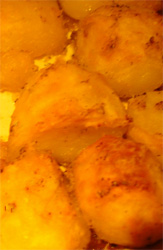
perfect roast potatoesGood potatoes make decent roast potatoes. Great crispy roast potatoes are cooked in goose fat. We discovered this when we had a surfeit of goose fat knocking about in the fridge. Until a month ago, I used to feel a bit guilty about using goose fat. Even so, I secretly looked forward to the highlight of the Sunday roast – crisp, soft centred, irresistible, golden roast potatoes.

Imagine my delight last month when I discovered that goose fat is the healthiest of animal fats. It’s high in healthy mono and polyunsaturated fatty acids and low in saturated fats.

Until I met Danny I wasn’t really interested in potatoes. I particularly liked those tiny expensive Jersey Royals. When these were out of season, I didn’t eat potatoes. If friends were coming for lunch I’d buy a bag and throw out the slimy remains a few weeks later.

Danny’s arrival heralded a change in diet. He was very patient, enduring months of sprouting mystery “white potatoes” that I bought in large paper sacks. They were excellent value as they lasted for weeks. Finally he tentatively suggested that we might buy a small bag of King Edwards for a Sunday roast. The 5 kilo bag was devoured within a couple of days.

Suitably chastened, I now grow our own and supplement these with the best available locally. Yet the secret of great roasties owes more to the fat than the potatoes.

Recipe for Perfect Roast Potatoes (for four – they will eat more of these than you might imagine!)

Pre-heat oven to 210c (190c fan, gas mark 6)

Ingredients:

  • 1 kilo potatoes (King Edward, Desiree, Kerrs Pinks are best but any will do. The fresher the better)
  • 2 tbsp goose fat
  • half tsp garlic granules
  • 1 tsp salt
  • 2 tsp ground black pepper

Method:

  1. Boil a large kettle of water, enough to cover the potatoes when they will eventually be in your saucepan
  2. Wash and peel the potatoes and cut into similar sized pieces (leave smaller potatoes whole or cut them in half and then match this chunk size when chopping the bigger ones)
  3. Place potatoes in a large saucepan and cover with boiling water. Parboil them by bringing them back to the boil and then boil gently for no more than ten minutes.
  4. Turn off the ring
  5. Put the goose fat into a large shallow oven-proof dish (or roasting tray) and put on top shelf of oven to melt and heat through
  6. Strain potatoes and return to the saucepan. Place the saucepan back onto the still-warm ring for about five minutes, shaking it every now and then to break down the edges of the potatoes, making them dry and fluffy.
  7. Remove the dish from the oven and sprinkle the salt, pepper and garlic granules fairly evenly over the goose fat.
  8. Carefully tip the parboiled potatoes into the dish so as to avoid splashing the hot fat over you. Turn them over and over until they are coated in the fat, salt, pepper and garlic mix.
  9. Return the dish to the top shelf of the oven for one hour, turning the potatoes half way through.

Tips and tricks:

  • Try to time the roast potatoes so that they are ready just as you are about to serve the meal, to enjoy them at their crispiest.
  • If your joint requires a lower cooking temperature you can still follow the method above. Just put them in half an hour before your joint is due to be taken out and then turn the oven up to 220c (200c fan) for the last half an hour whilst your joint is relaxing under a keep-warm duvet of foil covered with tea cloths.
  • These potatoes need an hour in the oven. Anything less does not work.
  • French goose fat in jars is available from Waitrose (in the butter and fat area). Store in your fridge. I’ve also seen tins of goose fat in Sainsbury’s at Christmas.
  • Goose fat can be reused. Pour into a seperate container and store in the fridge, it keeps for quite a while.
  • If we eat goose for Christmas lunch we save the fat and freeze quite a bit in cubes.
Related Posts with Thumbnails
Stop smoking with a NobaccWhen you (or a smoker you know) decides to kick the habit it makes sense get the best aids to help you succeed. Nobacc gives you two big advantages. It is something to hold and handle instead of a cigarette and the menthol hit kills the pangs. Click here to stop smoking

38 Comments so far

  1. Lesley on September 28th, 2007

    Can you freeze roasted potatoes? If so, how and how do you defrost and reheat?

  2. fn on September 28th, 2007

    Hi Lesley,

    I don’t know if you can freeze them all of ours are gobbled up immediately.

  3. alisha on November 7th, 2007

    yes you can freeze them and reheat them via microwave but they will not be as crispy.

  4. fn on November 7th, 2007

    Hi Alisha,

    Thanks for leaving this comment! Very useful.

  5. SARAH on November 22nd, 2007

    THIS IS THE PERFECT ROASTIES!
    I FOUND JAR OF GOOSE FAT IN TESCO £2.06- IN THE LARD AND BUTTER SECTION

  6. kate on December 20th, 2007

    I am going to have to cook a goose so I can try these. They sound delicious!! I had no idea that goose fat was among the healthiest.

  7. fn on December 20th, 2007

    Hi Kate

    We now always eat goose on Christmas day. It is expensive but we get enough goose fat to last a year. So the price of the goose is halved!

    In the olden days in England (hundreds of years ago) people used to rub goose fat on their chests if they got a cold!

    Goose is delicious. Very rich. A very special treat.

  8. foodrambler on December 1st, 2008

    Yay for goose fat! I think it wins hands down over olive oil…
    http://foodrambler.com/2008/12/01/the-perfect-roast-potato/

  9. karen O on December 1st, 2008

    Ooh this sounds lovely. We’ve never eaten goose (it is expensive) and consequently never had goose fat but with this recipe could be tempted to spend that £2.06 in Tesco!!

  10. nigel 01772 on December 24th, 2008

    Excellent article, I roast a goose every christmas as my contribution to dinner but am doing the full meal this year and I was always dissapointed by the lack of crispiness of my roast potatoes, having your advice bwill make them a success I’m sure, thank you

  11. Dan on December 24th, 2008

    We first had goose fat roasties a couple of years ago and eat them regularly now but here’s a little tip to make them even more fluffy: boil them the evening before and pop them in the freezer over-night then cook from frozen for 1 hour. Try it, you won’t be disappointed!

  12. Yvonne on December 25th, 2008

    What fantasic tips i have never seemed to get them right, So i am trying these today Christmas day 2008, I will let you all know how they turn out!!!! or not Dan i like the idea of getting some prep done the night before i will try it next time. Thanks

  13. Laraine on December 25th, 2008

    I prepare mine the day before. After the partial boiling I toss them in a handful of semolina and put them in the fridge until the next morning. It’s probably best to put them in the oven while they are hot but I still get a nice crunchy surface when putting them in cold. I use goose fat at Christmas but ordinary beef dripping during the year. I can’t say I notice that the goose fat makes the potatoes crisper than the dripping. I heat it first, then coat the potatoes in it, sprinkle them with salt and roast them for 25 minutes, then turn them over for another 20 minutes. Use as hot an oven as you can. If I’m serving Yorkshire pudding this goes into the preheated pans at the turning of the potatoes. My meat comes out of the oven before I cook the potatoes. I don’t like cooking meat at the temperature required for potatoes and Yorkshire pudding. It cooks much more evenly at lower temperatures and is tenderer. To get it tender at the high temperatures you have to cook it very rare, which many guests won’t like. Do remember to salt the potatoes. All too often when I dine with friends the roast ‘taties are ruined by lack of salt. Putting it on before you eat them just doesn’t work the same. :-(

  14. Yvonne on January 10th, 2009

    Well I did my roast potatoes and WOW i just could not believe it I am 62 years old and it was my very first really great roastie. Thank you so much. We had company on Boxing day and i know now what you mean about doing more than you think you will need!!! I am sure that my daughters partner would have fought over the last one LOL!!! needless to say they on our regular menu now, I am now in serch of some good soup recipes as i have judt brought my first Pressure Cooker.,

  15. Laraine on January 10th, 2009

    My goose fat cost me NZ$8 a jar, plus postage. I had to buy it on-line; it isn’t available from our supermarkets. I bought two because the postage was pretty high and was no more for two jars than one. I won’t be buying it again though. Beef dripping crisps the potatoes just as well. And I’m sick of the medical profession trying to stop us using good natural fats and suggesting horrible over-processed things like margarine instead. Yuk!

  16. Andy in Budapest on July 12th, 2009

    Duck fat works as well, and I really like the taste you get by using lard from a smoked bacon roast….variations on a theme.

    Really not difficult to get goose fat here in Hungary, it runs about pds 2.50 – 3.00 a kilo from any poulterers (distinct from butchers here). However, I tend to make my own, taking advantage of the fact that although Hungarians eat a lot of Goose, what they go for is the leg and the breast – same with Duck. They really don’t go much for roasting the whole bird in either case. So, there’s always a big tray of goose wings on display at about pds 1.00 per kilo. I usually buy 4 kilos, and proceed as follows:

    1. Pack the wings into my biggest roasting tin – 4 kilos just fits. I tuck the cut ends underneath, as they have some meat for which I have plans. Spinkle on a little salt, and put into a 180 oven for an hour and a half.

    2. Once the (now golden crispy) wings have cooled off a bit, I stretch a tea-towel over the top (keeps the wings in place) and drain off the fat – typically a kilo or a little more.

    3. Then I cut off the easily reachable meat, with some crunchy skin – usually about 3/4 of a kilo. This will go either for a stir fry, or into a risotto, or sometimes I dice it, pound it out inside a plastic bag with rubber mallet, then mix it with chopped red onions, cornichons and chopped parsley, salt, pepper, dijon mustard and a little basalmic, 5 – 6 table spoons of warm goose fat to hold it together. It goes into the fridge until cold, at which point it gets rolled up tightly in clingfilm into a salami shape. Cuts like brawn, awesome with salads or as a sandwich filler with a bit of mustard, keeps at least a week in the fridge.

    4. The hacked-about wings go into a big pan with a few stock veggies and some bay, and simmer for about an hour – wonderful colour to the stock, which is much more flavoursome than chicken.

    5. I then strip the remaining skin ect. from the bones, which go to the dogs. This gives me about a kilo of clammy sticky mess. I put three liters of water into a pan, and add a couple of fine-chopped carrots, plus the boiled out stock veg. When it boils, I drop in 1 kilo of cheap pasta, and start stirring. The chopped-up goose skin etc. goes in when the pasta is about cooked, usually with a quarter of a savoy cabbage or similar green chopped up. Hey presto, about 6 kilos of dog food! Keeps our 2 (a Husky and a Rottie) going for about 4 days in summer, 3 in winter (I add in some fat in the winter).

    Back to the goose fat: I use it a bit for roasting spuds, but mainly for pastry – very easy to rub into the flour, just halve the amount of water you would normally add if using butter or lard – it’s a “soft” fat. Makes very tasty, crunchy shortcrust pastry, also good for savoury biscuits…

    I doubt that you’ll find the goose wings in the UK. However, I think you’ll have a better chance with duck wings, particularly if you find a butcher who supplies restaurants, as they tend to want duck legs and breasts in preference to the whole bird. I’ve gone through my routine with duck wings on occasion when the goose had run out, and it works exactly as well. And my opinion, my goose fat tastes better than the bought, because it’s roasted rather than rendered.

  17. Laraine on July 13th, 2009

    Wow, Andy! I am SO impressed. Most of what you’ve described is real hard work, and yucky to boot. (Never mind that it leads to something totally delicious.) Oh how I wish I had a husband like yo!. :-)

  18. Andrew on December 19th, 2009

    Thank you guys so much for the tips. We are having a good number of our extended family for a Roast on Boxing Day and I’ve been doing some research regarding the potatoes. We will have to resort to pre-roasting and freezing due to the quantities involved. What did we do before the Internet.

  19. fn on December 19th, 2009

    Hi Andrew

    Thanks for leaving a comment. I’d love to know how the pre roastinbg and freezing works out if you have the time.

  20. Heather on December 20th, 2009

    I would like more info on roasting potatoes prior to Christmas Day and freezing then reheating again — in every detail please someone! Also precooking vegies, freezing and cooking on Christmas day to accompany turnkey and in oven and roast pork in Weber.
    Pleae explain!! I’m in Australia. Don’t know if I can get Goose fat here – will have to look for it.
    Heather

  21. Danny on December 20th, 2009

    Andy, your tips are really useful. Thank you very much for going to the trouble of writing them up for us. I agree that home made (roasted) goose or duck fat is better than store-bought rendered stuff. Our Christmas goose usually produces enough fat to keep us going throughout the year, which is a good thing because goose in the UK is expensive, approx £50 for a family size bird. The fat balances the outlay a little (maybe £13 to £15 worth of fat). We must seek out a restaurant supplier of duck as you described. Brilliant idea.

    Andrew / Heather – I am intrigued by the possibility of freezing pre-cooked roast potatoes. Today I will experiment in advance of our Sunday lunch and report back.

  22. Andrew on December 20th, 2009

    Hey guys, I’ve done more research on the web and can only find that freezing is referred to by a number of folk only after the parboil stage. http://www.goodhousekeeping.co.uk/index.php/chatroom/topic/5149 being a good example of such articles.
    This is not going to help those of us who have many meals to prepare at Christmas; however, the presenter on TV stated that roast potatoes can be frozen and reheated. Pity she was not too explicit on the process. Producers of frozen roast potatoes that supply Supermarkets clearly are able to achieve success; however are we going to save much oven time by pre-roasting and then re-roasting? Maybe not. A comment early on this site by Alisha on 7 November 2007 stated that you can roast, freeze and then microwave without loosing too much quality. Maybe that is going to be my best option when cooking for 20.
    Danny – I’ll be interested in your experiments. Heather – let’s hope we find a way through :)

  23. Laraine on December 20th, 2009

    Heather, I’m sure you can get goose fat in Australia. You can certainly buy it in NZ, though I had to do it over the Internet, and glass jars make for expensive postage. You don’t need to freeze the potatoes. I boil mine for about 5-6 minutes (I do the same to the kumara and pumpkin) a day or two ahead and store them covered in a bowl in the refrigerator. Nobody is any the wiser because they still roast beautifully. I pod my peas and string and slice my beans at least a day ahead too. These I store in plastic bags from which I make sure to take all the air before sealing and placing in the fridge. They still taste great. You have to do as much as you can ahead of the day if, like myself, you have no help with your Christmas dinner. I make my mince pies ahead too (over several days because I land up making a good eight dozen) and store them in their pans in the freezer until I need to cook them. I’m lucky to have plenty of those round-bottomed small cake pans that we used to call muffin pans. They are nice and black from decades of use. I hate those non-stick things that are all you can buy these days.

  24. fn on December 22nd, 2009

    Hi Laraine

    Thanks for all these great tips. 8 dozen mince pies – you must have a huge family!

  25. Laraine on December 22nd, 2009

    I don’t have a huge family. Most are in Auckland and there will be only myself, my husband and his elderly sister for Christmas Day. All our friends seem to have other arrangements. I give mince pies (in dozens) as gifts. Our Rural Postie gets some for instance; he gives us great service. They are more thank you gifts than Christmas presents and they are small enough not to embarrass the recipients. Mince pies for Christmas are a relatively recent thing in New Zealand. We certainly never had them when I was a child. When the supermarkets put in their own bakeries they started making them and gradually their popularity increased. But I’ve made them most of my married life of forty years because my husband is English and his mother always made them.

  26. Heather on December 23rd, 2009

    Back to making life easier on Christmas Day — when you parboil them day before and put them in fridge (not freezer) covered – do they not discolour – same with green vegetables ? So how long potatoes need to be cooked for in oven then to cook through and brown and crisp ? And …. whenever I parboil pumpkin then roast it is always soft and soggy — what am I doing wrong here …… can we cancel Christmas Day by the way ?

  27. Laraine on December 23rd, 2009

    Heather, the potatoes would probably discolour if you kept them too long in the fridge, but a day or two shouldn’t hurt. Because they are partly cooked, only the cooked parts are exposed to air, which is what causes the discolouration. I’m sure you’ve stored left-over cooked potato in your fridge for a few days without any harm. If you store them in the fridge without parboiling them, however, you would need to put them in bags and make sure all the air was sucked out. I’ve done that with kumara and had no problems but never tried it with potato. As for pumpkin, it can go soft and soggy even without parboiling. It’s a pain at Christmas because Crown pumpkin seems to be nice only in mid-winter. Pumpkin is scrumptious when it’s nice but it’s not easy to get nice pumpkin these days. (Mmm. I’ve just finished a slice of Ozzie watermelon. It’s always so much nicer than New Zealand grown ones.)

  28. Andrew on December 27th, 2009

    Thanks for your help; the roast potatoes this Christmas were the best yet. Parboiled for about 8 to 10 minutes, depending upon the size of them. Scratched with a fork on the surfaces not covered with washed and scrubbed skin. Placed into the oven tray in hot goose fat [about 3 tablespoons per half kg of potatoes], basted and sprinkled with Thyme. Covered loosely in foil for 20 minutes to retain some moisture. Turned no more than twice and re-basted. Total roasting time about one hour. Now I’ve to master the art of roasting beef – anyone any tips?

  29. fn on December 28th, 2009

    Hi Andrew

    This is great! Thanks for the feedback. Danny is a master when it comes to roasting beef so I’ve asked him to leave a comment for you.

    Happy holidays!

  30. Danny on December 28th, 2009

    Hi Andrew – we are delighted to hear of your success. I like the way you added thyme. Apparently a little rosemary (not too much!) also adds zing but we have not tried it ourselves.
    Take a look at this roast beef method. That is the way I like it – almost black on the outside and quite rare inside. It’s a matter of weight, temperatures, timings and trial & error :-)

  31. Andrew on December 30th, 2009

    Thanks Fiona and Danny – your help is much appreciated and I will go to work on this later. Danny, when it comes to slicing the beef, how thick do you like it and how do you best achieve that?
    All the best to you for 2010

  32. Andrew on February 7th, 2010

    Danny – I followed your advice regarding the roasting of beef, even to the detail of the carrot stock for gravy. Yummy – I’ve never tasted such tender beef; we were all very well surprised, thanks. The size of the beef was a bit large however, 1.8 kg. Although I put it in a hot oven [gas mark 9] for 20 minutes and then turned the oven down to Mark 4 for the prescribed time, I didn’t get the blackened outer surface. Next time I’ll try increasing the initial phase if the joint is that size and see what results.
    However, I am so encouraged and delighted. The basting in olive oil and seasoning with no aluminum foil covering clearly works so well, with the foil holding the juice close to the joint. :)
    This website is a great resource, many thanks. Andrew

  33. Laraine on February 8th, 2010

    My roast potatoes were lovely too, but I can’t honestly say I find the extra I spent on buying goose fat made the potatoes any nicer than when I cook them in my usual fat (dripping). So when I’ve finished the goose fat I bought I won’t be buying any more.

  34. fn on February 8th, 2010

    Hello Andrew

    Danny worked for years developing the perfect recipe – his beef roasts are always excellent. BTW he is really chuffed by your comment!

    Hi Laraine

    We’ve never tried roasting spuds in dripping – must give that a go – thanks for the tip!

  35. Laraine on February 8th, 2010

    My mother always cooked her roast veggies in dripping. Unfortunately, it’s not only becoming expensive (last time I bought it I had to pay somewhere between 3 and 4 dollars a half kilo for what cost $1.99 not long ago) but is also hard to find. I can understand the former problem (with so many of New Zealand’s beef and sheep farms being shoved into dairy production, the price of beef and lamb/mutton are naturally going to rise) but I’ve no idea why I’m having trouble finding it. With the stupid medical profession urging us to use oil and to eat that horrid chemical concoction with a texture like axle grease instead of butter, there shouldn’t be a shortage of dripping because not many people will be using it. My goose fat, BTW, cost me about $8.50 for a jar that (I think) has about 320g in it.

  36. John on July 14th, 2010

    this really helped me with my school work ! :)

  37. Odelle on October 27th, 2010

    Morning,
    Aggie from (how clean is your house fame) swears by goose fat for making her sweet pastry for mince pies, have kept the article, shall have to find it out amongst my many ‘cuttings’ from magazines and will post recipie, when I find it!
    Oh how I wish I wasn’t such a hoader!…..LOL
    It does come in handy sometimes though, well that’s my excuse.
    Lv Odelle X

  38. Jen McGregor on December 25th, 2011

    When you said perfect roasties, you weren’t joking… I just made these for Christmas dinner and my partner and I both agree that they’re the best roasties we’ve ever tasted. So I’m doing them again for Hogmanay! Thank you so much for this recipe.

Leave a reply

Subscribe without commenting

FD