Print this article Print this article

The Pickled Walnuts project: stage two. Plus original recipes for spiced pickling vinegar

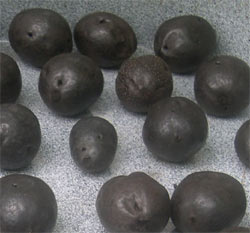
walnuts drying prior to picklingGood pickled walnuts are a wonderful accompaniment to strong cheese or cold meat. They are an English tradition. Often they are made with malt vinegar and can be very challenging to eat. This year I was determined to try to make the ultimate pickled walnut.

Part one of the challenge can be perused here.

After the two week saline soak (changing the solution after one week) I rinsed the walnuts and moved them down to the greenhouse to dry. This can take from 3-5 days. They turn a greyish black quite quickly. Not knowing how black the walnuts should be, I gave them a five day rest before starting the pickling process. As I had used our entire tranche of roasting trays, the pickling process had to start immediately on day five. D needed the trays to cook the Sunday roast.

Wishing to avoid expensive litigation involving claims for extensive dental repairs, I tested the walnuts for a final time. They were divided into four piles. Very soft, softish, firmish and hard. The latter were tossed immediately and the firmish will be devoured last. I’m hoping that the pickling process may soften them a little more. Next year I’ll be picking well before the end of June.

I’d researched and endlessly mulled over the recipes for my pickling spice. There aren’t a lot of pickled walnut recipes out there. I studied HFW’s one in The River Cottage Cookbook and eventually discovered this great site written by a pickled walnut fanatic back in 2005. Some of the links have died on the collection of pickling recipes. But enough had survived for me to get some pointers and the list of pickled walnuts for sale gave me a clear idea of the essential ingredient – vinegar. The rest is up to you. I did spot that many of the older recipes included garlic.

I made two pickling vinegars, one using white wine vinegar and the other cider vinegar. Very different. They both tasted good with a satisfying depth of flavour. But how will they combine with the walnuts and what will happen when they mature? Only time will tell. The results will be posted well before the start of the green walnut picking season next year.

I pulled out all the stops for these as they are my entries for Magic Cochin’s Inter Blog Great Pickled Walnut Challenge that will take place sometime in December. Meanwhile the jars are maturing on the new shelves in the barn. I’m still clearing up from the landslide disaster on rainy days. It could take some time.

The Pickled Walnuts project. Stage two

  • Having soaked your walnuts in a saline solution rinse them well in cold water and set them on non porous trays to dry. Beware setting them on plates unless you want a decoration of rows of small brown dots for ever.
  • Leave them to blacken and dry for 3-5 days. They will turn a deep, dark grey. The colour didn’t change much from the third day onwards.
  • Re test the walnuts for woodiness. Use a darning needle to prod the stalk end of the nut as this is the place where the nut casing hardens first. If the nut casing is hard, reject the nut.
  • Pack the nuts in sterilised jars leaving enough space to completely cover them with your pickling vinegar (use a ladle and funnel). Seal with sterilised plastic lined metal lids immediately.

In the end I had roughly 50 walnuts ready to be pickled and needed 2.5 litres of pickling spice to cover them. Here are my recipes.

Garlic and Tarragon spiced pickling white wine vinegar recipe

  • 1.5 litres of white wine vinegar
  • 3 tbsp of mixed white, pink and black peppercorns
  • 3 tbsp of allspice berries (whole)
  • 6 cloves
  • 1.5 tsp of ground mace
  • 1.5 tsp of dried tarragon
  • 1 bay leaf
  • 1 plump clove of fresh garlic chopped very fine
  • 3 tbsp of dark molasses sugar

Bring all the ingredients to simmering point and barely simmer for about an hour. Stir briskly and using a ladle and funnel, cover the walnuts with the hot spiced vinegar and seal the jars immediately. Leave to mature for 3 months.

Sweetish ginger spiced pickling cider vinegar recipe

  • 1.5 litres of organic cider vinegar
  • 2 tbsp of mixed white, pink and black peppercorns
  • 3 tbsp of allspice berries (whole)
  • 9 cloves
  • 1.5 tsp of ground mace
  • 3 level tbsp of grated fresh ginger
  • 2 plump cloves of fresh garlic chopped very fine
  • 9 tbsp of dark molasses sugar

Bring all the ingredients to simmering point and barely simmer for about an hour. Stir briskly and using a ladle and funnel, cover the walnuts with the hot spiced vinegar and seal the jars immediately. Leave to mature for 3 months.

Related Posts with Thumbnails
Online discount vouchersOnline vouchers give you a discount at loads of shopping sites, like Tesco, Argos, Mothercare and lots of other online stores. Do not pass up this opportunity to keep costs down. Fantastic discounts! Click here now

33 Comments so far

  1. Emma on August 23rd, 2008

    Another fascinating post, which is why I’ve given you a Brilliant Blogger Award!

    http://coopette.com/blog/brilliant-bloggers

  2. Pat on August 23rd, 2008

    Another informative blog!!! Very ambitious there Fiona, looking forward to when you have them to eat and blog about.

  3. magic cochin on August 23rd, 2008

    We’re so looking forward to tasting the different preserved walnuts. Your spiced vinegars are impressive! and will be very different from ours which was based on the HFW RC Cookbook recipe.

    Celia

  4. Monica on August 23rd, 2008

    I have never even heard of pickled walnuts before! It sounds really interesting. Did you grow the walnuts in your own garden?

    /Monica

  5. Diane Epps on September 1st, 2008

    Well done I wish I had access to walnuts but unfortunately I don’t know anyone with a tree and my garden is to small to accommodate one. My husband loves pickled walnuts and I always buy him a jar for Christmas

  6. fn on September 1st, 2008

    Hi Emma

    Thanks so much for the award!

    Hi Pat

    I’m on tenterhooks to see what the taste like.

    Hi Magic Cochin

    I pulled out all the stops for this one! Looking forward to the great PW challenge at Christmas time.

    Hi Monica

    They are rather good with cheese or cold meat.

    We don’t grow walnuts but a friend has a couple of trees in her garden.

    Soon the wet (un dried walnuts) will be ready and they are delicious.

    Hi Diane

    What a shame that you don’t have access to a tree. They are such useful nuts.

  7. Tom Gregory on September 14th, 2008

    We have been pickling walnuts from our gdn trees since 1939! We make beer from the leaves, wine from the sap when it is rising in march..(tap the trees ,fill a bucket of clear sap – add yeast and sugar and ferment for 3 months. After two years it will knock your head off!) Pick them not later than end of June before the nut has formed for pickling purposes. I approve of the above pickling recipe….. Then my grandmother used to pestle and mortar the green husks in Oct/Nov and add a little water….boil it up on the stove….strain and then dipped her comb in it and never went grey! Definitely add more sugar and mace to the vinegar, when pickling – this will greatly improve the taste for the modern housewife (The victorians liked them tart..which rather makes them unpopular today). If you have any left over from previous years . whizz them in your food processor with some tomato paste to create an acceptable “Daddies HP Sauce”. They keep for about 5 years before they eventually go soft…but they’re still edible!!Good luck with your pickling!
    P.S. The brown husks (in October) mixed with bees wax makes a very good stain for removing scratches from furniture.(But I can’t imagine the modern housewife bothering herself with that recipe!)

  8. evelyn on September 16th, 2008

    The HP pickle sounds very interesting..good idea. Pickled walnuts also good in steak pie instead of the old fashioned oysters.

  9. judith on September 24th, 2008

    have you eaten the walnuts in june before the nut ripens..ie as in the french manner…that is peel off the green husk & eat the contents in a green salad ?

  10. isabelle higson on May 2nd, 2009

    Very interesting. I had never heard of pickled walnuts ’till a British friend came to lunch and saw our English walnut farm in California. Do you use English walnuts or black walnuts; or can you us both? Thank you, Isabelle

  11. mandy on June 9th, 2009

    Do you have a recipe for cider vinegar
    We have just moved into a house with three apple trees and want to make chutneys and our own cider vinegar.
    Thanks Mandy

  12. Jane on June 22nd, 2009

    I heard it was traditional to harvest the walnuts (here in France) before Bastille day (14 July) We don’t have a walnut tree but there is one in the cow field next door and we have a friend five minute walk away that has a walnut tree and we’re supposed to be going round there one day this week – perfect timing ;)

    This year will be my first attempt at pickled walnuts – I never bothered until I tasted one last year (in August so too late to do any last year) I’ve been waiting for the walnuts ever since!

  13. Donita on June 22nd, 2009

    I’m wondering how your pickled walnuts turned out. I started the brine on a batch this morning, and am interested in the difference between the sweet and the savory recipes you used. Have you tried them yet?

  14. denbigh on July 9th, 2009

    What a nice site…

    As a long-time pickler, just a couple of comments.
    First, after the two soaks in brine (I use 1lb/gallon) leave in a light but not so hot place, the idea being to get both sides to turn black (just turn over once)this should take about one day. To leave them longer till they shrivel up is a mistake, they should retain their shape but go black. If they shrivel, they will take up more of the pickling vinegar and be too sharp to the taste of most people.
    The prick-test should be at the opposite end to the stalk which is where the shell begins to form.
    I have always used brown sugar in the making, and have tried varying it, but 1lb/3pts seems to be just right.
    I deal with a dustbin-full each time I do them, so as to supply all our extended family. It means tipping off the brine is straight into the outside drain, which is handy for avoiding contact. I also start it carefully, as I want all the oil which sits on the surfact to go and not get back on the walnuts. I don’t know if it matters, but I have always done that.

    My source book was/is an admirable volume published by HMSO for Min of Ag and Fish. First published in 1929, my edition 1968. Amazingley, I have just looked and it is still in print!!! It costs just £8.95 from Amazon (mine was 9/6 from HMSO). It is a FANTASTIC source book and the recipes/formulas contained have never failed me.

    Search for “Home Preservation of Fruit and Vegetables” – this will be the best value for money cook-book in your library.

  15. fn on July 10th, 2009

    Hello Denbigh

    Thanks so much for leaving such an instructive comment. I’m going to take your advice and try making a batch your way. I will be gather walnuts this weekend ready for the 2010 challenge.

    Thanks again for dropping by.

  16. Mike on August 8th, 2009

    I have just discovered a walnut tree with plenty of fruit.Its now 8th Aug I am too late to have a go a pickling?

    If I am could you advise what I could do instead, like collect and save

    Thanks
    Mike

  17. fn on August 8th, 2009

    Hello Mike

    Yes mid July is about the last time you could possibly pick them – the begining of July is best.

    When the walnots drop in September you can eat wet walnuts – delicious and crisp. Also you can take off the green skins and dry them to store (a week in a warm airing cupboard).

  18. Joanne on September 28th, 2009

    Very pleased to have seen this. Have just been rescuing a few walnuts that squirrels had hidden in a pile of leaves. I adore wet walnuts. But a few is the most there ever is, because the squirrels take them before they drop. But I hadn’t thought of picking some so much earlier for pickling. My query, though, is that if the walnuts are pickled before the internal nuts have developed at all, are the casings on there own still pickleable to good effect now after the developed nut has been removed? They wouldn’t look great because they would be broken pieces, but the pickled walnuts are only really the pickled walnut cases in effect anyway. Does anyone know? It could be the best of both worlds.

    And in terms of what is in season to be made now from hedge row sources, not that it is pickle, but there is little bettr than Rose Hip syrup. It is SO delicious! And I am always amazed that so few people know how good it is. It is off topic, but I understand that you can made a good syrup from hawthorne berries too, although I have never tried it. I am going to this year, just to see, but I would be interested to hear if anyone else has ever tried any, and what thoughts were.

    Jo

  19. fn on September 28th, 2009

    Hi Jo

    I dont know about pickling the casings – why not test it out. I’d love to hear the results :)

    I have so many rosehips this year that I’m going to make loads of rosehip syrup and dry the hips for tea. I’ve never tried hawthorne syrup.

    It might be worth posting on our new forum as there seem to be a lot of seasoned preservers out there.

  20. denbigh on September 29th, 2009

    They are so much more than pickled casings, the whole shape of the walnuts inside are there, it is just the shell which is missing.
    We opened our first jar of 2009 walnuts this week, had them with some superb roast pork and some lovely Cantal cheese. Suuuuper !!

    Because I rather went amok from the original vinegar recipe and last time I made PW, the shell had started to form and they are just not nice when crunchy – but the vinegar was TOO spicy and wrong. So I went right back to the textbook recipe from the Min of Ag and Fish book I gave the reference of above. So glad I did, they are really delicious. Also, I was sloppy about how long in the brine each of the two brinings, but very careful to expose them to daylight just for the one day – this has left them with a delicate nuttyness over the vinegar power.

    Hope everyone has as much success !!

    Now all my friends and family will come and cadge most of my produce.

  21. denbigh on September 29th, 2009

    Joanne – get out in the hedgerows and look for the lovely sour sloes. Sloe gin recipes abound, but I have discovered the French hereabouts (Brittany) use Calvados… should be interesting !

  22. Joanne on September 30th, 2009

    Forgive my ignorance on the subject, Denbigh, and I have criminally never even actually tried pickled walnuts, although I adore wet walnuts (not so keen on the dried). So although it is too late this year, I am already looking forward to making some next. And your advice and warnings on the subject are therefore hugely welcome.

    I have picked up early walnut falls, though, and looked to see what is inside. And at that stage, anyway, there hasn’t been nut development inside apparent at all, or so small it is immaterial. On the other hand, maybe not developing properly was why they had fallen in the first place. But if those were theoretically pickleable, with the walnut flavour throughout, then it is not entirely unlikely that the later casings on their own, after the nuts have been removed, could still be good. But it was only a thought, and since I have never tried the pickles at all, I certainly haven’t sampled the outer bit on it’s own to see what it’s like.

    But I absolutely concur re sloe (or variation on a theme) gin. It is fabulous! I am fortunate in that I don’t have to trawl hegderows, though, in that I have what I think are wild damsons in the garden. I am not sure that I have ever tasted what I am sure are definitely sloes, though (isn’t that terrible), so I ought to hunt some out just to check the differences.

    And sloe calvados? It would never have occurred to me! Am very curious to hear how good it is in practice.

  23. mike P on October 4th, 2009

    Hi its a bit late in the season now and having visted a friend yesterday we have two very large bags of walnuts, they said we could take all we can carry as they have seven trees. also we got food and beer too. What nice friends we have. We really want to pickle some so we are going to shell the nuts and use the vinegar recipie above and see how it goes. i’ll try to remeber to post our results around December

  24. Sue H on November 4th, 2009

    I made pickled walnuts last year. There were hard bits so had to throw them out. This year started earlier in June but don’t know the results yet. Great to have some new receipes for vinegar. Has anyone a receipe for pickled walnut chutney.

  25. Pierre de la bourianne on November 11th, 2009

    just tapped into this blog on pickled Walnuts. I can’t see that it’s been mentioned but an effective way to test if walnuts are ready for the pickling process is to prick them with a steralised pin while on the tree. If the pin goes in easily and smoothly then the shell has not yet started to form and you can pick it for pickling. Water normally sqirts out of the walnut also indicating you have penertrated the nut. I always pick before the middle of June at the latest.

  26. DAVE POTTER on November 19th, 2009

    Hi – I’v just made an apple and pickled walnut chutney using Bramley apples and the outsides of pickled walnuts where the shells had – unfortunately – become too hard! It is a bit early to tell, but after a week the chutney tastes great. I based the recipe loosely on a Gordon Ramsey’s one for Apple and walnut chutney, replacing the fresh walnuts with the pickled ones and, as with the Ramsey recipe, I added the pickled ones at the end of cooking.

  27. Barbra Hickey on July 7th, 2011

    I just found a recipe calling for pickled walnuts. This is a whole new thing for this American cook. I grew up on farm with walnut (black) trees but all we ever did was try to collect and dry them before the squirrels grabbed them for their own use. Now, for pickling. I believe I’m understanding if you do this process early enough you can eat the nut meat inside (which, as yet, has no hard shell) AND the green outer coating? Is this correct? I could never have imagined that bitter green stuff that stained my hands so when I was a little girl would every be good for anything. I am anxious to learn about this – but seems it is too late already this year. I’ll hunt for walnut trees from which I can pick next June. Any advice will be wonderfully appreciated.

  28. David on July 7th, 2011

    It is NOT too late this year, in fact here in England it’s the perfect time to pick, especially as it has been a very dry spring and anyone who picked mid-June before we had a decent amount of rain would have very undersized nuts. I picked 7 kg yesterday and they are in perfect condition. As long as you can get a fork into the middle they are fine – if you can’t then the shell has started to form, but you can still pickle them if you’re prepared to go through the very tedious process of removing the shell, but keeping both the nut and the green outer casing for pickling. Good luck in finding a tree!

  29. Sadia on August 2nd, 2011

    I picked some walnut at the end of July and have begun the process of soaking them in brine. I wonder if i should not have bothered this year, because they were hard inside. I wonder if soaking them would soften them? Perhaps I should abandon my attempt for this year and make sure I start in early June next year.

  30. fn on August 2nd, 2011

    Hi Sadie

    You ate too late I’m sorry to say. Nothing will make them soft :( Best to wait until next year.

  31. Denbigh Gabbitas on August 2nd, 2011

    Yes, I agree. It is too late, throw them away. I have been caught twice like that, just too late and I thought to keep them long enough… even when the non-hard bits have turned to mush, after a few years – the shell bits stay shell.

    Last year’s crop, here in France, were just in time, but the actual pickle liquor was not quite right and I am disappointed with them – so family and friends will get loads of jars as pressies !!!

  32. Jane on August 2nd, 2011

    I picked my walnuts and soaked them in plenty of time, I dreed them off in the greenhouse and I’ve just realised I haven’t put them in the vinegar – do you think it’s now too late to finish the process? it’s been at least three weeks…

  33. Denbigh on August 2nd, 2011

    The brining process and drying have two purposes, to extract water and to turn them black. As long as you brined them fully (twice), I would guess you will be OK. They will be very dry, so will soak up the pickling liquor very well, so don’t make it too powerful, I would err on the side of sweetness rather than spiciness.

    Dont forget to feedback the results when you eat the first of your pickles, as this seems to have become a useful thread for would-be walnut picklers.

Leave a reply

Subscribe without commenting

FD